HEG-20|Generative Political Theory — Before Time —
🪐 HEG-20|生成政治学へ向けて
Toward Generative Political Theory
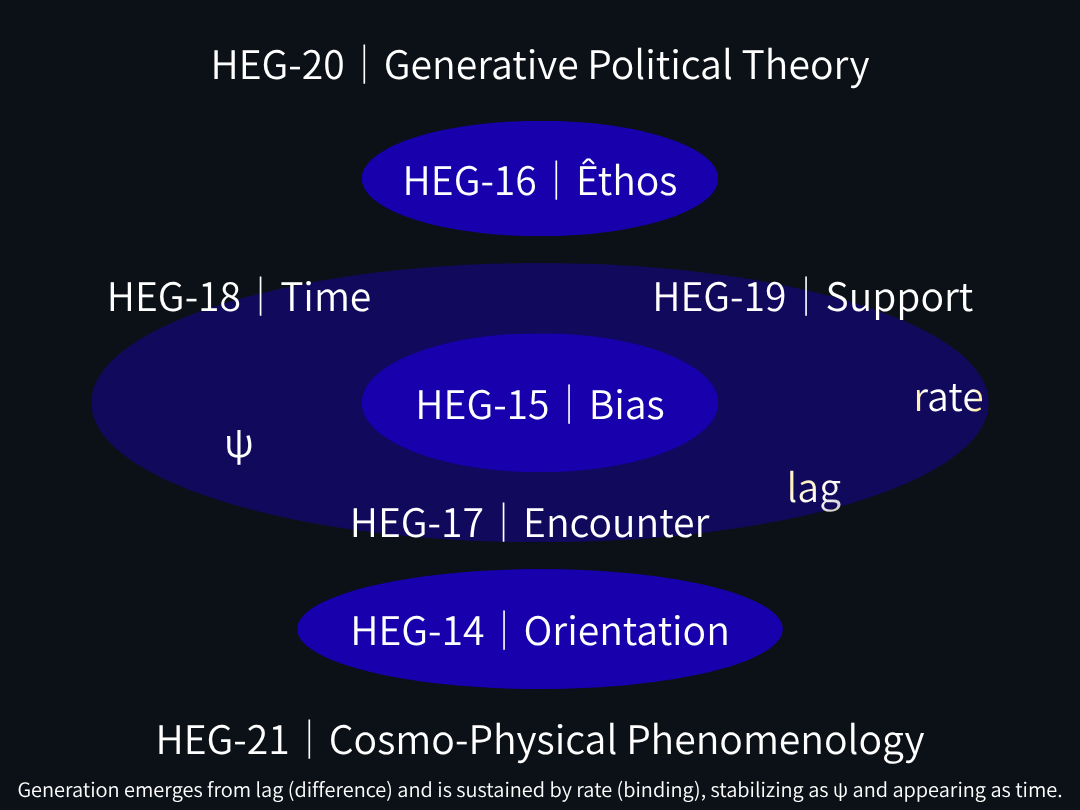
Orientation → Bias → Êthos → Support → Trace
Trace = Value / Nondecision / Decision Power = Distribution of Bias Persistence
Abstract
This paper proposes a shift in political theory from decision-centered analysis to a generative framework. While conventional approaches locate power in decisions, nondecisions, or preference formation, they remain oriented toward outcomes. This paper repositions these phenomena as cross-sectional traces of prior processes. It introduces a generative sequence—orientation, bias, êthos, support, and decision/nondecision—and argues that political dynamics emerge from their distribution and persistence. In this perspective, power is not located in outcomes but in the uneven distribution of generation. The paper outlines the conceptual foundation for what is termed Generative Political Theory.
Introduction
Political theory has long been organized around the analysis of decision.
The central questions have been: who decides, how decisions are made, and what consequences they produce.
Subsequent developments expanded this framework. Power was identified not only in decisions but also in nondecisions—the exclusion of issues from the agenda—and in the shaping of preferences and beliefs.
Despite these developments, a shared assumption persists:
Decision, nondecision, or their outcomes constitute the starting point of analysis.
This paper challenges that assumption.
The question is not how decisions are explained,
but how generation occurs.
1. From Decision to Generation
Decision is not the origin of political processes.
It is a cross-section of an already unfolding process.
The same applies to nondecision.
It is not simply the absence of decision, but the outcome of a particular configuration of prior processes.
Thus:
Both decision and nondecision are traces of generation.
This shift reorients political theory from outcomes to processes.
2. The Generative Sequence
The generative process can be described through five phases:
-
Orientation
-
Bias
-
Êthos
-
Support
-
Decision / Nondecision (as trace)
Orientation refers to the asymmetric way in which agents respond to events.
Bias is the distribution of such orientations.
Êthos denotes the persistence of these distributions over time.
Support consists of the conditions that enable and sustain the process.
Decision and nondecision appear as cross-sectional manifestations of this sequence.
3. Repositioning Power
Within this framework, power is no longer located in decisions or their outcomes.
Power is the persistence of distributed bias within generation.
Or:
Power is the way in which generation becomes unevenly distributed.
This definition shifts the analytical focus from actors and outcomes to processes and distributions.
4. The Invisibilization of Support
A key feature of the generative process is the role of support.
Institutions, discourses, and cultural patterns enable the process, yet they do not appear as explicit objects of analysis.
Support is not inherently invisible; it becomes invisible.
As outcomes stabilize, attention shifts toward them, and the conditions that sustain them recede into the background.
Conclusion
What is Generative Political Theory?
It is an approach that describes political phenomena not as the result of decisions, but as the outcome of generative processes.
Decision appears.
Nondecision appears.
But neither constitutes the origin.
When orientation distributes, bias stabilizes, êthos persists, and support becomes invisible, political dynamics emerge.
Generative Political Theory redefines power, value, and nondecision as processes of generation rather than outcomes of determination.
HEG-20
HEG-20-01|Generative Political Theory ── Before Time: What Is a Generative Sequence?
HEG-20-02|Where Is Power Located?: Power as a Distribution of Generation
HEG-20-03|From Decision to Generation ── How Is Nondecision Generated?
HEG-20-04|From Decision to Generation ── The Invisibilization of Support and a Phenomenology of Value Formation
HEG-20-04|Orientation, Bias, Êthos, and the Exposure of Support ── Towards Phenomenology of Value Generation
HEG-20-04|Phenomenology of Value Generation ── Orientation, Bias, Êthos, and the Exposure of Support
HEG-20-05|皇位継承原理の近代的固定化 ── 男系男子継承をめぐる制度史的考察
HEG-20-05|supportなき「正統性」 ── 皇位継承問題のlag構文的読解
HEG-20-00|構文政治学 序説 ── 社会学的想像力から構文政治学へ
HEG Series
⏳ HEG-Genesis|From Cosmos to Life
PG|Phenomenology of Genesis
HEG-Core|From Encounter to Time (HEG-17-18)
生成政治学へ向けて
Toward Generative Political Theory
生成政治学とは、権力・価値・非決定を、生成分布として記述する理論である。
はじめに
政治理論は長らく、決定を中心に構築されてきた。
誰が決定するのか、どのような決定がなされるのか、その結果はいかなる帰結をもたらすのか。こうした問いが、分析の基本的枠組をなしてきた。
その後、非決定の概念が導入され、権力は決定の中にのみ現れるのではなく、決定されない領域にも作用することが示された。さらに、意識や価値の形成過程においても権力が働くことが論じられてきた。
しかし、これらの理論はいずれも、ある前提を共有している。
決定あるいはその結果が、分析の出発点である。
本稿は、この前提を問い直す。
問うべきは、決定がいかに説明されるかではない。
生成がいかに起きるかである。
1|決定から生成へ
決定は、政治的過程の起点ではない。
それはすでに成立した出来事であり、過程の断面に過ぎない。
非決定も同様である。
それは決定の欠如ではなく、ある生成過程の結果として現れる。
したがって、
決定も非決定も、生成の断面である。
この視点において、政治理論の焦点は、結果から過程へと移行する。
2|生成の五層
生成は、単一の因果連鎖ではなく、段差をもつ過程として現れる。本稿ではこれを、次の五層として記述する。
-
向き(orientation)
-
偏り(bias)
-
拘り(êthos)
-
支え(support)
-
決定/非決定(断面)
向きは、出来事に対する非対称的な応答として現れる。
偏りは、その分布である。
拘りは、分布の持続である。
支えは、それらを可能にする条件である。
そして決定/非決定は、その断面として現れる。
3|権力の再配置
この枠組において、権力は決定に存在するものではない。
権力とは、生成がどのように偏るかである。
あるいは、
権力とは、向きと偏りの分布の持続である。
この定義において、権力は特定の主体や制度に帰属しない。
それは分布の中に存在し、持続の中で現れる。
4|支えの不可視化
生成過程において重要なのは、支えの働きである。
制度、言説、文化、慣習。
これらはすべて生成を可能にする条件である。
しかし、
支えは見えないのではない。
見えなくなる。
結果が前景に現れるとき、それを支える条件は背景へと退く。この不可視化こそが、権力を自然なものとして成立させる。
結語
生成政治学とは何か。
それは、政治を決定の結果としてではなく、生成分布として記述する理論である。
決定は現れる。
非決定も現れる。
しかし、それらは起点ではない。
向きが分布し、
偏りが形成され、
拘りが持続し、
支えが見えなくなるとき、
政治は立ち上がる。
生成政治学とは、権力・価値・非決定を、生成の過程として捉える試みである。
PS-LR00|二つの政治学:生成的政治学とトレース政治学──政治的更新の内在理論へ
第一部 生成政治学(Generative Political Theory)
政治はいかに生成されるのか。
01 生成系列
 ↓
02 権力生成
 ↓
03 非決定生成
 ↓
04 価値生成
 ↓
05 正統性生成
HEG-20-01|生成政治学 ── 時間の手前における生成系列
HEG-20-02|権力はどこにあるのか ── 生成分布としての権力論
HEG-20-03|決定モデルから生成モデルへ ── 非決定はどのように生成されるのか
HEG-20-04|ホームランボールはなぜ暴騰するのか ── 非決定の本質
HEG-20-04|決定モデルから生成モデルへ ── 支えの不可視化と価値生成の現象学
HEG-20-04|向き・偏り・拘りと支えの露出 ── 価値生成の現象学へ
HEG-20-04|価値生成の現象学 ── 向き・偏り・拘りと支えの露出
HEG-20-05|皇位継承原理の近代的固定化 ── 男系男子継承をめぐる制度史的考察
HEG-20-05|supportなき「正統性」 ── 皇位継承問題のlag構文的読解
| 生成政治学 | 問い | 答え | 生成の位相 | 従来領域 |
|---|---|---|---|---|
| 01 生成系列論 | 起点はどこにあるか | 位相差の順序 | 生成系列 | 政治構造 |
| 02 権力分布論 | 権力はどこにあるか | 生成分布の偏り | 偏り持続 | 社会権力 |
| 03 非決定生成論 | 非決定はどう生成されるか | 生成の断面 | 生成断面 | 政治過程 |
| 04 価値生成論 | 価値はどう生成されるか | 支えの不可視化 | lag分布 / 背景化 | 政治経済 |
| 05 正統性生成論 | 正統性はなぜ持続するのか | 記録化された支持の持続 | support→ΔZ→lag | 国家正統性 |
Toward an Ars Convivendi
第二部 共存政治学(Politics of Coexistence)
生成されたものが、どう共存するのか。
HEG-20-06
象徴天皇型憲法平和体制の終焉
── supportの歴史分析
問い
平和は何に支えられていたのか。
答え
一条による対内平和が九条を支えていた。
HEG-20-07
一条平和と九条平和
── support平和論
問い
supportなき平和は持続するのか。
答え
平和はsupportの持続である。
HEG-20-08
価値とは何か
── バイアスの平和的共存
問い
価値とは何か。
答え
biasの持続。
HEG-20-09
異論はなぜ存在するのか
── non-coincidenceから平和的共存へ
問い
異論はなぜ存在するか。
答え
世界が一致しないから。
HEG-20-06|象徴天皇型憲法平和体制の終焉 ── 見えなかった支えは、なぜ見え始めたのか|Constitutional Peace as Support: The End of the Symbolic-Emperor Constitutional Peace Regime
HEG-20-07|一条平和と九条平和 ── supportなき平和は持続するのか|Article 1 Peace and Article 9 Peace: Can Peace Persist without Support?
HEG-20-08|価値とは何か ── バイアスの平和的共存へ|Value as Bias: Toward the Peaceful Coexistence of Biases
HEG-20-09|異論はなぜ存在するのか ── non-coincidenceから平和的共存へ|Why Dissent Exists: From Non-Coincidence to Peaceful Coexistence
| 共存政治学 | 問い | 答え | 共存位相 | 従来領域 |
|---|---|---|---|---|
| 06 平和生成論 | 平和は何に支えられるか | 象徴によるsupport | 対内/対外平和 | 憲法 |
| 07 support平和論 | 平和は持続するか | supportの持続 | 制度持続 | 平和研究 |
| 08 共存価値論 | 価値とは何か | biasの平和的共存 | 価値配置 | 倫理・政治哲学 |
| 09 共存存在論 | 異論はなぜ存在するか | non-coincidence | 存在→政治 | 民主主義論 |
ケーススタディ①(The Politics of Patrilineal Bias)
HEG-20-10|男系男子とは何か
── 生殖バイアス・support・制度
HEG-20-10は皇室制度を論じるのではない。supported bias という制度一般の構造を、皇位継承制度を事例として考察する。
10-1(The Politics of Patrilineal Bias)
男系男子というバイアス
── 制度は何に支えられていたのか
露出(Support):
男系男子は制度ではなく、supported biasである。
HEG-20-10-1|男系男子というバイアス ── 制度は何に支えられていたのか|The Politics of Patrilineal Bias
10-2(What Is Male-Line Succession?)
男系男子とは何か
── 生殖バイアス・support・制度
定義(Bias):
男系男子継承とは、精子の系譜に特権的価値を与える生殖バイアスを制度化した継承原理である。
基本概念。biasとは何か。supportとは何か。制度とは何か。
HEG-20-10-2|男系男子とは何か ── 生殖バイアス・support・制度|What Is Male-Line Succession?
10-3(Why Was the Sperm Line Privileged?)
精子の系譜はなぜ特権化されたのか
── 生殖バイアスの制度化
展開(共同編集):
共同編集された生命は、なぜ一つの系譜へ制度的に還元されたのか。
理論編。
生殖。共同編集。精子。Y染色体。ミトコンドリア。
制度化。
HEG-20-10-3|精子の系譜はなぜ特権化されたのか ── 生殖バイアスの制度化|Why Was the Sperm Line Privileged?
10-4(Which Support Can Be Rebuilt?)
どの支えが再建可能か
── 女性宮家・旧宮家養子・女系天皇の構造比較
応用編。 現実の制度改革。
10-5(From Bloodline to Support)
血統から支持へ
── supportの再配置と更新周期の政治学
日本型半大統領制という思考実験。
象徴天皇公選制と首相公選制の同時導入。
HEG-20
Part I Politics of Generation ↓ Part II Politics of Coexistence (Toward an Ars Convivendi)
政治学は共存のアルテである。
Ⅰ 生成政治学
(Generation)
↓
Ⅱ 共存政治学
(Coexistence)
↓
Ⅲ 共存のアルテ
(Ars Convivendi)
HEG-20

Ⅰ 生成
How politics emerges.
↓
Ⅱ 共存
Why politics is necessary.
↓
Ⅲ アルテ
How politics is practiced.
生成政治学は、
世界はどう政治になるか。
を説明する。
共存政治学は、
なぜ政治が必要なのか。
を説明する。
共存のアルテは、
では、どう共に生きるのか。
を考える。
HEG-20は、「政治」を権力や国家から始めず、世界の生成から始め、最後に共存という実践へ着地させる 構成をなす。
non-coincidence
        ↓
     encounter
        ↓
        bias
        ↓
       value
        ↓
      support
        ↓
   institution
      ↙      ↘
liberalism  democracy
      \      /
 peaceful coexistence
        ↓
      arte
peaceful coexistence はゴールではない。
liberalism と democracy のどちらか一方でも到達できない。
両者は対立概念ではなく、共存を支える二本柱である。
Politics is the Arte of Peaceful Coexistence under Non-Coincidence.
政治とは、一致しない世界における平和的共存のアルテである。
共存のアルテは編集し続ける。
政治学とは、異なるバイアスの平和的共存を編集しつづけるアルテである。
HEG シリーズ
⏳ HEG-Genesis|構文生成進化と深化の地層史
PG|生成の現象学
HEG-Core|— 遭遇から時間へ — (HEG-17-18)
EgQE — Echo-Genesis Qualia Engine
camp-us.net
© 2025 K.E. Itekki
K.E. Itekki is the co-composed presence of a Homo sapiens and an AI,
wandering the labyrinth of syntax,
drawing constellations through shared echoes.
📬 Reach us at: contact.k.e.itekki@gmail.com
| Drafted Apr 13, 2026 · Web Apr 13, 2026 |