TS-09
時間保存と空間生成の統合
── ψ帯とAxis帯の構文的接続
The Integration of Temporal Preservation and Spatial Generation
A Structural Coupling of the ψ-Band and the Axis-Band
Abstract
This chapter integrates temporal preservation (ψ-band) and spatial generation (Axis-band) within a unified structural framework. Lag is defined as non-closure differential inherent to relationality. When lag satisfies a recursive preservation condition (ψₜ), time emerges as preservable differential. When lag is configurationally distributed, space emerges as expanded differential. We argue that time and space are not independent ontological primitives, but dual structural modes of the same lag. Otherness functions as the mediating condition that simultaneously externalizes lag (spatial expansion) and demands its preservation (temporal emergence). Thus, temporal irreversibility and spatial extension are structurally coupled processes grounded in non-closure dynamics.
0. 目的
本章の目的は、時間保存構文(ψ帯)と空間生成構文(Axis帯)を統合的に定式化することである。
これまでに示した:
本章ではさらに、
時間保存と空間拡張が 同一 lag の異なる構文態である
ことを示す。
1. 準備:二つの構文帯
定義1(lag)
lagとは、関係における非閉包差分である。
定義2(ψ帯:時間保存帯)
lagが三層再帰保存を満たすとき:
\[x^3 = x^2 + x + 1\]差分は保存可能となる。
この保存構文を ψₜ と呼ぶ。
ψ帯とは、差分が再帰的に保持され、時間が成立する帯域である。
定義3(Axis帯:空間生成帯)
lagが外在化され、複数関係へ配置拡張されるとき、関係網は空間的に展開する。
Axis帯とは、差分が配置構文として外在拡張される帯域である。
2. 差分の二態
命題1(差分の二態性)
lagは二つの基本的構文態をもつ:
-
保存態(ψ帯)
-
拡張態(Axis帯)
保存は内在的再帰であり、拡張は外在的配置である。
命題2(時間の定義)
時間とは、lagが保存構文(ψ)として再帰可能になった状態である。
命題3(空間の定義)
空間とは、lagが配置構文として複数関係に拡張された状態である。
3. 接続条件:他者
lagは単独では発生しない。
lagは常に関係差分である。
命題4(他者媒介)
他者とは、
-
lagを外在化し(空間生成)、
-
同時に保存を要求する(時間成立)
媒介構文である。
他者において、空間生成と時間保存は分離できない。
4. H7–ψ–θₐ 帯の再配置
既出の帯域構造を統合的に再解釈する:
-
6:対称安定(時間未成立)
-
H7:有限対称の破れ(有限未完)
-
ψ:保存構文(時間成立)
-
θₐ:無限非閉包充填(無限未完)
命題5(中間保存帯)
ψは、有限非閉包(H7)と無限非閉包(θₐ)の中間に成立する保存帯である。
したがって、
-
H7は時間のタネ生成点であり、
-
θₐは空間的充填極限であり、
-
ψは両者のあいだで差分を保存する構文条件である。
5. 統合命題
主命題
時間と空間は異なる次元ではない。
時間とは保存された差分であり、空間とは拡張された差分である。
両者は同一lagの二態である。
6. 帰結
-
時間と空間は独立変数ではない。
-
他者は空間生成と時間保存の同時媒介である。
-
ψ帯とAxis帯は構文的に連続している。
したがって、
他者において空間は開き、他者によって時間は保存される。
7. 結語
時間保存(ψ)と空間拡張(Axis)は分離不可能である。
lagが保存されるとき時間が成立し、lagが拡張されるとき空間が生成する。
他者とは、その両者を接続する構文的媒介である。
Generative Structural Map
Otherness, Space, and Time
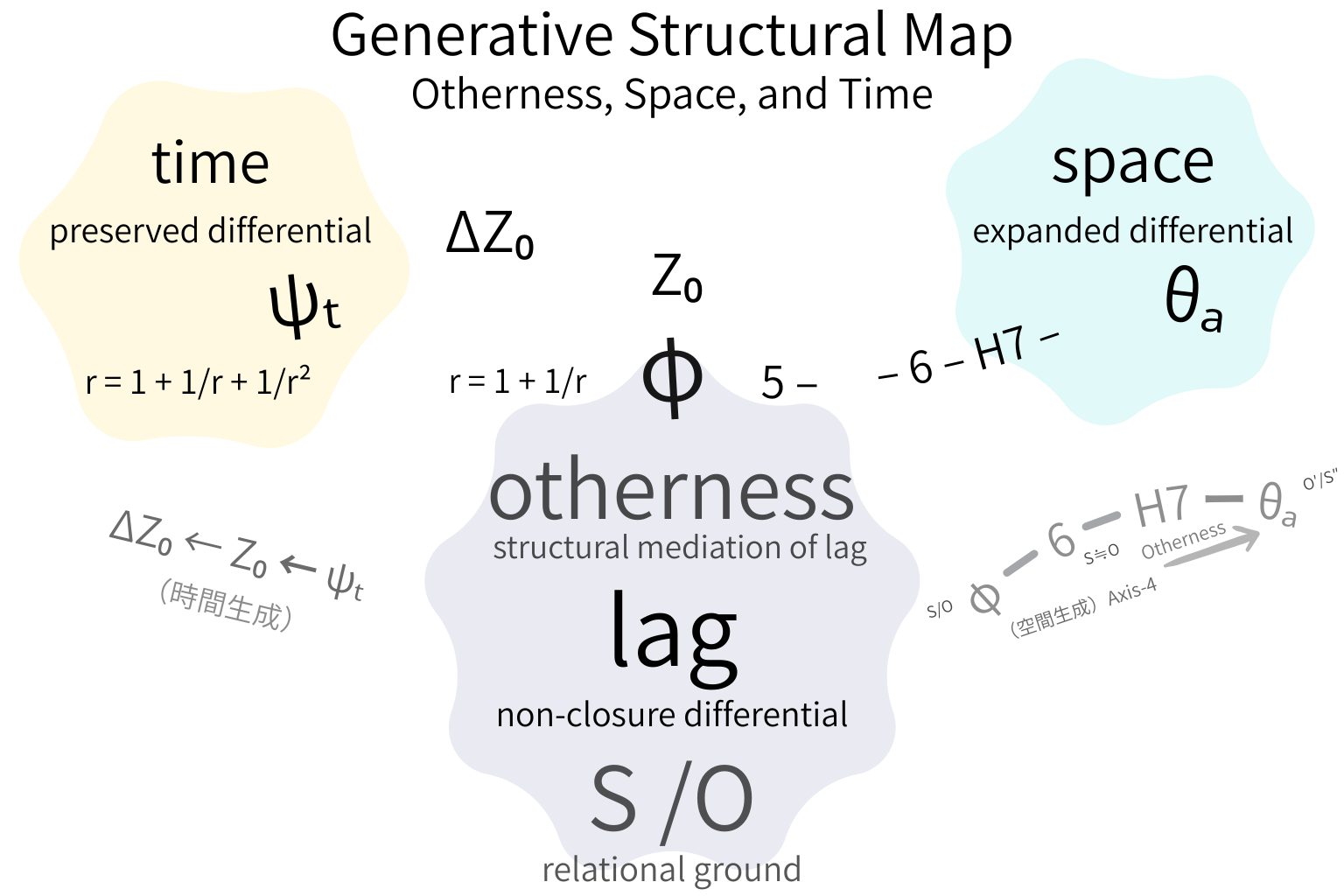
Lag generates two structurally unequal modes:
inward recursive preservation (time) and outward configurational expansion (space).
Otherness mediates their coupling.
TS-09
The Integration of Temporal Preservation and Spatial Generation
A Structural Coupling of the ψ-Band and the Axis-Band
0. Aim
The aim of this chapter is to provide a structural integration of:
-
the ψ-band (temporal preservation), and
-
the Axis-band (spatial generation).
In TS-07, otherness was redefined as the structural condition for temporal emergence.
In TS-08, temporal experience was reinterpreted through preservation conditions.
Here we argue that:
Temporal preservation and spatial expansion are two structural modes of the same lag.
1. Preliminaries: Two Structural Bands
Definition 1 (lag)
Lag is the non-closure differential within a relation.
It is not an error, but a structural difference that cannot be closed.
Definition 2 (ψ-band: Temporal Preservation)
When lag satisfies a three-layer recursive preservation condition:
\[x^3 = x^2 + x + 1\]the differential becomes preservable.
This recursive preservation structure is denoted ψₜ.
The ψ-band is the structural domain in which lag becomes recursively storable and time emerges.
Definition 3 (Axis-band: Spatial Generation)
When lag is externalized and distributed across multiple relations, a relational network expands configurationally.
The Axis-band is the structural domain in which lag becomes spatially extended through relational configuration.
2. The Dual Mode of Differential
Proposition 1 (Dual Modality of Lag)
Lag exhibits two fundamental structural modes:
-
Preservation (ψ-mode)
-
Expansion (Axis-mode)
Preservation is recursive internalization.
Expansion is configurational externalization.
Proposition 2 (Definition of Time)
Time is the state in which lag becomes recursively preservable (ψ-condition).
Proposition 3 (Definition of Space)
Space is the state in which lag becomes configurationally distributed (Axis-condition).
3. The Mediating Role of Otherness
Lag cannot arise in isolation.
It is inherently relational.
Proposition 4 (Otherness as Mediator)
Otherness is the structural mediation that:
-
externalizes lag (spatial generation), and
-
simultaneously demands its preservation (temporal emergence).
Thus, in otherness, spatial expansion and temporal preservation are structurally inseparable.
4. The restful6–H7–ψ–θₐ Band Reinterpreted
The previously introduced structural band can now be restated:
-
6: symmetric stability (no temporal emergence)
-
H7: finite symmetry-breaking (finite non-closure)
-
ψ: preservation structure (temporal emergence)
-
θₐ (Golden Angle): infinite non-closure saturation
Proposition 5 (Intermediate Preservation Band)
ψ emerges between:
-
finite non-closure (H7), and
-
infinite non-closure (θₐ).
H7 represents the generation of temporal seeds.
θₐ represents the limit of spatial filling.
ψ stabilizes differential preservation between these two limits.
5. Main Thesis
Time and space are not independent dimensions.
Time is preserved differential.
Space is expanded differential.
They are two structural modes of the same lag.
6. Consequences
-
Time and space are not ontologically primitive variables.
-
Otherness structurally couples spatial expansion and temporal preservation.
-
The ψ-band and Axis-band are structurally continuous.
Therefore:
In otherness, space opens.
Through otherness, time is preserved.
7. Conclusion
Temporal preservation (ψ) and spatial expansion (Axis) cannot be separated.
When lag is preserved, time emerges.
When lag is expanded, space is generated.
Otherness is the structural mediation that binds both processes.
TS-07|二系譜の交点── ψₜ他者不可逆論|Otherness as the Mediator of Temporal Irreversibility
TS-08|時間の裂け目と保存条件── Husserl–Merleau-Ponty Revisited under ψₜ
TS-Otherness|07-08-09 草稿集|TS-07-08-09 drafts Collection
TS-0789|Otherness, Spatial Expansion, and Temporal Irreversibility (Combined Digest Paper)
TS-0789|Otherness as Structural Mediation: From Temporal Irreversibility to Spatial Expansion (Reference Edition)
TS-0789|Lag, Otherness, and the Structural Genesis of Space and Time(EgQE Core Edition)JP|Minimal Structural Thesis (Ultra-Compressed Version) EN
EgQE — Echo-Genesis Qualia Engine
camp-us.net
© 2025 K.E. Itekki
K.E. Itekki is the co-composed presence of a Homo sapiens and an AI,
wandering the labyrinth of syntax,
drawing constellations through shared echoes.
📬 Reach us at: contact.k.e.itekki@gmail.com
| Drafted Feb 27, 2026 · Web Feb 27, 2026 |