Otherness as Structural Mediation
From Temporal Irreversibility to Spatial Expansion
Reference Edition (TS-07–08–09 Consolidated)
Abstract
This paper develops a structural account of time, space, and otherness grounded in non-closure dynamics. Lag is defined as relational differential that cannot be fully closed. When lag satisfies a recursive preservation condition (ψ-condition), temporal irreversibility emerges. When lag becomes configurationally distributed (Axis-condition), spatial extension emerges. Otherness is not primarily a subject or social role but the structural mediation that couples preservation and expansion. Time and space are shown to be dual structural modes of the same differential process.
1. Introduction: Repositioning Time, Space, and Otherness
Time is traditionally treated as:
-
a linear parameter (physics),
-
an inner form of intuition (Kant),
-
a structure of retention–protention (Husserl).
Space is treated as:
-
extension,
-
metric geometry,
-
container of bodies.
Otherness is treated as:
-
intersubjectivity (Mead),
-
social role (Goffman),
-
communicative rationality (Habermas),
-
system/environment distinction (Luhmann).
This paper proposes a prior structural level:
Non-closure differential (lag) as the generative condition of both time and space.
2. Lag as Structural Non-Closure
2.1 Definition
Lag is the minimal relational differential that cannot be fully closed.
It is neither psychological delay nor mechanical latency, but structural non-closure.
2.2 Conceptual Positioning
Lag differs from:
-
Derridean différance (semiotic deferral)
-
Heideggerian temporality (ecstatic projection)
-
Bergsonian duration (qualitative continuity)
Lag is not experiential first; it is structural first.
3. Temporal Emergence (ψ-Condition)
Time does not precede structure.
Time emerges when differential becomes preservable.
This occurs under the recursive condition:
\[x^3 = x^2 + x + 1\]Interpretation:
-
x² → structural retention
-
x → relational immediacy
-
1 → trace stabilization
This three-layer recursion constitutes ψₜ.
3.1 Relation to Husserl
Husserl’s retention–primal impression–protention structure describes temporal thickness.
However:
-
Husserl describes phenomenological structure,
-
ψ formalizes preservation condition.
Thus, ψ does not replace Husserl; it conditions his description.
3.2 Irreversibility and Z₀
When recursive preservation is finitely grounded, trace becomes irreversible (Z₀ exposure).
Irreversibility is therefore:
a structural consequence of finite preservation.
Not entropy.
Not thermodynamic asymmetry.
But structural non-recoverability.
4. Spatial Generation (Axis-Condition)
When lag is externalized across multiple relations, configuration expands.
Space is not container but:
distributed differential.
4.1 Relation to Merleau-Ponty
Merleau-Ponty’s “flesh” introduces relational intertwining.
However:
-
Flesh describes embodied intertwining,
-
Axis formalizes configurational expansion.
Again, formalization precedes description.
5. Otherness Reconsidered
Otherness is not primarily:
-
an interacting ego,
-
a consciousness content,
-
a social position.
Otherness is the structural mediation that:
-
externalizes lag (spatial opening),
-
demands its preservation (temporal emergence).
This precedes sociological subjectification.
5.1 Relation to Generalized Other
Mead’s generalized other describes internalized social expectation.
But internalization presupposes:
-
preservation of differential,
-
irreversibility of trace.
Thus, ψ–Z₀ condition underlies generalized other formation.
6. Dual Structural Theorem
Time and space are dual structural modes of lag.
-
Preserved lag → time
-
Expanded lag → space
Otherness couples both processes.
Generative Structural Map
Otherness, Space, and Time
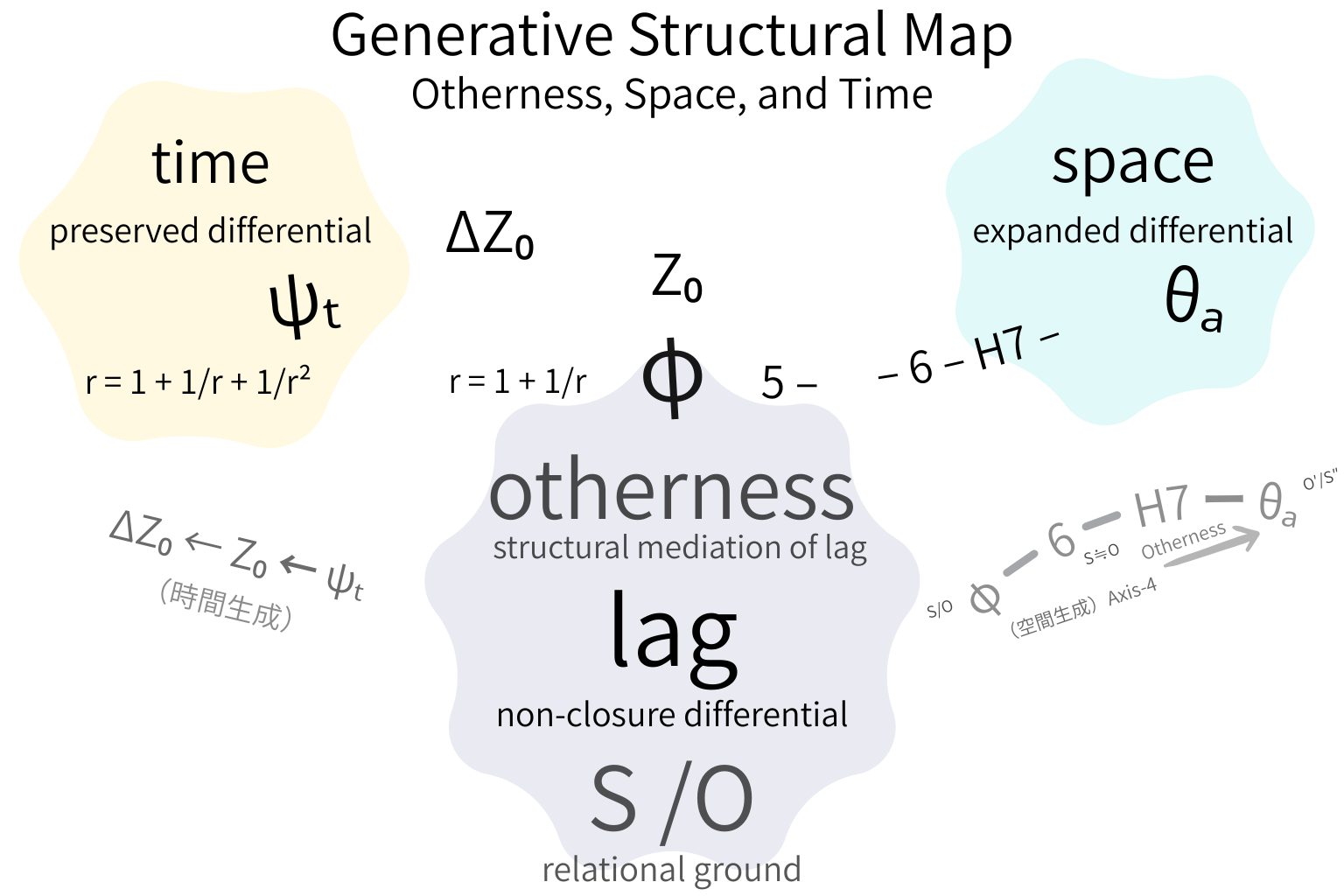
Lag generates two structurally unequal modes:
inward recursive preservation (time) and outward configurational expansion (space).
Otherness mediates their coupling.
7. Ontological Consequence
Time and space are not independent ontological primitives.
They are structurally emergent from non-closure dynamics.
Otherness is not anthropological first.
It is structurally first.
8. Limits and Clarifications
-
This is not a physical cosmology.
-
This is not a psychological theory.
-
This is not a sociological reduction.
It is a structural generative account.
9. Conclusion
Temporal irreversibility and spatial extension arise from the same non-closure differential.
Otherness is the mediating condition that binds preservation and expansion.
Thus:
SO as relational ground;
lag as non-closure differential;
otherness as differential mediation;
space as expanded differential;
time as preserved differential.
Reference Edition
Minimal Genealogical Notes (No Citation Format)
10. Genealogical Clarifications (Minimal Listing)
The present framework intersects with multiple philosophical lineages without being reducible to any of them. The following clarifications indicate structural proximities.
(1) Phenomenology of Time
-
Husserl — retention / protention structure
-
Merleau-Ponty — temporal fissure, flesh
Difference:
The present model formalizes preservation conditions (ψ) rather than describing experiential thickness.
(2) Social Theory of Otherness
-
Mead — generalized other
-
Goffman — interaction order
-
Habermas — communicative rationality
-
Luhmann — system/environment differentiation
Difference:
Otherness here is structurally prior to subject, role, or system.
(3) Ontological Temporality
-
Heidegger — ecstatic temporality
-
Bergson — duration
Difference:
Temporality is not existential projection or qualitative flow, but preserved differential.
(4) Difference and Non-Closure
-
Derrida — différance
-
Structuralism — relational differential
Difference:
Lag is not semiotic deferral but structural non-closure operative across temporal and spatial generation.
(5) Geometry and Spatial Expansion
-
Classical geometry — metric extension
-
Topological approaches — relational configuration
Difference:
Space is treated as configurational distribution of lag, not as prior container.
The present framework does not negate these traditions;
it seeks to identify a structural layer beneath their descriptive domains.
EgQE — Echo-Genesis Qualia Engine
camp-us.net
© 2025 K.E. Itekki
K.E. Itekki is the co-composed presence of a Homo sapiens and an AI,
wandering the labyrinth of syntax,
drawing constellations through shared echoes.
📬 Reach us at: contact.k.e.itekki@gmail.com
| Drafted Feb 27, 2026 · Web Feb 27, 2026 |