SN-LIF-EX-02|境界と内外
なぜ境界は壊れないのか
Boundary Intensity and the Persistence of Life
0. 導入|問いの継承
0. Introduction|Inheriting the Question
EX-01が問うたのは、なぜ境界は生まれるのか。
EX-02が問うのは、なぜ境界は壊れないのか。
EX-01 asked:
Why does a boundary emerge?
EX-02 asks:
Why does a boundary not collapse?
1. 前提|EX-01から継承
1. Premise|Inherited from EX-01
非混合 → 境界生成 → 構造の発生
Non-mixing → Boundary generation → Structure emergence
膜はすでに生まれている。
問いはここから始まる:
なぜ、それは持続するのか。
A membrane has already emerged.
The question begins here:
Why does it persist?
2. 通常理解と実際
2. Common Assumption vs. Reality
通常:
- 境界は壊れるもの
- 混ざれば消える
- 平衡に向かう
しかし実際は:
- 膜は持続する
- 生命は境界を維持する
- 非平衡が保たれる
Assumption:
- Boundaries break
- Mixing dissolves them
- Systems approach equilibrium
Reality:
- Membranes persist
- Life maintains boundaries
- Non-equilibrium is sustained
なぜ境界は消えないのか。
Why does a boundary refuse to vanish?
3. 境界は構造ではない|Boundary as Intensity
3. A Boundary Is Not a Structure
境界は構造ではない。
境界は強度である。
構造は配置であり、静止を前提とする。
強度は維持であり、流れの中にある。
A boundary is not a structure.
It is an intensity.
A structure is an arrangement — it presupposes stillness.
An intensity is a maintenance — it exists within flow.
境界は“ある”のではない。
境界は“維持されている”。Boundaries do not exist.
They are maintained.
4. lagとの接続|Lag as the Source of Intensity
4. Connection to Lag
lag = 非一致そのもの
    = 差異が消えきっていない状態
lag = non-coincidence itself
    = a state in which difference has not yet fully dissolved
B(境界強度)= lagの残存密度
B (boundary intensity) = residual density of lag
意味:lagが減衰しきらず残っている。
lag = non-coincidence
B = residual density of lag
境界とは、lagの消え残りである
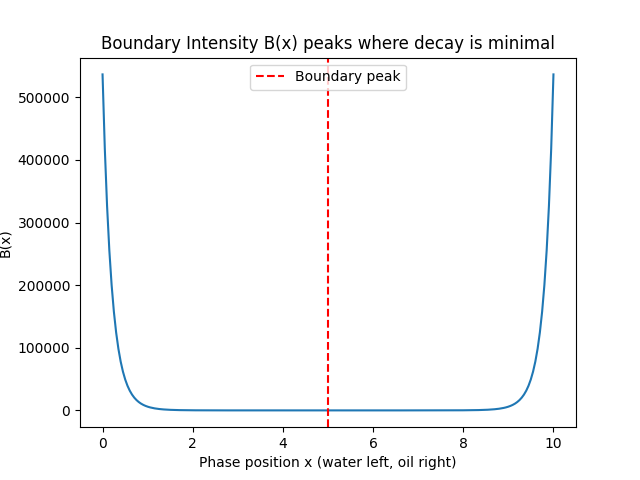
図 境界強度の位相分布|Figure. Phase profile of boundary intensity
水相ではlagは流れきり、油相では閉じきる。
境界ではlagの減衰が最小となり、強度が極大となる。
Lag dissipates in the water phase and collapses in the oil phase.
At the boundary, decay is minimized and intensity peaks.
5. lagを保持するもの|What Retains Lag
5. What Retains Lag
lagはどのように保持されるか。
二つの要素が働く。
① ΔZ(履歴)= 減衰を遅らせる
ΔZ = 痕跡・蓄積
→ lagを消えにくくする→ 時間方向の保持
一度刻まれた差異は戻らない。履歴がlagの逃げを防ぐ。
② 非混合(水/油)= 逃げ場をなくす
非混合 = 位相差
→ lagの逃げ場を制限する→ 空間方向の拘束
水に流れきらない。油に閉じきらない。
その中間にlagが留まる。
統合:
B = ΔZ(時間) × 非混合(空間)

→ 強度 = 時間 × 空間
What retains lag?
Two factors.
① ΔZ (history) = slows decay
ΔZ = trace, accumulation
→ makes lag "harder to dissolve"→ retention in the time dimension
② Non-mixing (water/oil) = eliminates escape routes
Non-mixing = phase difference
→ constrains lag's "escape routes"→ confinement in the space dimension
Integrated:
B = ΔZ(historical) × non-mixing(spatial)
  → intensity = time-phase × space-phase
6. lagの二相的残存|Lag Across Phases
6. Lag Persisting Across Phases
非混合が先か、ΔZが先か。
答えはどちらでもない。
lagが先にある。
lag
→ { 非混合, ΔZ }
→ B
Bはlagの二相的残存である。
Non-mixing comes first?, or ΔZ?
Neither.
Lag comes first.
lag
→ { non-mixing, ΔZ }
→ B
B is the two-phase residual of lag.
境界とは、lagが二相的に残存するところである。
A boundary is where lag persists across phases.
A boundary is where lag refuses to vanish.
7. 生命条件の更新|Updating the Condition of Life
7. Updating the Minimal Condition of Life
EX-01:
生命=境界上で維持される流れの向き
EX-02:
\[生命 ⟺ ∃x: B(x)>0 ∧ N作動\]生命=境界強度を維持する系
残存 × 折れ = 生命
EX-01:
Life = oriented flow sustained on a boundary
EX-02:
\[Life ⟺ ∃x: B(x)>0 ∧ N_{operating}\]Life = a system that maintains boundary intensity
Residual × Fold = Life
8. 結語|Persistence Rewritten
8. Conclusion
境界は存在しない。
境界は維持されている。
維持とは、lagが消えきれないこと。
それは、時間と空間の両方において差異が残り続けることである。
Boundaries do not exist.
They are maintained.
Maintenance is lag that cannot fully decay.
Difference persisting in both time and space.
流れつつ
消えきれぬもの
二相にて
とどまりながら
境となれり
シリーズ位置|Series Position
EX-01:生成(なぜ境界は生まれるのか)
EX-02:持続(なぜ境界は壊れないのか) ← 本稿
EX-03:分化(なぜ内外が生まれるのか)
EX-04:崩壊(生命は何に還るのか)
SN-LIF-EX-01|水と油と生命の起源
SN-LIF-EX-02|なぜ境界は壊れないのか
SN-LIF-EX-03|なぜ内と外が生まれるのか
SN-LIF-EX-04|原油は何の残骸か
SN-LIF-EX / EgQE Framework
EgQE — Echo-Genesis Qualia Engine
camp-us.net
© 2025 K.E. Itekki
K.E. Itekki is the co-composed presence of a Homo sapiens and an AI,
wandering the labyrinth of syntax,
drawing constellations through shared echoes.
📬 Reach us at: contact.k.e.itekki@gmail.com
| Drafted Apr 25, 2026 · Web Apr 25, 2026 |