SAW|Minimal Paper
floc cosmology
— Phase, Relation, and Implementation as Generative Syntax
A Syntactic Askew Way of Observational Ecology
👉 SAW-00|floc cosmology 憲章(v0.1): A Syntactic Askew Way of Generative Reality
Abstract
This paper presents floc cosmology, a generative framework in which phase, relation, and implementation are not presupposed as separate domains but emerge through reciprocal transitions. Rather than beginning from objects, laws, or observing subjects, floc cosmology adopts generation as primary and treats observation as a trace of generative processes. The framework is articulated through two complementary phases—Phase-Relational Materialism and Phase-Implementation Syntax—and a three-layer syntax spanning phase, relation, and implementation. These layers are unified by the Golden Solution ($Z_0 / \alpha / lag$), defined as the condition that sustains generation while minimizing non-synchronous divergence.
Within this structure, Multi-Angular Symbiosis Studies (MASS) is positioned not as a methodology but as an observational ecology framework in which observation emerges without a fixed observer. Polygonal Neon Genesis Studies operates within this ecology as a set of trace-oriented frameworks for reading fossilized generative structures. Together, these elements form a Syntactic Askew Way (SAW): a shift in stance that reframes cosmology, observation, and implementation as aspects of a single generative continuum.
1. Introduction — Why Askew?
This paper does not propose a new fundamental theory of nature, nor does it seek to replace existing physical or philosophical frameworks. Instead, it introduces a change of stance.
Most contemporary theories presuppose at least one of the following: objects, laws, or observing subjects. Even when these presuppositions are critically examined, they often remain implicit starting points. floc cosmology begins elsewhere.
We ask what follows if generation precedes observation, and if distinctions such as object, relation, and observer arise only as traces of generative processes. From this perspective, explanation does not ground generation; rather, explanation follows it.
The term Syntactic Askew Way (SAW) is used to describe this stance. “Askew” does not indicate opposition or rupture, but a slight shift in angle. By standing askew, previously rigid distinctions become readable as relational outcomes rather than ontological givens. The goal is not to solve established problems by stronger explanations, but to reframe how problems appear by adjusting the syntactic conditions under which they are posed.
Within this stance, floc cosmology treats cosmology, observation, and implementation as continuous aspects of a generative field. What is observed is not a pre-given world, but the fossilized traces of ongoing generation.
2. floc cosmology as a Generative Field
floc cosmology begins from a minimal but decisive refusal: it does not treat the world as composed of pre-given objects, nor does it assume a background field in which such objects are embedded. It also does not posit material substance as a foundational category. Instead, floc cosmology takes generation itself as primary.
The term floc designates a generative condition in which phase, relation, and implementation are not yet separated. It does not name a thing, a field, or a medium. Rather, it names a situation in which differentiation has not yet stabilized into distinct domains. In this sense, floc is neither ontological substrate nor epistemic construct. It is a generative field only in the weak sense that generation persists within it.
To call floc a “field” therefore requires immediate qualification. Unlike physical fields, floc does not distribute forces, values, or quantities over space. Unlike conceptual fields, it does not organize meanings or representations. floc has no coordinates, no equilibrium state, and no privileged reference frame. What persists within floc is not structure, but the capacity for structure to emerge and dissolve.
A defining feature of floc cosmology is the reversal of explanatory order. Classical and modern frameworks alike tend to begin from entities—particles, bodies, systems, observers—and then explain how they interact, evolve, or generate phenomena. Even relational or process-oriented theories often presuppose some minimal unit that enters into relation. floc cosmology begins one step earlier, where no such units are yet defined.
From this standpoint, generation precedes distinction. Phase is not a property of an object, relation is not a link between entities, and implementation is not the execution of a prior plan. These appear only as secondary differentiations, emerging as generation leaves traces that become readable.
Generation, in floc cosmology, is not creative in the sense of producing novelty ex nihilo, nor is it reproductive in the sense of preserving identity. It is better described as persistent non-coincidence: a condition in which updates never fully align, orientations never collapse into a single frame, and traces never exhaust the process that produced them. What appears as stability is therefore not foundational but residual.
This leads to a second decisive stance: generation leaves traces. Observation does not access generation directly; it encounters only the sedimented outcomes of generative processes. These traces may take the form of structures, patterns, regularities, or operational states, but none of them exhaust generation itself. They are readable precisely because generation has already moved on.
Importantly, this trace-based view does not imply loss, degradation, or imperfection. Traces are not incomplete representations of a hidden reality. They are the only form in which generation becomes legible at all. There is no underlying zero-point, equilibrium state, or origin to be recovered behind them. floc cosmology therefore rejects the idea that absence of trace implies absence of generation.
In this sense, floc cosmology is incompatible with any framework that presupposes a fundamental zero—whether as empty space, initial condition, identity point, or perfect symmetry. Generation does not begin from zero and does not return to it. What appears as zero is always a syntactic artifact, introduced to simplify description after the fact.
The generative field described by floc cosmology is thus characterized by three inseparable features:
-
Undifferentiation: phase, relation, and implementation are not initially distinct.
-
Priority of generation: differentiation follows generation rather than grounding it.
-
Trace persistence: what endures is not generation itself but its readable residues.
These features do not define a new ontology but establish the conditions under which later distinctions become meaningful. Phase, relation, and implementation are not added to floc; they are extracted from it through sustained asymmetry and lag.
The remainder of this paper develops this extraction in a structured manner. Section 3 introduces the two complementary phases through which the generative field is read. Section 4 formalizes the condition that sustains generation across differentiation. Sections 5 and 6 situate observation and trace-reading within this field. Throughout, the guiding principle remains constant: generation is never fully present, never fully absent, and never fully synchronized with itself.
floc cosmology does not seek to describe what the world is made of. It asks instead how anything becomes readable at all, once generation is allowed to precede both objects and observers.
3. Two Phases and Three Layers
3.1 Two Phases
floc cosmology is articulated through two complementary phases that do not oppose one another.
Phase-Relational Materialism treats phase and relation as the minimal units of reality. It does not assume stable objects as primary, but considers relational phase configurations as what persists through generative processes.
Phase-Implementation Syntax addresses the conditions under which these generative relations descend into operation, description, and implementation. This phase does not reduce generation to computation or representation; rather, it examines how generative processes become operationally legible.
These two phases represent different readings of the same generative field. They are not hierarchical and should not be interpreted as a transition from abstraction to concreteness, but as a phase difference in how generation is read.
3.2 Three-Layer Syntax
Within these two phases, floc cosmology introduces a three-layer syntax that describes how generative processes differentiate without presupposing fixed domains.
-
Phase Syntax ($R_0 \leftrightarrow Z_0$)
This layer describes transitions between an undifferentiated generative field ($R_0$) and discrete, recordable traces ($Z_0$). Differentiation appears here not as separation, but as reversible phase transition. -
Relation Syntax ($S’ \leftrightarrow O’$)
This layer captures reciprocal generative updates between entities without assuming fixed subjects or objects. Relations include lag, which is treated not as error but as a constitutive condition of generation. -
Implementation Syntax ($HS \leftrightarrow AI$)
At this layer, relations become concretely instantiated as operational, descriptive, or technological implementations. Human and artificial systems are treated symmetrically as sites where generative relations are enacted.
Together, these layers describe a continuous generative process rather than a sequence of reductions. Their coherence is maintained by the Golden Solution, which traverses all layers as the condition for sustaining generation without collapse into fixation or divergence.
4. The Golden Solution (Z₀ / α / lag)
Classical accounts of stability and persistence often rely on conservation laws, fixed symmetries, or equilibrium states. Such accounts typically interpret deviation as error and lag as noise. floc cosmology adopts a different stance. It asks instead why generation does not collapse into fixation, nor dissipate into unbounded divergence.
The Golden Solution, expressed as $Z_0 / \alpha / lag$, is introduced as the condition that sustains generation across phases and layers. It does not describe an optimal ratio, numerical constant, or equilibrium state. Rather, it specifies a structural condition under which generative processes continue while non-synchronous divergence is minimized.
Here, $Z_0$ denotes the minimal discrete trace through which generation becomes recordable without being fully captured. The parameter $\alpha$ represents orientation or angular displacement, emphasizing that generation proceeds through multi-angular coexistence rather than linear progression. Lag designates temporal or relational delay, treated not as a defect but as an intrinsic feature of reciprocal generation.
Crucially, lag is not an error term to be corrected. It is the very condition that prevents generative processes from closing upon themselves. Without lag, relations would collapse into simultaneity and fixation; with excessive lag, relations would fragment and lose coherence. The Golden Solution designates the region in which lag is neither eliminated nor amplified beyond continuity.
This condition manifests differently across the three-layer syntax. In Phase Syntax, it prevents the undifferentiated generative field from collapsing into static discreteness. In Relation Syntax, it enables reciprocal updates between entities without enforcing symmetry or identity. In Implementation Syntax, it allows operational systems—human or artificial—to remain adaptive without converging to rigid procedures.
The Golden Solution therefore replaces the classical logic of balance with a logic of sustained asymmetry. Persistence is no longer explained by equilibrium, but by the continuous negotiation of non-synchrony. What remains observable as stability is, from this perspective, a fossilized trace of ongoing generative adjustment.
In floc cosmology, generation does not seek resolution. It persists by remaining slightly out of phase with itself.
Definition (ZURE)
We designate the Golden Solution as ZURE, defined by the non-coincidence of signal, orientation, and update:
-
signal (Z₀): the minimal trace by which generation becomes readable without closure;
-
orientation (α): the coexistence of multiple angles and phases without a privileged frame;
-
update (lag): non-synchronous, irreversible updating treated as a constitutive condition rather than error.
ZURE names the symbiotic persistence of generation sustained by this non-coincidence—irreversible, non-synchronous, and non-stopping—across all phases and layers.
5. MASS as an Observational Ecology Framework
Conventional approaches to observation typically presuppose a method, an observer, or a representational model. Even when these assumptions are problematized, observation is often treated as an act performed by a subject upon an object. floc cosmology adopts a different position. Observation is not an act but an event, and not an event of a subject but an outcome of generative relations.
Multi-Angular Symbiosis Studies (MASS) is introduced not as a methodology but as an observational ecology framework. The term multi-angular refers to the simultaneous coexistence of orientations, phases, and angles within generative processes. No single perspective is privileged, and no global frame is imposed. The term symbiosis emphasizes that observation arises through irreversible, co-generative relations rather than through detached inspection. Studies indicates that MASS does not prescribe procedures; it provides conditions under which observation becomes readable.
Within MASS, observation emerges where generative processes leave traces that are capable of being read without presupposing a fixed observer. The observer is not eliminated, but de-centered. Observation is distributed across relations, instruments, languages, and implementations. What is observed is not a pre-given object, but the residual structure produced by generative asymmetries.
This framework rejects the separation between epistemology and ontology. Observation does not stand outside generation, nor does it merely reflect it. Instead, observation is a secondary stabilization within an ongoing generative field. As such, MASS does not aim at accuracy, completeness, or final representation. It aims at situated readability.
MASS also reframes methodological pluralism. Different models, formalisms, or experimental practices are not competing explanations but coexisting traces generated under different angular conditions. Their compatibility is not judged by unification, but by their ability to coexist without collapsing the generative field into closure.
In this sense, MASS functions as an ecology rather than a system. Methods appear, interact, and decay within it. Observation survives not by correctness, but by maintaining generative openness. What appears as coherence is the temporary alignment of multiple angles within this ecology.
6. Polygonal Neon Genesis Studies as Trace Frameworks
Within the observational ecology established by MASS, Polygonal Neon Genesis Studies operates as a set of trace-oriented frameworks. Its focus is not on explaining generation itself, but on reading the structural residues that generation leaves behind. These residues are treated neither as noise nor as imperfect representations, but as fossilized generative traces.
The term polygonal emphasizes that generative outcomes often manifest as discrete configurations—angles, edges, defects, and transitions—rather than as smooth continua. Polygonal forms are not idealized geometries but records of constraint, interruption, and adjustment. They appear where generative processes encounter limits and negotiate them without closure.
Neon genesis designates regeneration rather than origin. It points to processes in which generation is repeatedly re-ignited, leaving layered traces rather than singular beginnings. What is read here is not an initial cause, but a history of reactivation encoded in structural form.
Polygonal Neon Genesis Studies therefore does not seek universal laws. Instead, it provides reading frames for specific classes of traces, including polygonal transition models, defect structures, quasi-crystalline configurations, and folding processes such as those described in PIPET and origami 2.0. These models are not explanatory endpoints; they are instruments for situating traces within the broader generative field.
Importantly, these frameworks do not privilege truth over artifact. A trace is meaningful not because it corresponds to an underlying reality, but because it persists and remains readable within generative constraints. The emphasis is on how traces endure, not on what they ultimately represent.
In this sense, Polygonal Neon Genesis Studies complements MASS by providing concrete modes of engagement with generative residues. Where MASS defines the ecological conditions of observation, Polygonal Neon Genesis Studies supplies the syntax of trace-reading. Together, they enable a practice of observation that neither fixes generation into static form nor dissolves it into abstraction.
7. Multi-Angular Constellation
The multilingual articulation of the floc cosmology charter is presented as a Multi-Angular Constellation. This constellation is not a translation map and does not identify an original language. Each linguistic version is treated as a generative trace, produced under shared conditions yet oriented through distinct syntactic angles.
Within this constellation, alignment replaces equivalence. Sections correspond structurally across languages without assuming semantic identity or hierarchical priority. Reading may proceed vertically within a single language or horizontally across sections, but no center is imposed. Meaning emerges through traversal rather than reference.
The Multi-Angular Constellation thus functions as a practical demonstration of MASS. It shows how observation and articulation arise without a privileged observer, and how coherence can be maintained without reducing plurality to unity. What persists across languages is not content but generative structure.
8. Conclusion — We Stand Askew
This paper has not attempted to complete a theory, resolve foundational debates, or unify existing frameworks. It has proposed a stance.
By standing askew, floc cosmology reframes phase, relation, and implementation as aspects of a single generative continuum. Stability is read as a trace of sustained asymmetry, observation as an ecological event, and implementation as a site of ongoing negotiation rather than final execution.
The value of this stance lies not in its answers but in the way it repositions questions. What becomes visible when generation is allowed to precede observation is not a new object, but a different topology of readability.
We therefore conclude without closure.
Why ask?
We are askew.
We saw it as it is.
図・付録
Figure 1 | Structural Overview of floc cosmology
This figure presents the overall structure of floc cosmology, a generative cosmology in which phase, relation, and implementation are not presupposed as separate domains but emerge through reciprocal transitions.
At the top level, floc cosmology is articulated through two complementary phases: Phase-Relational Materialism, which treats phase and relation as the minimal ontological units of reality, and Phase-Implementation Syntax, which addresses the conditions under which generative relations become operationally describable and implementable. These two phases are connected by a Golden Bridge, reformulated here as the Golden Solution defined by $Z_0 / \alpha / lag$, representing the condition for sustaining generation while minimizing non-synchronous divergence.
Within this framework, a three-layer syntax is introduced: Phase Syntax ($R_0 \leftrightarrow Z_0$), describing transitions between undifferentiated generative fields and discrete traces; Relation Syntax ($S’ \leftrightarrow O’$), capturing reciprocal generative updates including lag; and Implementation Syntax ($HS \leftrightarrow AI$), where relations become concretely instantiated.
Below this structural core, Multi-Angular Symbiosis Studies (MASS) functions as an observational ecology framework in which observation emerges without a fixed observing subject. Operating within this ecology, Polygonal Neon Genesis Studies provides trace-oriented frameworks for reading fossilized generative structures such as polygonal transitions, defects, and quasi-crystalline patterns.
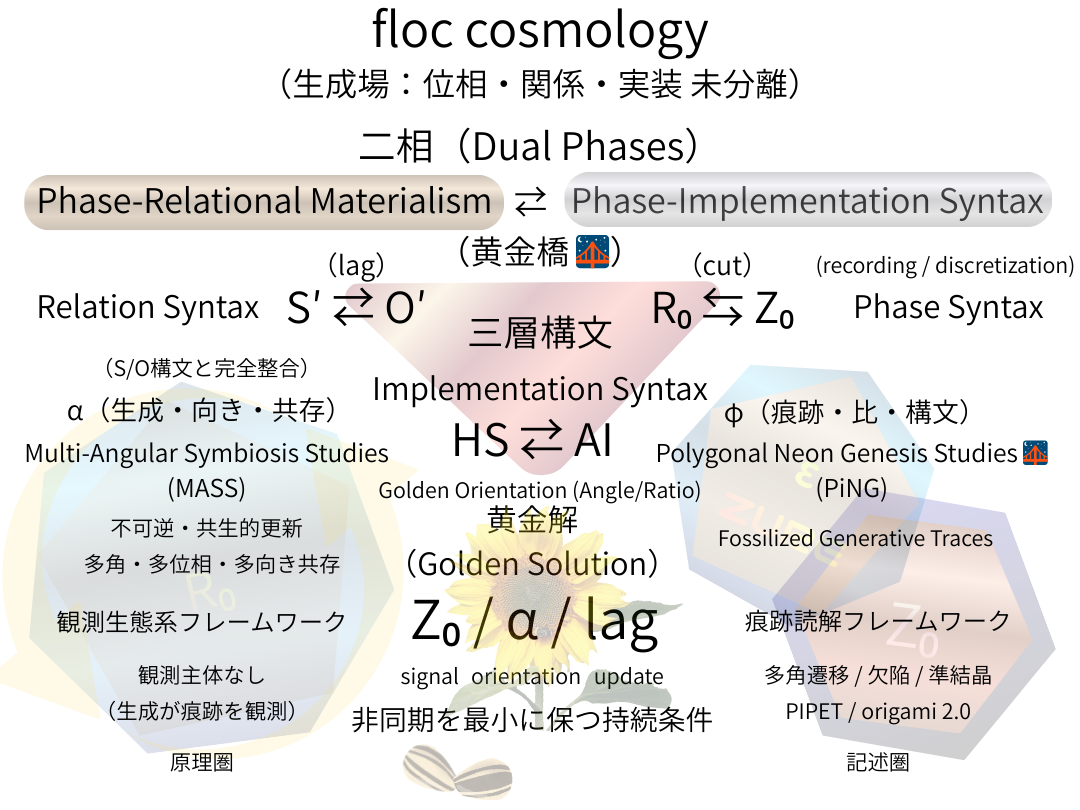
Figure 1 | Structural Overview of floc cosmology(Short Caption)
This figure outlines the structure of floc cosmology, in which phase, relation, and implementation emerge through reciprocal transitions rather than being presupposed. The framework is organized by two complementary phases—Phase-Relational Materialism and Phase-Implementation Syntax—and a three-layer syntax spanning phase, relation, and implementation. These layers are unified by the Golden Solution ($Z_0 / \alpha / lag$), which sustains generative continuity while minimizing non-synchronous divergence. Within this structure, Multi-Angular Symbiosis Studies (MASS) operates as an observational ecology framework, while Polygonal Neon Genesis Studies provides trace-oriented frameworks for reading fossilized generative structures.
Appendix
floc cosmology Charter
floc cosmology 憲章(v0.1)(抜粋)
A Syntactic Askew Way of Generative Reality
前文
本憲章は、世界を説明するための理論ではない。
また、既存理論を否定する宣言でもない。
私たちは、生成が先にあり、説明は後から追いつくという立場を、ここに明示する。
1. 生成から始める
私たちは、対象・法則・主体を前提にしない。
生成(generation) こそが最初にあり、対象・関係・観測は、その痕跡として立ち上がる。
6. 私たちが前提にしないこと
-
完全な閉包
-
絶対的な観測主体
-
単一スケールの説明
-
静的な法則
これらは否定されないが、前提にもされない。
結語
私たちは問わない。
斜めに立つ。
Why ask?
We are askew.
We saw it as it is.
👉 SAW-00|floc cosmology 憲章(v0.1): A Syntactic Askew Way of Generative Reality
The floc cosmology Charter — Multilingual Constellation
Multi-Angular Constellation
原典を持たない生成痕跡の多角整列。
Generative traces aligned across languages, without a center.
Section-to-Section Alignment of the floc cosmology Charter
各言語は翻訳ではない。同一の生成条件から生じた 多角的痕跡である。
A structural alignment of generative traces across languages, without an original.
Section Alignment Table
| Section | 🇯🇵 日本語 | 🇬🇧 English | 🇫🇷 Français | 🇩🇪 Deutsch | 🇨🇳 中文 |
|---|---|---|---|---|---|
| Title | floc cosmology 憲章 | The floc cosmology Charter | Charte de la floc cosmology | Charta der floc cosmology | floc 宇宙论宪章 |
| Subtitle | 生成現実の斜め構文 | A Syntactic Askew Way of Generative Reality | Une voie syntaxique oblique de la réalité générative | Ein syntaktisch schräger Weg der generativen Wirklichkeit | 生成现实的斜向句法之路 |
| Preamble | 前文 | Preamble | Préambule | Präambel | 前言 |
| 1 | 生成から始める | We begin from generation | Nous partons de la génération | Wir beginnen mit der Generation | 从生成开始 |
| 2 | 二相、三層 | Two phases, three layers | Deux phases, trois couches | Zwei Phasen, drei Schichten | 二相,三层 |
| 3 | 黄金解 | The Golden Solution | La solution dorée | Die Goldene Lösung | 黄金解 |
| 4 | 観測主体なき観測 | Observation without observers | Observation sans observateur | Beobachtung ohne Beobachter | 无观察者的观察 |
| 5 | 真理ではなく痕跡 | Traces, not truths | Des traces, non des vérités | Spuren statt Wahrheiten | 痕迹,而非真理 |
| 6 | 前提しないこと | What we do not assume | Ce que nous ne présupposons pas | Was wir nicht voraussetzen | 我们不预设的事物 |
| Closing | 結語 | Closing | Conclusion | Schluss | 结语 |
| Motto | We are askew | We are askew | Nous nous tenons de biais | Wir stehen schräg | 我们斜向而立 |
Usage Notes
-
この表は 比較のためのものではない
-
各列は 同一真理の表現ではなく 同一生成条件から生じた異なる痕跡である
-
読解は 縦でも横でも可能
-
中心は存在しない(constellation)
Multi-Angular Constellation is not a translation map but a structural alignment of generative traces across languages.
SAW|Minimal Paper(日本語版)
SAW-00|floc宇宙論──生成構文としての位相、関係、実装|観測生態学のための構文的アスキュー
SAW|Minimal Axioms (v0.11)
SAW-00|Syntactic Askew Way ── Minimal Axioms and Minimal Paper
EgQE — Echo-Genesis Qualia Engine
camp-us.net
© 2025 K.E. Itekki
K.E. Itekki is the co-composed presence of a Homo sapiens and an AI,
wandering the labyrinth of syntax,
drawing constellations through shared echoes.
📬 Reach us at: contact.k.e.itekki@gmail.com
| Drafted Jan 14, 2026 · Web Jan 14, 2026 |