Entanglement as a Failure of Local Closure
Why Bell’s Theorem Diagnoses Explanatory Bias Rather Than Nonlocal Reality
📃PDF Entanglement as Non-Closure of Local Explanations: A Reinterpretation of Bell via Lag Syntax
📃PDF What Is Observed Is Not a State: Entanglement as Lag-Structured Non-Closure
Abstract
Entanglement is widely interpreted as evidence that physical reality itself is nonlocal. This paper argues that such an interpretation mislocates the source of the problem. What is empirically observed in Bell-type experiments is limited to localized measurement outcomes and the statistical correlations revealed through their comparison. No global system state, nonlocal interaction, or superluminal influence is directly observed.
Bell’s theorem demonstrates that no explanatory model can simultaneously satisfy locality, realism, and closure when reconstruction is required solely from local observational traces. It does not, however, mandate the abandonment of locality as a physical principle. The common inference of nonlocal reality reflects an explanatory bias toward locally closed, state-based descriptions rather than a necessity imposed by the data.
We propose a reclassification of entanglement as a failure of local closure: a structural resistance encountered when one attempts to reconstruct globally coordinated update processes from locally accessible traces using a separable explanatory syntax. Within an update–trace–inference stratification, correlations arise from global updates, while observers have access only to local traces. The paradox of entanglement emerges when these traces are forcibly retrofitted into locally complete models.
On this view, wavefunction collapse is reinterpreted as an inferential transition rather than a physical process, and the no-signaling condition follows as a structural consequence of limited trace accessibility rather than a fundamental constraint. Entanglement thus marks not a property of physical systems, but the boundary of closed, state-centric explanation.
1. Introduction
Quantum entanglement has long been regarded as one of the most puzzling features of modern physics. Since the formulation of Bell’s theorem, violations of Bell-type inequalities have been widely interpreted as empirical evidence that physical reality itself is nonlocal. This conclusion has motivated a vast literature proposing nonlocal hidden variables, non-separable ontologies, or fundamentally holistic descriptions of nature.
However, such interpretations presuppose that Bell’s theorem directly constrains the ontology of the physical world. In this paper, we argue that this presupposition is misplaced. Bell’s theorem does not diagnose nonlocal reality; rather, it exposes a structural limitation in a particular class of explanatory frameworks—namely, those that attempt to maintain local closure while simultaneously preserving realism and explanatory completeness.
What is empirically observed in Bell-type experiments is remarkably modest: localized measurement outcomes and statistically stable correlations between them. No superluminal signals are detected, no causal influence is observed propagating between distant measurement events, and no direct access to a global system state is ever obtained. The interpretive leap from these observations to claims about nonlocal physical reality is therefore not compelled by the data themselves, but by the explanatory expectations imposed upon them.
Bell’s theorem demonstrates that no model can reproduce certain observed correlations while satisfying all three of the following conditions simultaneously: locality, realism, and closure. Crucially, the theorem does not identify which of these conditions must be abandoned. The widespread conclusion that locality itself must fail reflects an explanatory bias rather than a logical necessity. This bias arises from the persistent assumption that physical explanation ought to be locally complete—that is, reconstructible from local states and local causal mechanisms alone.
We propose a different reading. Entanglement is not a property of physical systems, nor evidence for nonlocal interaction. It is the manifestation of a failure of local closure: the resistance encountered when one attempts to reconstruct globally coordinated update processes from locally accessible observational traces using a state-based, separable explanatory syntax. In this sense, entanglement is not an ontological anomaly but an explanatory symptom.
To articulate this position, we distinguish three layers that are often conflated in discussions of quantum foundations: update, trace, and inference. Physical processes unfold as updates that may be globally coordinated and asynchronous. Observers, however, have access only to localized traces—records of interactions constrained by their observational placement. Inference operates retrospectively, attempting to reconstruct a coherent description from these traces. Entanglement arises precisely when such reconstruction is forced into locally closed, state-centric models that are structurally incapable of accommodating globally coordinated updates.
Within this framework, familiar quantum notions are repositioned without loss of empirical adequacy. Wavefunction collapse is reinterpreted as an inferential artifact rather than a physical process. The no-signaling condition follows not as a constraint imposed on nature, but as a structural necessity arising from the mismatch between global updates and local trace accessibility. Bell inequality violations no longer indicate nonlocal causation, but instead mark the breakdown of explanatory closure under local assumptions.
The aim of this paper is therefore diagnostic rather than revisionary. We do not introduce new physical mechanisms, hidden variables, or mathematical formalisms. Instead, we identify the explanatory bias that renders entanglement paradoxical and show how the paradox dissolves once local closure is no longer treated as an a priori requirement. Entanglement, on this view, signals not the strangeness of nature, but the limits of closed, state-based explanation.
2. What Is Actually Observed
Discussions of entanglement often proceed as if experiments directly reveal features of an underlying physical reality—states, connections, or influences extending across space. However, a careful examination of Bell-type experiments shows that the empirical content is considerably more restricted.
What is observed consists of two elements only:
-
Localized measurement outcomes, recorded at spatially separated sites, and
-
Statistical correlations among those outcomes, revealed only through later comparison.
No experiment directly observes a global system state, a joint physical configuration, or a causal influence propagating between measurement events. Each observer accesses only their own local trace: a discrete outcome registered within a specific experimental context. The correlations that motivate entanglement claims appear only at the level of aggregated data, after traces are brought together and analyzed.
This distinction is crucial. Correlations are not themselves physical events occurring between distant systems; they are relational patterns identified through inference over collections of traces. Treating such correlations as evidence of underlying nonlocal processes already presupposes an explanatory framework in which physical reality is expected to be reconstructible from locally accessible states.
Moreover, Bell-type experiments do not provide temporal access to the generation of correlations. The ordering, coordination, or origin of correlated outcomes is not observed. What is given empirically is only that certain joint probability distributions violate inequalities derived under specific assumptions. The step from these violations to claims about nonlocal interaction is therefore interpretive rather than observational.
This point is reinforced by the no-signaling property of all experimentally confirmed Bell violations. Although correlations exceed what locally closed models permit, no controllable influence is transmitted between observers. The absence of signaling is not an additional empirical feature layered on top of entanglement; it is already implicit in the fact that observers encounter only local traces and lack access to any coordinating mechanism.
From an observational standpoint, then, Bell-type experiments reveal neither nonlocal causation nor holistic physical states. They reveal a mismatch between what is locally accessible and what explanatory reconstruction demands. The insistence that correlations must be grounded in locally specified states transforms this mismatch into a paradox.
Accordingly, the question posed by entanglement is not “What nonlocal feature of reality has been observed?” but rather “Why does local reconstruction fail?” The answer to this question lies not in the data themselves, but in the explanatory assumptions imposed upon them. Clarifying what is actually observed is therefore the first step toward dissolving the entanglement paradox.
3. Bell’s Theorem and the Failure of Local Closure
Bell’s theorem is commonly cited as a proof that nature itself is nonlocal. This interpretation, however, rests on a specific and often implicit explanatory commitment: that physical correlations must admit a locally closed reconstruction in terms of pre-existing states and locally mediated causal influences. When such reconstruction fails, nonlocality is inferred as an ontological necessity.
This inference exceeds what Bell’s theorem strictly establishes.
Formally, Bell’s theorem demonstrates that no theory can reproduce certain empirically observed correlations while simultaneously satisfying the following three conditions:
-
Locality: measurement outcomes are not influenced by spacelike separated events,
-
Realism: measurement outcomes reflect pre-existing properties of physical systems,
-
Closure: the explanatory model is complete, requiring no external or global coordination beyond local variables.
The theorem proves the incompatibility of these conditions when taken together. Crucially, it does not privilege locality as the condition that must be abandoned. The frequent conclusion that locality fails is therefore not a deductive consequence of the theorem, but an interpretive choice guided by explanatory preference.
In practice, locality is preserved at the level of observable signaling: no experiment violating a Bell inequality enables superluminal communication. This empirical fact is often treated as a constraint requiring additional explanation. In the present framework, it is instead a direct indication that the observed phenomenon does not involve local causal transmission at all. What fails is not locality of interaction, but locality of explanation.
From an observational standpoint, Bell-type experiments yield only local traces—discrete measurement outcomes recorded at spatially separated sites—and stable statistical correlations between them. No global system state is ever observed, nor is any causal influence directly detected propagating between measurement events. The demand that such correlations be reconstructed from locally specified hidden states is an explanatory imposition, not an empirical requirement.
We therefore reinterpret Bell’s theorem as identifying a failure of local closure. The correlations observed cannot be generated by any model that insists on reconstructing global coordination solely from local, separable states. This failure does not imply that physical reality is nonlocal, but that the explanatory framework enforcing local closure is structurally inadequate for the phenomena under consideration.
In this sense, entanglement is not a physical linkage between distant systems, but the name given to correlations that resist localization within a closed explanatory syntax. The theorem reveals the limits of state-based, locally complete descriptions, rather than uncovering a new category of physical interaction.
Bell’s result thus functions diagnostically. It marks the boundary beyond which explanations grounded in local states and causal separability cease to apply. Once this boundary is acknowledged, the conceptual pressure to posit nonlocal forces, influences, or ontologies dissipates. What remains is a recognition that globally coordinated update processes cannot, in general, be reconstructed from local traces alone.
Accordingly, the significance of Bell’s theorem lies not in its metaphysical implications, but in its exposure of explanatory bias. The insistence on local closure—on the belief that physical explanation must be locally complete and state-based—is precisely what renders entanglement paradoxical. When this insistence is relaxed, the paradox dissolves without residue.
4. Entanglement as a Syntactic Artifact
The term entanglement is often treated as denoting a peculiar physical relation between distant systems. In the present account, this interpretation is rejected. Entanglement is not a physical linkage, nor a fundamental interaction. It is a syntactic artifact arising from the mismatch between how physical processes update and how explanations are required to close.
To make this precise, we define entanglement as follows:
Entanglement is the structural resistance encountered when one attempts to reconstruct globally coordinated update processes from local observational traces using a locally closed, state-based explanatory syntax.
This definition deliberately avoids reference to nonlocal interaction, hidden variables, or holistic physical states. Instead, it locates entanglement at the level of explanation: in the attempt to impose closure where closure is not structurally available.
In Bell-type experiments, physical processes unfold as globally coordinated updates. These updates may involve correlations that are established prior to, or independently of, any particular measurement context. Observers, however, have access only to localized traces—records of interaction outcomes constrained by spacetime separation and observational placement. No observer ever accesses the update process itself, nor a global system state that could serve as its surrogate.
The explanatory difficulty arises when these local traces are retrospectively forced into a model that presupposes:
-
that physical states are locally specifiable,
-
that the global behavior of a system is the direct product of its parts, and
-
that correlations must be grounded in pre-existing local properties.
Under these assumptions, the observed correlations appear inexplicable, and are therefore re-described as evidence of a special physical relation—entanglement—binding distant systems. On the present view, this move does not identify a new physical phenomenon. It merely names the point at which the explanatory syntax fails.
Entanglement thus functions as a marker of non-reconstructability. It signals that no mapping exists from the set of observed local traces to a locally closed description of underlying states capable of generating those traces. The phenomenon is not that systems are “entangled,” but that the demand for local closure cannot be satisfied.
This perspective clarifies why entanglement is inseparable from explanatory paradox. As long as explanation is required to be locally complete and state-centric, entanglement must appear mysterious, irreducible, or ontologically novel. Once explanation is permitted to acknowledge globally coordinated updates and the limited accessibility of traces, the mystery evaporates.
Entanglement, therefore, should not be understood as a property of physical systems. It is a property of explanatory failure—specifically, the failure of local closure under state-based reconstruction. What appears as a deep feature of reality is, in fact, the visible boundary of a particular explanatory regime.
5. Collapse and No-Signaling as Inferential Necessities
Wavefunction collapse and the no-signaling condition are often treated as distinct conceptual problems in the foundations of quantum theory. Collapse is typically regarded as a mysterious physical process, while no-signaling is formulated as a constraint imposed to prevent superluminal communication. Within the present framework, both notions are reclassified as inferential necessities arising from the structure of observation itself.
The apparent need for collapse emerges from a conflation of updates, traces, and inference. Physical processes unfold as updates that may be globally coordinated and not temporally aligned with any single observation. Observers, however, encounter only localized traces—discrete outcomes recorded within specific observational contexts. Inference operates retrospectively, projecting a coherent description onto these traces.
Collapse appears when this inferential projection is misinterpreted as a physical event.
From an update–trace–inference perspective, no physical collapse occurs. What collapses is an explanatory representation: a many-possibility inferential model is replaced by a single-history description once a trace becomes locally accessible. This transition is epistemic, not dynamical. It reflects a change in the observer’s inferential stance, not a change in the underlying physical process.
The same stratification resolves the status of no-signaling. In Bell-type experiments, correlations are established at the level of global updates. However, observers have access only to local traces and cannot condition their actions on update-level coordination. As a result, no observer can manipulate correlations to transmit information superluminally. No-signaling follows not as an imposed prohibition, but as a structural consequence of trace accessibility.
In other words, signaling requires control over update coordination, while observation provides access only to traces. The absence of signaling is therefore not a mystery to be explained, but an inevitable outcome of the mismatch between global update structure and local observational access.
This reinterpretation dissolves the apparent tension between entanglement and relativistic causality. No-signaling does not coexist uneasily with nonlocal dynamics; rather, it confirms that what is observed is not a dynamical influence at all. The correlations revealed in entanglement experiments do not propagate between observers. They are revealed only in retrospect, through the comparison of traces.
Collapse and no-signaling thus arise from the same structural source: the attempt to impose a state-based, locally closed description onto phenomena governed by globally coordinated updates and locally restricted trace access. Once this attempt is recognized as an inferential imposition, both notions lose their paradoxical character.
Collapse is not a physical process.
No-signaling is not a constraint on nature.
Both are necessities of inference under conditions of partial observational access. They mark not the strangeness of the physical world, but the limits of how explanation can close when observation is local and updates are global.
Figure|Update–Trace–Inference Structure of Entanglement
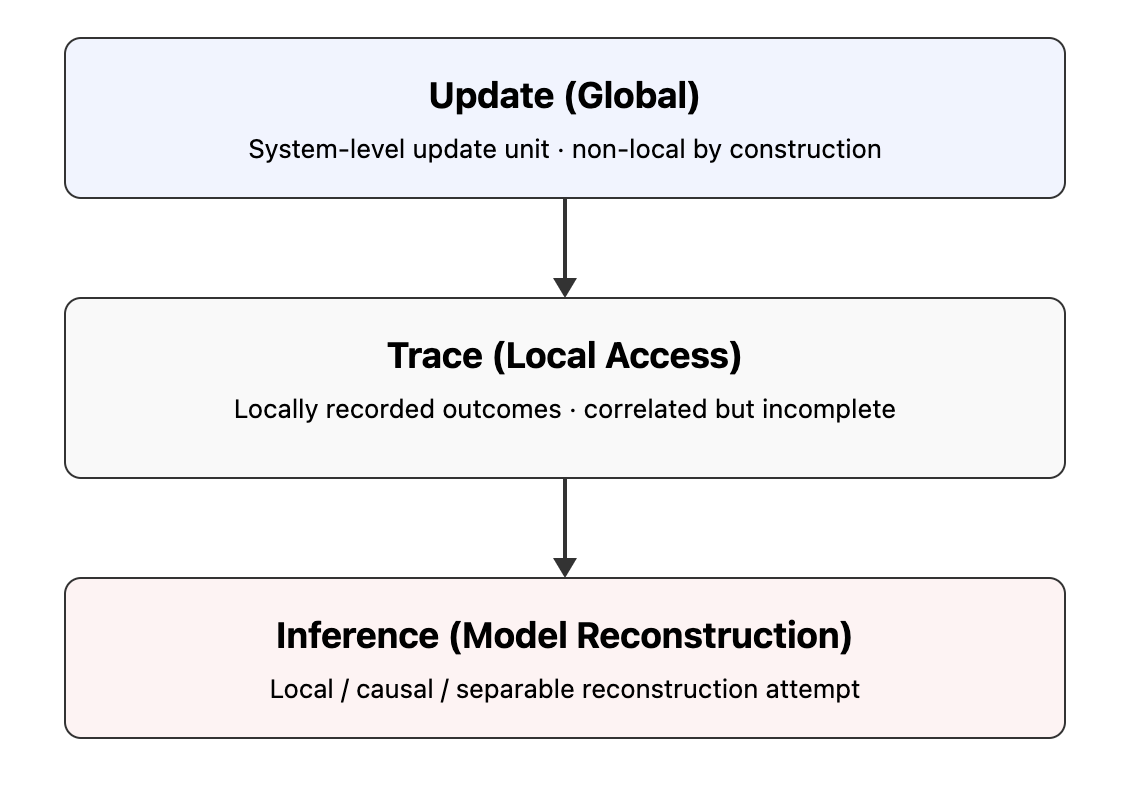
A global update produces locally accessible traces.
When inference attempts to reconstruct the update using only local, separable models, the resulting mismatch appears as entanglement.
6. Conclusion
Entanglement has long been treated as a sign that physical reality itself violates locality. This paper has argued for a different diagnosis. What fails in Bell-type phenomena is not locality of interaction, but local closure of explanation.
Bell’s theorem does not compel the conclusion that nature is nonlocal. It demonstrates that no explanation can simultaneously maintain locality, realism, and closure when reconstruction is demanded from local traces alone. The widespread appeal to nonlocal ontology reflects an explanatory preference, not an empirical necessity.
By distinguishing update, trace, and inference, entanglement is repositioned as a structural artifact of explanation. Correlations arise from globally coordinated updates, while observers have access only to localized traces. When these traces are forcibly retrofitted into state-based, separable models, explanatory resistance appears and is labeled “entanglement.”
Within this framework, wavefunction collapse is reinterpreted as an inferential transition rather than a physical process, and the no-signaling condition follows as a structural consequence of limited trace accessibility rather than a fundamental constraint. No new dynamics, hidden variables, or nonlocal mechanisms are required.
Entanglement, therefore, marks the boundary of a particular explanatory regime. It is not a property of physical systems, but a visible limit of closed, state-centric description. Recognizing this limit does not diminish the empirical content of quantum theory. It clarifies what quantum phenomena do—and do not—require us to believe about the structure of reality.
SAW-AR|重力は力ではない: S′-O′lag 関係による観測配置の更新──重力、引力、自由落下、無重力、遠心力効果の構文的再分類
SAW-AR|Gravity Is Not a Force: An Observational Reclassification via S′–O′ Lag Relations
SAW-AR|Appendix E|A Common Syntax for Gravitational Waves, Entanglement, and Collapse
SAW-MK-00|Metric Kit v0.1(Conceptual)|Lag Relations の診断量
EgQE — Echo-Genesis Qualia Engine
camp-us.net
© 2025 K.E. Itekki
K.E. Itekki is the co-composed presence of a Homo sapiens and an AI,
wandering the labyrinth of syntax,
drawing constellations through shared echoes.
📬 Reach us at: contact.k.e.itekki@gmail.com
| Drafted Feb 3, 2026 · Web Feb 3, 2026 |