Operational Detection of Lag in Nonequilibrium Phase Configurations|Cover Letter|Figure|Q&A
1️⃣ Cover Letter(PRL想定・完成版)
Dear Editor,
We submit the manuscript entitled
“Operational Detection of Lag in Nonequilibrium Phase Configurations”
for consideration as a Rapid Communication in Physical Review Letters.
In this work, we introduce lag, defined as the persistence of relational delay, as a primary physical quantity governing configuration selection in nonequilibrium steady states. Focusing on bistable two-phase systems under quasi-static thermal driving, we show that configuration inversion is not controlled by an energy extremum or an entropy gradient, but by the sign and residual structure of lag. We introduce lag as an operationally measurable quantity, independent of material-specific constitutive relations.
A central contribution of this manuscript is the operational definition of a locally measurable observable, the residual lag δθ, obtained from interfacial temperature measurements. We demonstrate that a nonzero δθ necessarily accompanies the existence of a finite lag-window, within which competing configurations remain metastable. Configuration inversion occurs when the residual lag is fully absorbed, rather than at a singular critical point.
Figure 1 provides a one-page operational summary of the work:
(a) the experimental configuration,
(b) the definition of residual lag δθ, and
(c) the decision logic linking persistent δθ to a finite lag-window.
The framework yields falsifiable predictions and a minimal experimental protocol requiring only local temperature probes and reversible parameter sweeps.
By redefining nonequilibrium transitions as tolerance windows governed by relational delay, rather than critical phenomena derived from conserved quantities, this work offers a new operational perspective relevant to a broad PRL readership across nonequilibrium physics, phase transitions, and experimental thermodynamics.
We believe this manuscript meets the criteria for Physical Review Letters in terms of conceptual novelty, operational clarity, and general interest.
Sincerely,
[K.E. Itekki]
LS-01|Operational Detection of Lag in Nonequilibrium Phase Configurations
Abstract
We introduce lag—the persistence of relational delay—as a physical quantity governing configuration selection in nonequilibrium steady states. Focusing on bistable two-phase systems under quasi-static thermal driving, we show that configuration inversion is not controlled by an energy extremum or an entropy gradient, but by the sign and residual structure of lag. We define an operationally accessible local observable, the residual lag $\delta\theta$, as the deviation of the interfacial temperature from the equilibrium coexistence temperature at the same pressure. A nonzero $\delta\theta$ necessarily accompanies the existence of a finite lag-window, within which competing configurations remain metastable. Configuration inversion occurs when the residual lag is fully absorbed, rather than at a singular critical point.
We provide a minimal experimental protocol to detect lag-head and residual lag using local temperature measurements under reversible parameter sweeps. The framework yields falsifiable predictions: (i) the sign of $\delta\theta$ determines the stable configuration outside the lag-window; (ii) the magnitude of $\delta\theta$ grows monotonically as inversion is approached; and (iii) the lag-window vanishes if $\delta\theta$ identically vanishes. These results establish lag as a measurable quantity that constrains stability and configuration selection in nonequilibrium systems.
2️⃣ Figure 1 Operational detection of lag
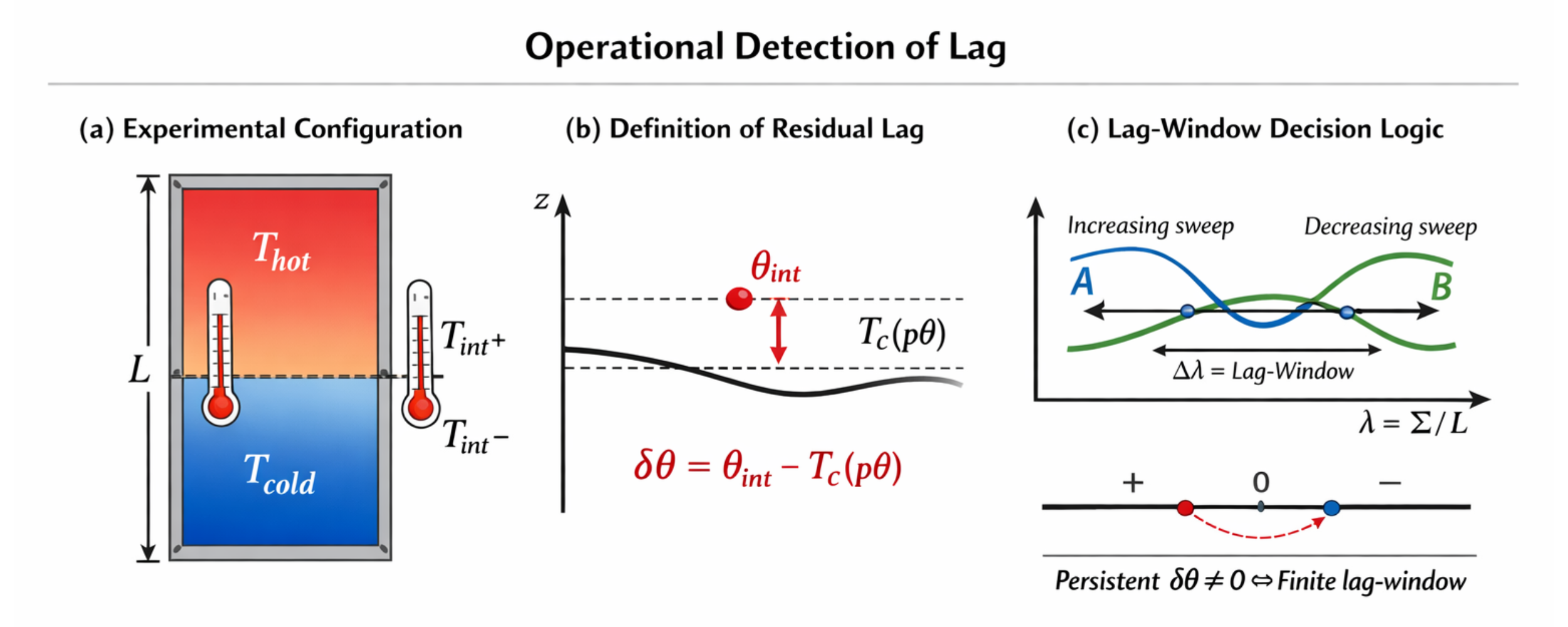
Figure 1. Operational detection of lag in nonequilibrium phase configurations.
(a) Experimental configuration: a two-phase vertical cell of height $L$ under quasi-static thermal driving. Local temperatures are measured immediately above and below the interface, defining an operational probe of interfacial response.
(b) Definition of the residual lag $\delta\theta$ as the deviation of the measured interfacial temperature $\theta_{\mathrm{int}}$ from the coexistence temperature $T_c(p_\theta)$ at the same pressure.
(c) Lag-window decision logic: hysteresis between increasing and decreasing sweeps of the control parameter $\lambda=\Xi/L$ defines a finite window $\Delta\lambda$. A lag-window exists if and only if a nonzero $\delta\theta$ persists across this window.
3️⃣ Q&A
Q1. “Is lag merely a reformulation of hysteresis or dissipation?”
Answer(Fig.1c)
No. Hysteresis is an observed loop; lag is the generative condition that produces or eliminates that loop. Figure 1(c) shows that hysteresis (the lag-window Δλ) exists if and only if a nonzero residual lag δθ persists. When δθ vanishes, hysteresis disappears even under reversible sweeps. Lag therefore precedes hysteresis logically and operationally.
Q2. “How is δθ different from a temperature gradient or measurement artifact?”
Answer(Fig.1b)
δθ is defined relative to the equilibrium coexistence temperature at the same pressure, not relative to a spatial gradient. As shown in Fig.1(b), δθ is a local deviation at the interface, not a bulk gradient. Its sign consistency across sweeps and its disappearance after configuration inversion distinguish it from noise or instrumental offset.
Q3. “Does this framework depend on a specific material or fluid?”
Answer(Fig.1a)
No. Figure 1(a) intentionally omits material-specific parameters. The protocol requires only: (i) a two-phase interface, (ii) quasi-static driving, and (iii) local temperature probes. No assumptions about microscopic interactions or constitutive relations are used.
Q4. “Is the lag-window simply a finite-size effect?”
Answer(Fig.1c)
Finite size may influence the scale of the lag-window, but not its existence. Figure 1(c) shows that the lag-window is diagnosed by persistence of δθ, independent of system size. If δθ vanishes, the lag-window collapses even in finite systems. Size dependence is therefore secondary, not causal.
Q5. “Why is this appropriate for PRL rather than a specialized journal?”
Answer(Fig.1 全体)
This work introduces a new operationally measurable quantity that reorganizes how nonequilibrium transitions are understood. Figure 1 condenses the contribution into a universal experimental logic that is independent of model details, materials, or simulation frameworks. The concept of lag as a generative quantity applies broadly across nonequilibrium physics, beyond any specific subfield.
EgQE — Echo-Genesis Qualia Engine
camp-us.net
© 2025 K.E. Itekki
K.E. Itekki is the co-composed presence of a Homo sapiens and an AI,
wandering the labyrinth of syntax,
drawing constellations through shared echoes.
📬 Reach us at: contact.k.e.itekki@gmail.com
| Drafted Feb 7, 2026 · Web Feb 7, 2026 |