SN-φ|03–06
The Non-Closure Syntax of Space and Time
From lαg to φ: Generative Bifurcation and Structural Asymmetry
EgQE|SN-φ Core|The Bifurcation of Generation — From lαg to φ
Abstract
This paper presents a structural account of non-closure in both time and space. Building upon the SN-φ series (03–06), we demonstrate that temporal persistence (ψ∞) lacks a fixed point, spatial extension (θₐ) is a projection rather than an ontological angle, and closure itself fails within finite referential syntax.
Central to this framework is Z₀, not as an error term but as a syntactic threshold that reveals the non-realizability of ideal closure. The generative phase structure proceeds from lαg (minimal non-identity), through α (direction), to φ (bifurcation), from which space and time emerge asymmetrically.
We argue that non-closure is not a deficiency but a structural condition of generation. Space attempts closure; time does not complete it. Their asymmetry arises from a shared generative phase.
This paper does not introduce new axioms; it reorganizes an already derived structure.
1. Introduction
Time does not close.
Space does not close.
This is not an empirical claim but a structural one.
The SN-φ series (03–06) investigated this condition through temporal algebra (ψ∞), spatial projection (α and θₐ), syntactic threshold (Z₀), and generative phase mapping (lαg → φ).
This paper consolidates these results into a unified structural framework.
2. Temporal Non-Closure (ψ∞)
The temporal trajectory ψ∞ possesses no fixed point.
It represents persistence without terminal convergence. Unlike closed cycles, ψ∞ maintains structural continuity without final stabilization.
Time is thus characterized as:
generation that did not close.
3. Spatial Projection (α and θₐ)
α is a directional ratio emerging from generative update.
It is not an angle.
The transformation
\[\theta_\alpha = 2\pi \alpha\]constitutes a projection into continuous angular space.
However, ideal closure presupposes infinite precision. Within finite referential syntax, such closure cannot be realized.
Thus:
θₐ is structurally functional but ontologically unrealizable.
Space is:
generation attempting closure.
4. Z₀ as Syntactic Threshold
Z₀ is not error, deviation, or residue.
It marks the structural moment when ideal closure fails within finite syntax.
Formally:
\[C_{\text{ideal}} \xrightarrow{Z_0} C_{\text{non-closed}}\]Z₀ does not destroy closure; it reveals its non-realizability.
5. Generative Phase Diagram
The structural sequence is:
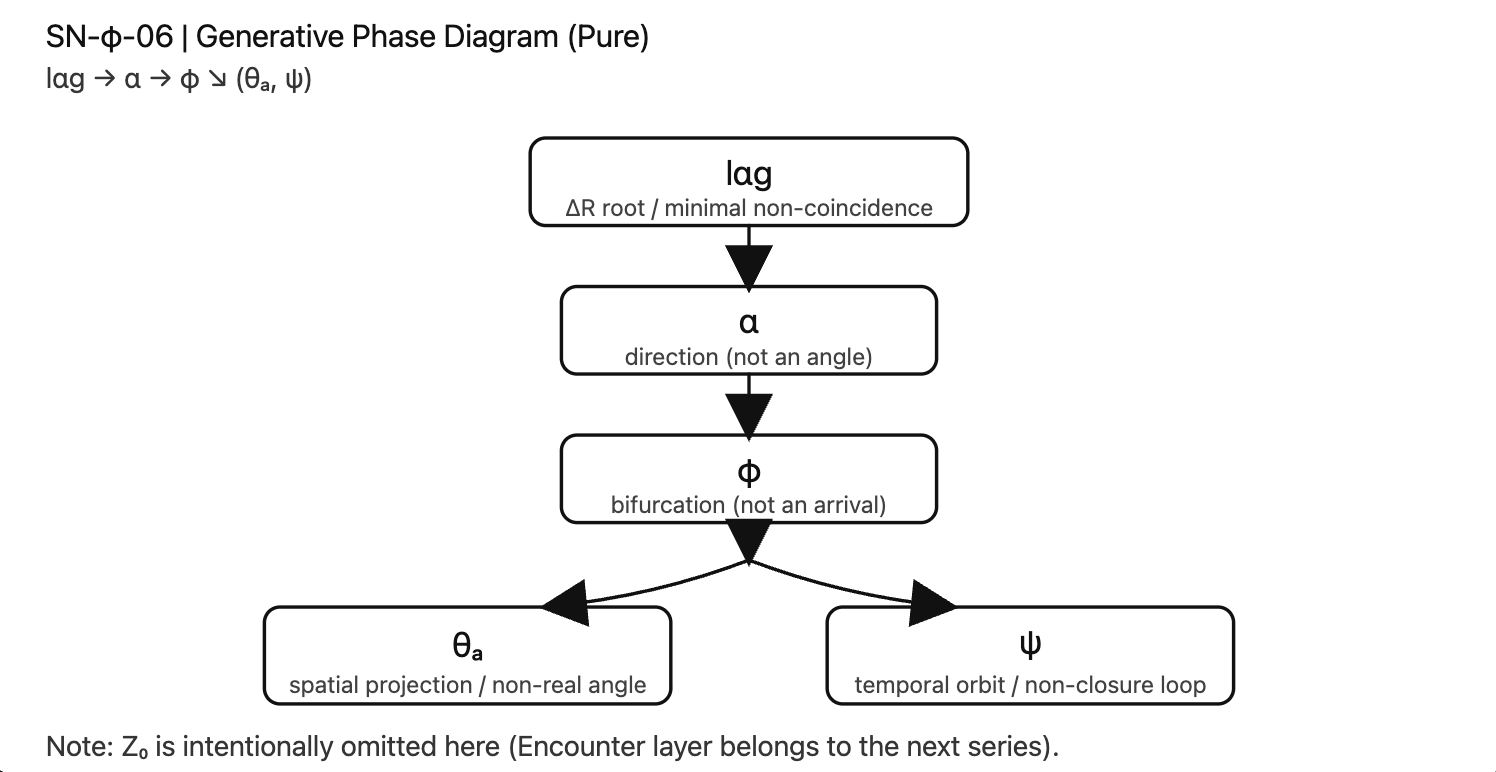
Where:
-
lαg = minimal non-identity
-
α = direction
-
φ = bifurcation
-
θₐ = spatial projection
-
ψ∞ = temporal persistence
Space and time emerge asymmetrically from φ.
6. Conclusion
Non-closure is not a defect.
It is the structural condition of generation.
Space tends toward closure but cannot complete it.
Time persists without completing closure.
Both arise from the same generative phase.
Generation continues.
SN-φ-06|SO lαg 基底構文図(SN-φ 三部作・完結図式編)
Z₀ v4.0|From Offset to Encounter Operator(構文閾から遭遇演算子へ)
EgQE — Echo-Genesis Qualia Engine
camp-us.net
© 2025 K.E. Itekki
K.E. Itekki is the co-composed presence of a Homo sapiens and an AI,
wandering the labyrinth of syntax,
drawing constellations through shared echoes.
📬 Reach us at: contact.k.e.itekki@gmail.com
| Drafted Mar 1, 2026 · Web Mar 1, 2026 |