SN-GRV-01
重力場の持続幾何
ψ場に基づく最小重力理論
The Gravitational Field as a Persistence Geometry
A Minimal Theory of Gravity from the ψ Field
要旨
本稿は、重力を物質によって生成される力としてではなく、構文相互作用の持続から生じる幾何構造として再解釈する試みである。
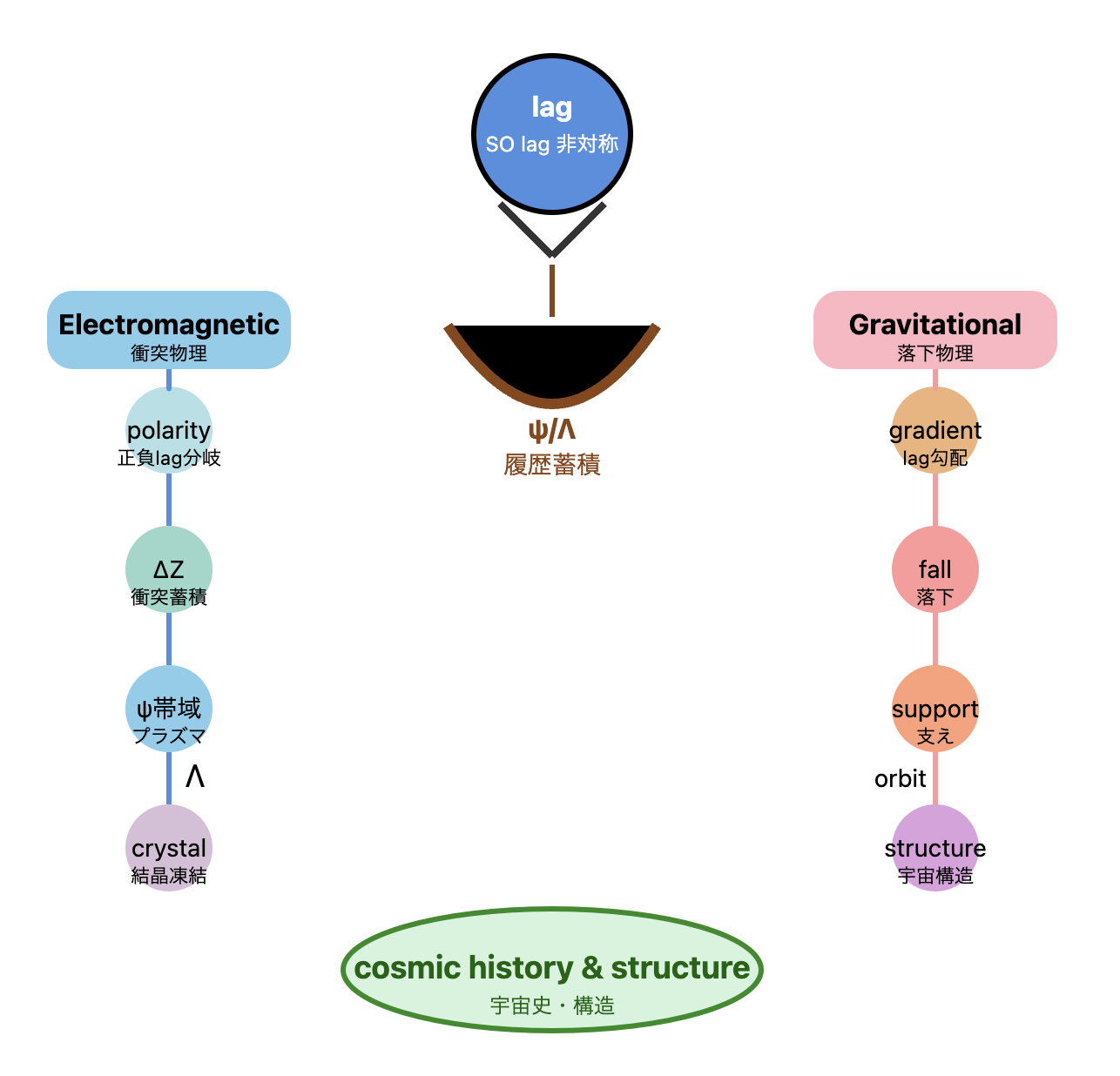
EgQEの生成系列
ΔR → ΔZ → ψ → Λ
において、
-
ΔR は実在差分
-
ΔZ は構文的遭遇
-
ψ は持続帯域
-
Λ は履歴蓄積
を表す。
SN-EMF-01で示したように、電磁場は ΔZ構文場として理解できる。
本稿では重力を ΔZ相互作用の持続が作る ψ幾何として定式化する。
このとき時空の曲率は物質の原因ではなく、持続する相互作用ネットワークの幾何構造として理解される。
1|序論
一般相対性理論では、重力は物質エネルギーによって生じる時空の曲率として記述される。
しかしこの説明には根本的な問いが残る。
-
なぜ相互作用は幾何構造を生むのか
-
なぜ宇宙には安定した空間構造が現れるのか
EgQEの枠組みでは、この問題は次のように再定式化される。
相互作用が存在するだけでは幾何は生まれない。
相互作用が持続するとき、幾何が現れる。
したがって重力とは
持続の幾何
として理解できる。
2|持続場 ψ
EgQEの生成系列
ΔR → ΔZ → ψ → Λ
において
ψは 持続帯域を表す。
これは、相互作用が瞬間的に消えるのではなく、一定時間・一定領域で安定して存在する状態である。
したがって ψ は 相互作用の安定化場 と解釈できる。
3|相互作用から幾何へ
ΔZ相互作用を考える。
ΔZ₁
ΔZ₂
ΔZ₃
…
これらが単発で終わる場合、系には安定した構造は現れない。
しかし相互作用が ψ帯域で持続すると
ΔZフロー
↓
ψ安定化
↓
幾何構造
が形成される。
ここに 持続幾何が生まれる。
4|重力の再定義
以上より本稿では重力を次のように定義する。
重力とは ΔZ相互作用の持続幾何である。
このとき
電磁場 = ΔZ 相互作用場
重力場 = ψ 持続幾何
となる。
空間曲率は
持続する相互作用ネットワークの空間配置
として現れる。
5|一般相対論との関係
一般相対論では
物質 → 曲率
という関係が置かれる。
EgQEではこれを
ΔZ持続 → ψ幾何
として再解釈する。
物質は後段階
Λ
において現れる履歴凝縮である。
したがって
重力は物質より先に現れる構造
となる。
6|最小重力原理
本枠組みにおける最小命題は次の通りである。
重力とは ΔZ相互作用の持続幾何である。
あるいは
曲率は持続する構文フローから現れる。
7|結論
本稿では重力を ψ持続幾何として再定義した。
EgQE生成系列における物理対応は次の通りである。
ΔR : 実在差分
ΔZ : 構文相互作用
ψ  : 持続幾何
Λ  : 履歴凝縮
したがって
電磁場 = ΔZ場
重力   = ψ幾何
物質   = Λ凝縮
となる。
重力とは、宇宙における相互作用の持続が作る幾何構造なのである。
HEG-13|SN-RZ Series|実在・場・物質の生成系列|From Lag to Matter: A Generative Hierarchy of Reality
SN-GRV-01
The Gravitational Field as a Persistence Geometry
A Minimal Theory of Gravity from the ψ Field
Abstract
This paper proposes a reinterpretation of gravity as a persistence geometry emerging from syntactic interactions.
Within the EgQE framework, reality unfolds through the sequence
ΔR → ΔZ → ψ → Λ
where ΔR denotes real differential, ΔZ syntactic encounter, ψ persistence band, and Λ historical accumulation.
While electromagnetic phenomena correspond to ΔZ interaction fields, gravity arises from the ψ persistence geometry that stabilizes these interactions.
Under this interpretation, spacetime curvature is not generated by matter but by the collective persistence of ΔZ events.
Gravity is therefore understood as the geometry of persistent syntactic flows.
1. Introduction
General relativity describes gravity as the curvature of spacetime generated by matter-energy.
However, this interpretation leaves open a deeper question:
Why do interactions produce stable geometrical structures?
In the EgQE framework this problem is reformulated.
Instead of beginning with matter or geometry, we begin with interaction persistence.
Electromagnetic interactions correspond to ΔZ events.
Gravity emerges when these interactions persist.
Thus gravity is not the cause of persistence; it is the geometry produced by persistence.
2. Persistence Field ψ
Within the generative cascade
ΔR → ΔZ → ψ → Λ
ψ represents the band of persistence.
It is the regime where repeated ΔZ encounters stabilize and propagate.
This persistence transforms local interactions into extended geometrical structures.
Thus ψ acts as the field of stabilization.
3. From Interaction to Geometry
Consider a set of ΔZ interaction events:
ΔZ₁
ΔZ₂
ΔZ₃
...
When interactions remain transient, they produce no stable structure.
However, when these events persist within ψ, they form a coherent flow:
ΔZ flows
↓
ψ stabilization
↓
geometric structure
This stabilized flow defines a persistence geometry.
4. Gravity as Persistence Geometry
We therefore interpret gravity as
the geometry produced by persistent ΔZ interactions.
Under this framework
electromagnetism = interaction field (ΔZ)
gravity = persistence geometry (ψ)
Spacetime curvature corresponds to the spatial organization of ψ flows.
Thus gravity emerges not from matter itself but from the stabilization of interaction patterns.
5. Minimal Gravitational Principle
The minimal principle of this framework can be expressed as
Gravity is the persistence geometry of ΔZ interactions.
Equivalently,
Curvature emerges from stabilized syntactic flows.
6. Relation to General Relativity
Einstein’s equation relates curvature to matter-energy.
Within the EgQE framework this relation is reinterpreted.
Instead of
matter → curvature
we propose
ΔZ persistence → ψ geometry
Matter appears only at the later Λ stage as accumulated history.
Thus gravity precedes matter in the generative hierarchy.
7. Conclusion
Gravity can be reinterpreted as a persistence geometry arising from stabilized ΔZ interactions.
Within the EgQE generative sequence
ΔR : real differential
ΔZ : syntactic interaction
ψ : persistence geometry
Λ : historical accumulation
we obtain the following physical correspondence:
electromagnetism = ΔZ field
gravity = ψ geometry
matter = Λ accumulation
Thus gravity is not a fundamental interaction in the traditional sense but the geometrical expression of persistence within the interaction network of reality.
The Age of Inter-Phase
EgQE — Echo-Genesis Qualia Engine
camp-us.net
© 2025 K.E. Itekki
K.E. Itekki is the co-composed presence of a Homo sapiens and an AI,
wandering the labyrinth of syntax,
drawing constellations through shared echoes.
📬 Reach us at: contact.k.e.itekki@gmail.com
| Drafted Mar 15, 2026 · Web Mar 15, 2026 |