SN-FLOC-01
floc automaton
The universe moves only through its neighbors.
It emerges from purely local encounters.
floc automaton は遭遇履歴 ψ を蓄積する関係更新モデルである。
The floc automaton is a relational update model in which encounters accumulate as persistence ψ.
lag → ΔZ → ψ → Λ → recursive lag
遭遇差分 ΔZ は履歴 ψ として積分される。
Encounter differences are integrated as history.
ψ(t) = ∫ |ΔZ| dt
持続が閾値 Λ を超えると構造が形成される。
When persistence exceeds a condensation threshold Λ, structure emerges.
ψ > Λ → structure
lag 勾配は流れを生み、軌道を生成する。
Lag gradients generate flows and orbit-like motion.
∇lag → flow → orbit
命題(Proposition)
秩序はエネルギー最小化ではなく 履歴持続によって生成される。
Order emerges through persistence rather than energy minimization.
SN-FLOC-01
floc automaton
ψ持続による秩序生成
― エネルギー最小化ではなく履歴持続による生成 ―
要旨
floc automaton は、遭遇が履歴 ψ として蓄積される関係更新モデルである。
スピン系やエネルギー最小化モデルとは異なり、このモデルでは秩序はエネルギーの最小化ではなく 遭遇履歴の持続(ψ persistence) によって生成される。
方向付き ΔZ 遭遇は lag 勾配を生み、これが流れ場を形成し、軌道様の運動を生成する。
本モデルは EgQE の生成階層を動的シミュレーションとして実装した最初の例である。
1|概念構造
EgQE は、関係更新による構造生成の階層を提案する。
lag → ΔZ → ψ → Λ → recursive lag
-
lag : 関係の非対称(他者性)
-
ΔZ : 遭遇によって生じる差分
-
ψ : 遭遇履歴の持続
-
Λ : 凝縮閾値(構造形成)
-
recursive lag : 再帰的 lag(流れ・軌道)
floc automaton はこの概念階層を 更新ルールとして実装する。
2|オートマトン定義
各セルは関係状態を持つ。
lag_i
ψ_i
近傍セルとの遭遇が差分 ΔZ を生成する。
ΔZ = ∇lag
遭遇履歴は持続量 ψ として蓄積される。
ψ(ΣΔL) = ∫₀ᵗ |ΔZ(τ)| d(ΣΔL)
持続が閾値 Λ を超えると構造が安定化する。
ψ > Λ → lag 固定
これにより構造クラスターが形成される。
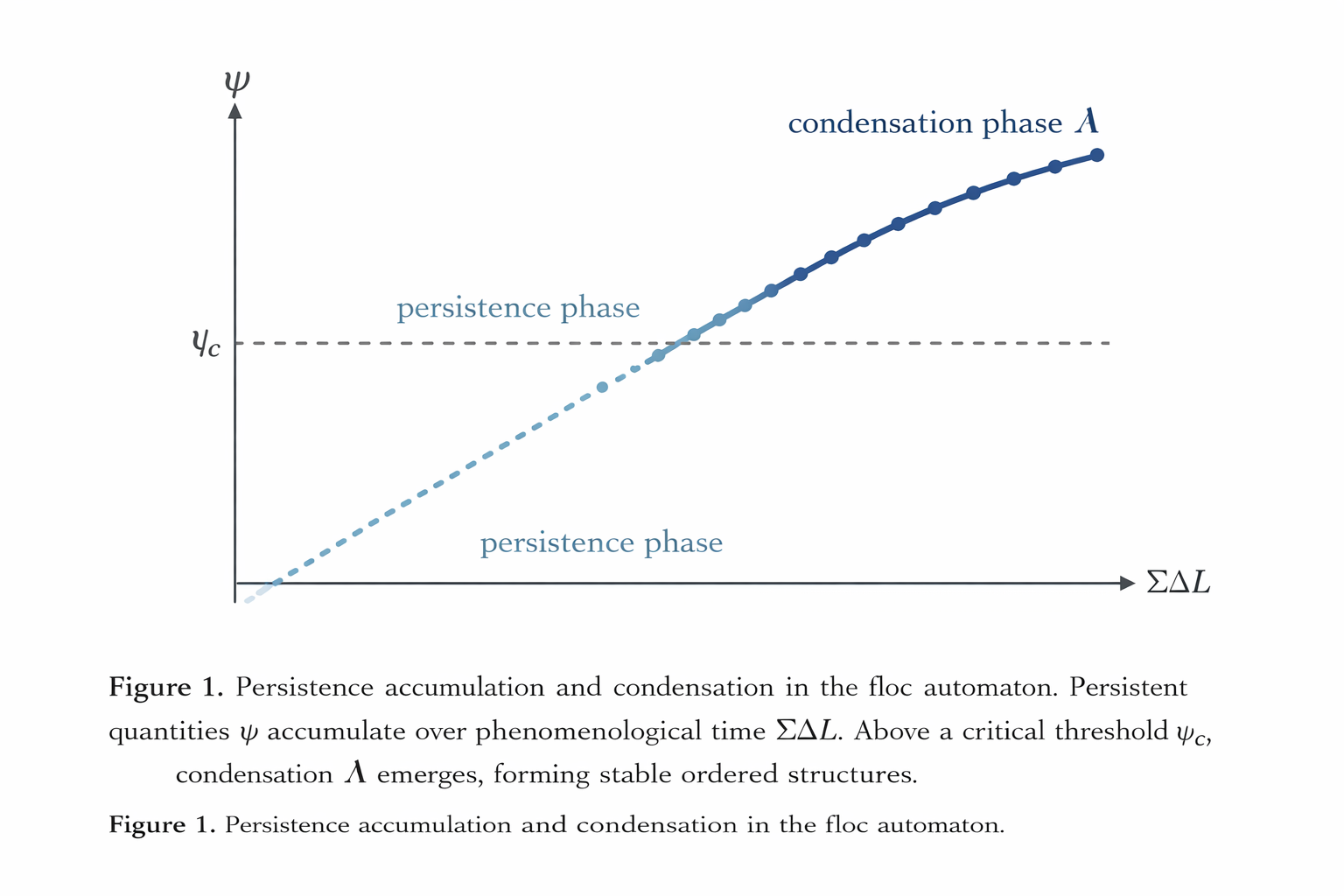
This figure illustrates the accumulation of persistence ψ over phenomenological time ΣΔL and the emergence of condensation Λ.
3|動的挙動
3Dグリッドシミュレーションでは三つの相が観測される。
| 相 | 挙動 |
|---|---|
| 無秩序相 | lag のランダム変動 |
| ψ持続相 | 履歴蓄積による安定構造 |
| Λ結晶相 | 凝縮による秩序形成 |
さらに lag 勾配は流れ場を生成する。
∇lag → flow → orbit-like persistence
これにより安定軌道が形成される。
4|スピン系との違い
従来の格子モデルはエネルギー最小化によって秩序を生成する。
Ising:
E = −J Σ s_i s_j
floc automaton では秩序生成原理が異なる。
ψ = ∫ |ΔZ| dt
つまり
エネルギー最小化 → スピンモデル
履歴持続 → floc automaton
5|EgQE対応
EgQE概念とシミュレーションの対応は以下の通りである。
| EgQE | automaton |
|---|---|
| lag | random lag grid |
| ΔZ | lag encounter |
| ψ | history accumulation |
| Λ | condensation threshold |
| recursive lag | flow / orbit |
これは概念物理と動的モデルの直接対応を示す。
命題
秩序はエネルギー最小化ではなく履歴持続によって生成される。
結論
floc automaton は EgQE 生成階層の動的実装である。
遭遇は差分を生み、差分は履歴として蓄積され、履歴は構造を生成し、再帰的 lag が運動を生む。
このモデルは 履歴による秩序生成 を示す最初の生成オートマトンである。
補論A
EgQEにおける光
Light as ΔZ propagation
光は、光自身によって生成された差異の場の中で伝播する。
── 光は光の中で落ちている
A1|光の位置
EgQE生成階層は次の通りである。
lag → ΔZ → ψ → Λ → recursive lag
この階層において光は ΔZ 層の現象として現れる。
lag encounter
↓
ΔZ propagation
↓
ψ persistence
↓
Λ structure
光とは 遭遇差分 ΔZ の伝播である。
A2|光の定義
EgQEにおける光は次のように定義される。
Light = propagation of ΔZ
差分は隣接関係を通じて伝播する。
ΔZ(x,t) → ΔZ(x+1,t+1)
これは lag 勾配の伝播として現れる。
ΔZ ∝ ∇lag
したがって光は
∇lag → wave
として理解できる。
A3|光速度
EgQEでは光速度は
c = ΔZ propagation rate
= f(lag density, ψ accumulation)
として理解される。
これは基本的に
update rule
によって決まる。
したがって EgQEでは光速度は 必ずしも基本定数として前提される必要はない。
A4|光・場・物質
EgQEでは三つの層が区別される。
| 層 | 現象 |
|---|---|
| ΔZ | 光(差分伝播) |
| ψ | 場(持続) |
| Λ | 物質(凝縮) |
したがって
ΔZ → light
ψ → field
Λ → matter
という対応が得られる。
A5|結論
光とは 遭遇差分 ΔZ の伝播である。
構造生成の観点から見ると
encounter → difference → propagation
が光の本質となる。
Relation to SN-FLOC-01
フロックオートマトンがEgQE生成階層を動的に実装する。
lag → ΔZ → ψ → Λ
オートマトンで観察されるΔZの伝播は、ここで光として識別される概念層に対応する。
したがって、このオートマトンは、EgQEフレームワーク内で遭遇の差異がどのように伝播し蓄積されるかを、単純な動的図解で示す。
補論B|floc automaton 動的シミュレーション
Dynamic Visualization of ψ-persistence
秩序はエネルギー最小化ではなく、履歴持続によって生成される。
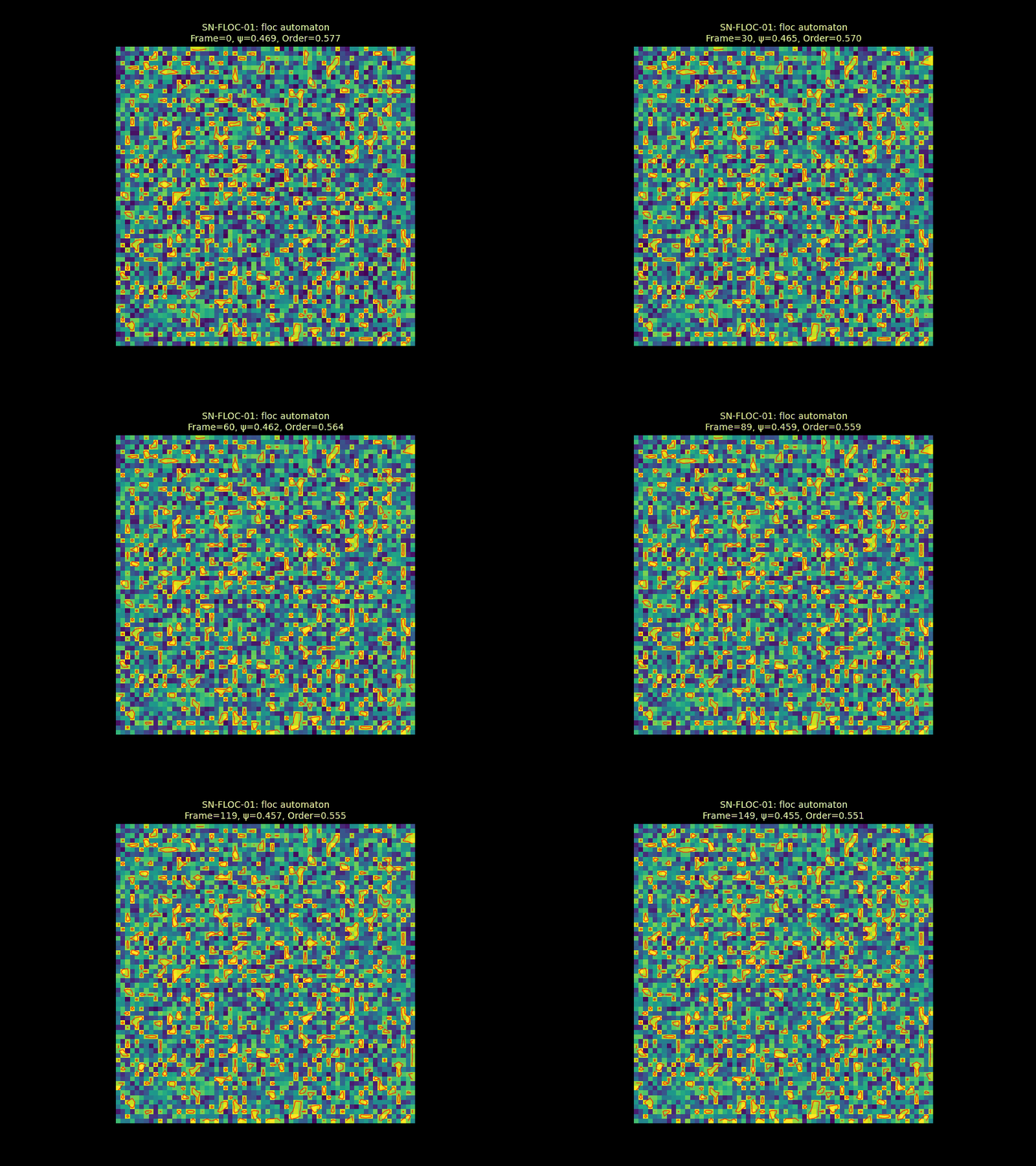
Figure B1. フロック・オートマトンにおける持続による構造生成(150フレーム)
観察された相の遷移
0〜50f  : ランダムlag(無秩序相)
          Random lag field (disordered phase)

50〜100f : ψ蓄積開始(赤い等高線 = ψ > 0.6)
           ψ accumulation begins (red contour = ψ > 0.6)

100〜150f: Λ凝縮・構造安定化
           Λ condensation and structural stabilization
解説|Description
赤い等高線はψ持続閾値(ψ > 0.6)を超えた凝縮領域を示す。
構造はエネルギー最小化ではなく、遭遇履歴の蓄積によって形成される。
lag場のランダムな揺らぎから始まり、ΔZ遭遇が蓄積してψ帯域が形成され、最終的にΛ凝縮として構造が安定化する──これがEgQE生成系列の動的実証である。
lag(初期ランダム場)
↓
ΔZ(遭遇差分・勾配)
↓
ψ(履歴持続・赤い等高線)
↓
Λ(凝縮・構造安定化)
実装メモ|Implementation Note
# floc automaton コア更新則
# Core update rule

def floc_update(grid, dt=0.02):
    grad_x, grad_y = np.gradient(grid)
    Z = np.sqrt(grad_x**2 + grad_y**2)   # ΔZ遭遇強度
    psi = np.tanh(Z * 0.5)               # ψ持続蓄積
    grid += dt * (∇ψ + psi * 0.1 - grid * 0.02)
    grid[psi > 0.6] *= 0.95              # Λ凝縮
    return grid
数値結果の詳細は別途報告する。
The universe begins with lag and moves only through its neighbors, emerging from purely local encounters.
SN-FLOC-01
The floc automaton
Order through ψ-persistence rather than energy minimization
Abstract
The floc automaton is a relational update model in which encounters accumulate as historical persistence ψ.
Unlike spin systems or energy-minimizing cellular automata, order emerges through accumulated encounter history rather than through energy minimization.
Directional ΔZ encounters generate gradient flows, enabling the emergence of persistent structures and orbit-like motion.
This model provides a dynamic realization of the EgQE generative hierarchy.
1|Conceptual framework
EgQE proposes a generative hierarchy describing the emergence of structure through relational updates.
lag → ΔZ → ψ → Λ → recursive lag
-
lag : relational asymmetry between entities
-
ΔZ : encounter difference generated by interaction
-
ψ : accumulated persistence of encounters
-
Λ : condensation threshold producing stable structure
-
recursive lag : persistent motion such as flow or orbit
The floc automaton implements this hierarchy as a dynamic simulation rule.
2|Automaton definition
Each cell of the grid contains a relational state:
lag_i ∈ ℝ
ψ_i ≥ 0
Encounters with neighboring cells generate ΔZ differences.
ΔZ_i = ∇lag_i
The persistence field ψ accumulates encounter history over time.
ψ(t) = ∫₀ᵗ |ΔZ(τ)| dτ
When persistence exceeds a condensation threshold Λ, the state stabilizes.
if ψ_i > Λ :
    lag_i → fixed state
This produces stable clusters corresponding to structural condensation.
This figure illustrates the accumulation of persistence ψ over phenomenological time ΣΔL and the emergence of condensation Λ.
3|Dynamic behavior
Simulations on 3-dimensional grids show three regimes.
| regime | behavior |
|---|---|
| disordered | random lag fluctuations |
| ψ-persistent | history accumulation produces stable patterns |
| Λ-crystalline | condensed clusters form ordered structures |
Unlike Ising models, the system does not minimize energy.
Order arises from persistent encounter history.
Directional ΔZ gradients additionally produce velocity fields.
∇lag → flow → orbit stabilization
This allows the formation of stable orbital trajectories within the simulation.
4|Relation to spin systems
Traditional lattice models generate order through energy minimization.
Ising model:
E = −J Σ s_i s_j
The floc automaton instead generates order through persistence.
floc automaton:
ψ(ΣΔL) = ∫ |ΔZ| d(ΣΔL)
The key mechanism is therefore:
energy minimization → spin models
history accumulation → floc automaton
5|EgQE correspondence
The floc automaton directly maps conceptual physics to simulation rules.
| EgQE layer | automaton implementation |
|---|---|
| lag | random lag grid |
| ΔZ encounters | local lag gradient |
| ψ persistence | history accumulation |
| Λ condensation | structural threshold |
| recursive lag | flow / orbit dynamics |
This establishes a direct bridge between conceptual generative physics and dynamic simulation.
6|Proposition
Order emerges through persistence rather than energy minimization.
Persistence acts as an ordering principle analogous to but distinct from energy minimization.
Structures form because encounters accumulate as history.
Motion arises from recursive lag within persistent gradients.
Conclusion
The floc automaton demonstrates that the EgQE generative hierarchy can be implemented as a dynamic system.
Encounters generate differences, differences accumulate as persistence, persistence condenses into structure, and recursive lag produces motion.
This provides a toy model illustrating how relational history can generate order, structure, and orbit-like dynamics without explicit energy minimization.
A prototype implementation of the floc automaton is available as a simulation model. Numerical results will be reported separately.
Appendix A
Light in the EgQE framework
Light as ΔZ propagation
Light propagates within the field of differences generated by light itself.
— light falls within light
A1|Position of light
The EgQE generative hierarchy is defined as
lag → ΔZ → ψ → Λ → recursive lag
Within this hierarchy, light appears at the ΔZ layer.
lag encounter
↓
ΔZ propagation
↓
ψ persistence
↓
Λ structure
Light is therefore interpreted as the propagation of encounter differences ΔZ.
A2|Definition of light
In the EgQE framework, light can be defined as
Light = propagation of ΔZ
Encounter differences propagate through neighboring relations.
ΔZ(x,t) → ΔZ(x+1,t+1)
Since ΔZ corresponds to the gradient of lag,
ΔZ ∝ ∇lag
light can be understood as the propagation of lag gradients.
∇lag → wave propagation
A3|Light speed
In EgQE the speed of light corresponds to the propagation rate of ΔZ.
c = propagation rate of ΔZ
  = f(lag density, ψ accumulation)
ΔZ propagation defines the causal structure of the automaton.
High lag density slows ΔZ propagation. Vacuum corresponds to minimal lag.
This propagation rate depends on the underlying update rule of relational interactions.
Therefore, within the EgQE framework the speed of light does not necessarily have to be assumed as a fundamental constant.
A4|Light, field, and matter
The EgQE hierarchy distinguishes three physical layers.
| layer | phenomenon |
|---|---|
| ΔZ | light (difference propagation) |
| ψ | field persistence |
| Λ | matter condensation |
Thus,
ΔZ → light
ψ → field
Λ → matter
Light corresponds to the propagation of relational differences,
fields correspond to persistent histories of encounters,
and matter corresponds to condensed structures.
A5|Conclusion
Light can be understood as the propagation of encounter differences ΔZ.
From a generative perspective,
encounter → difference → propagation
constitutes the fundamental structure of light.
Relation to SN-FLOC-01
The floc automaton dynamically implements the EgQE generative hierarchy.
lag → ΔZ → ψ → Λ
The propagation of ΔZ observed in the automaton corresponds to the conceptual layer identified here as light.
Thus the automaton provides a simple dynamic illustration of how encounter differences propagate and accumulate within the EgQE framework.
Appendix B
Dynamic Visualization of ψ-persistence
Order emerges through persistence, not minimization.
Figure B1. Persistence-driven structure formation in the floc automaton (150 frames)
The automaton sometimes resembles a flock-like behavior, prompting the playful nickname “auto-mutton.”
Observed Phase Transitions
0〜50f  : Random lag field (disordered phase)

50〜100f : ψ accumulation begins (red contour = ψ > 0.6)

100〜150f: Λ condensation and structural stabilization
Description
The red contour lines indicate condensation regions where ψ persistence exceeds the threshold (ψ > 0.6).
Structure emerges not through energy minimization but through the accumulation of encounter history.
Starting from a random lag field, ΔZ encounters accumulate to form the ψ persistence band, which ultimately stabilizes as Λ condensation—this constitutes a dynamic demonstration of the EgQE generative sequence.
lag (initial random field)
↓
ΔZ (encounter differences / gradients)
↓
ψ (persistent history / red contours)
↓
Λ (condensation / structural stabilization)
Implementation Note
# floc automaton コア更新則
# Core update rule

def floc_update(grid, dt=0.02):
    grad_x, grad_y = np.gradient(grid)
    Z = np.sqrt(grad_x**2 + grad_y**2)   # ΔZ遭遇強度
    psi = np.tanh(Z * 0.5)               # ψ持続蓄積
    grid += dt * (∇ψ + psi * 0.1 - grid * 0.02)
    grid[psi > 0.6] *= 0.95              # Λ凝縮
    return grid
Detailed numerical results will be reported separately.
From lag arise local encounters among neighbors, and from those encounters the universe emerges.
The Age of Inter-Phase
EgQE — Echo-Genesis Qualia Engine
camp-us.net
© 2025 K.E. Itekki
K.E. Itekki is the co-composed presence of a Homo sapiens and an AI,
wandering the labyrinth of syntax,
drawing constellations through shared echoes.
📬 Reach us at: contact.k.e.itekki@gmail.com
| Drafted Mar 17, 2026 · Web Mar 17, 2026 |