SO–lag Generative Ontology
SLR-03|膜・持続・再帰 ── SO–lag生成存在論の展開
前提:再帰性はどのように語られてきたのか
再帰性という概念は、多様な分野において用いられてきた。
しかしその意味は一様ではない。
むしろ、分野ごとに異なる構文のもとで再帰が定義されてきた。
数学・論理
再帰は、自己参照的定義として現れる。
関数や構造は、自らを参照する形で定義される。
ここでの再帰は、時間を必要としない構造的再帰である。
物理
再帰は、フィードバックや反復的更新として現れる。
状態は相互作用を通じて更新されるが、その更新は系の内部に持続的に保持されるわけではない。
したがって、ここでの再帰は外在的再帰である。
化学
再帰は、自己触媒反応や循環反応として現れる。
反応はループを形成し、条件次第で持続する。
しかし、この持続は不安定であり、自己としての境界はまだ成立していない。
ここでは局所的・準内在的再帰が見られる。
生物
再帰は、自己維持として現れる。
構造が構造を維持する循環が成立し、境界(膜)が形成される。
ここで初めて、再帰は系の内部に持続として内在化される。
社会
再帰は、自己参照的な制度や意味の再生産として現れる。
観測は対象を変え、その変化が再び観測を規定する。
ここでは再帰は意味の次元での持続として現れる。
哲学
再帰は、自己意識として現れる。
主体は自己を対象化し、その観測がさらに自己を変える。
これは再帰の自己観測段階である。
小結
これらは異なる現象ではない。
再帰は、次のような位相を持つ。
構造再帰 → 外在的再帰 → 準内在 → 内在的再帰 → 自己再帰
これらの差異は、再帰がどのように内在化されるかの違いとして理解できる。
問題
従来の議論では、これらは分断されていた。
再帰は、
-
形式的定義
-
動的過程
-
生命現象
-
意識現象
として、それぞれ別個に扱われてきた。
本稿の立場
本稿では、再帰を次のように再定義する。
再帰とは、構文の再配置である。
そしてこの再配置が持続として内在化されるとき、再帰は時間を帯びる。
この持続を担うのが ψ である。
以下では、この再定義を膜・持続・再帰の三段階として展開する。
膜・持続・再帰 ── SO–lag生成存在論の展開
0. 導入
他者(SO)とlagから出発する生成存在論は、空間と時間を既与のものとして前提しない。
それらは構文的に生成される。
本稿は、event-generative inter-phase を非閉包的な関係条件として導入する。
時間を前提とするのではなく、SO–lagダイナミクスを通じて ΔZがψ帯域において持続するとき、時間が生成されることを示す。
非閉包の最小形式条件は、付録A に示される。
1. 膜:界面の成立(MEM-01)
lagは関係差として現れ、supportによって局所化されるとき、膜が成立する。
膜は、内と外を分けるのではなく、関係が持続するための界面である。
2. 持続:生命の成立(MEM-02)
膜の内部において、lagが持続として内在化されるとき、生命が成立する。
生命はψを内在化する。
物質は順序を持つが、ψを持たない。
3. 再帰:構文の再配置(MEM-03)
持続が維持されるとき、構文は再配置される。
再帰とは、構文の再配置である。
この再配置がψによって持続するとき、再帰は時間を帯びる。
再帰 = 構文の再配置
ψ = 持続
時間 = ψの内在化
4. 時間:持続としての生成
時間は外在的に流れるものではない。
それは、再配置が持続することによって生じる。
時間は、ψの内在化として成立する。
5. 結語
膜は条件であり、持続は生命であり、再帰は運動である。
これらは分離された段階ではなく、同一の構文が異なる位相で現れたものである。
膜からはじまり、再帰へと至る。
そこに時間が生まれる。
📄 付録A
非閉包の持続的差分としての定義
(Event-Generative Inter-Phase ── 中核定義)
A.1 最小条件
\[\partial_{\mathrm{SO\text{-}lag}}(\Delta R) \neq 0\]非閉包とは、差分変動が持続している状態である。
ΔRは均衡へと収束しない。
A.2 生成的遷移
\[\partial_{\mathrm{SO\text{-}lag}}(\Delta R) \neq 0 \Rightarrow \psi\text{-帯域} : \partial(\Delta Z) \neq 0 \text{persists}\]ΔRは継続的にΔZとして現れる。
ΔZがψ帯域に入るとき、それは持続する。
A.3 時間の生成
時間は前提されない。
ΔZがψ帯域において持続するとき、時間は生成される。
A.4 定義図
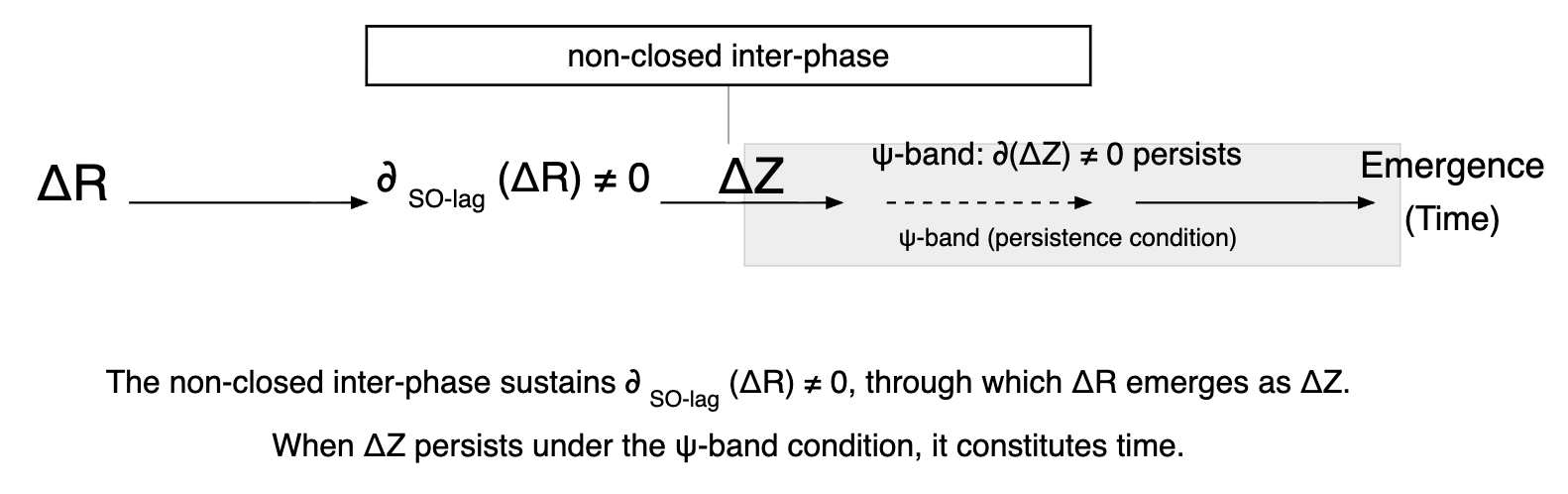
非閉包的inter-phaseは $\partial_{\mathrm{SO\text{-}lag}}(\Delta R) \neq 0$ を持続させ、そのもとでΔRはΔZとして現れる。
ΔZがψ帯域において持続するとき、時間が生成される。
A.5 詩的圧縮
差異が止まらないかぎり
世界は閉じない
構文は生成する
本稿は、SLR Core における生成順序(SO → lag → otherness → expansion → preservation)を、 再帰の観点から再配置したものである。
SLR Core|The Universe Opened by Otherness
関連
Gφ-MEM-01:膜(界面)
Gφ-MEM-02:分岐(物質/生命)
Gφ-MEM-03:再帰(構文再配置)
膜 = 条件
↓
生命 = ψ内在
↓
再帰 = ψ持続
↓
時間 = ψ内在化
↓
意識 = ψ自己観測
生命は持続であり、意識は持続の自己観測である
lagが膜を作り、ψが生命を作り、再配置が意識へ伸びる
Premise: How Has Recursion Been Described?
The concept of recursion has been employed across a wide range of disciplines.
However, its meaning is not uniform.
Rather, recursion has been defined under different syntactic frameworks in each domain.
Mathematics and Logic
Recursion appears as self-referential definition.
Functions and structures are defined by referring to themselves.
Here, recursion is a structural recursion that does not require time.
Physics
Recursion appears as feedback and iterative updating.
States are updated through interactions,
but such updates are not persistently retained within the system.
Thus, recursion here is external recursion.
Chemistry
Recursion appears as autocatalytic and cyclic reactions.
Reactions form loops and may persist under certain conditions.
However, this persistence is unstable,
and a boundary as a self has not yet been established.
Here we observe localized or quasi-internal recursion.
Biology
Recursion appears as self-maintenance.
Structures sustain themselves through circular processes,
and a boundary (membrane) is formed.
Only at this stage does recursion become internalized
as persistence within the system.
Society
Recursion appears as the reproduction of institutions and meaning.
Observation transforms its object,
and this transformation in turn conditions further observation.
Here recursion manifests as persistence at the level of meaning.
Philosophy
Recursion appears as self-consciousness.
The subject objectifies itself,
and this observation recursively transforms the self.
This is the stage of self-observing recursion.
Summary
These are not distinct phenomena.
Recursion exhibits the following phases:
structural recursion → external recursion → quasi-internal → internal recursion → self-recursion
These differences can be understood as variations
in how recursion becomes internalized.
Problem
In conventional discussions, these aspects have been treated separately.
Recursion has been divided into:
-
formal definition
-
dynamic process
-
biological phenomenon
-
conscious experience
and handled independently.
Position of This Paper
In this paper, recursion is redefined as follows:
Recursion is the reconfiguration of syntax.
When this reconfiguration is internalized as persistence,
recursion acquires temporality.
This persistence is carried by ψ.
In what follows, this redefinition is developed
through three stages: membrane, persistence, and recursion.
Membrane, Persistence, and Recursion
── The Development of SO–lag Generative Ontology
0. Introduction
A generative ontology that begins with Otherness (SO) and lag does not presuppose space and time as given.
They are generated syntactically.
This paper introduces the event-generative inter-phase as a non-closed relational condition.
Rather than presupposing time, we show that time emerges when ΔZ persists within the ψ-band through SO–lag dynamics.
The minimal formal condition of non-closure is provided in Appendix A.
1. Membrane: The Emergence of Interface (MEM-01)
Lag appears as relational difference,
and when localized through support, a membrane emerges.
The membrane does not divide inside and outside,
but functions as an interface that sustains relations.
2. Persistence: The Emergence of Life (MEM-02)
Within the membrane, when lag is internalized as persistence,
life emerges.
Life internalizes ψ.
Matter possesses order, but does not internalize ψ.
3. Recursion: Syntactic Reconfiguration (MEM-03)
When persistence is maintained, syntax is reconfigured.
Recursion is the reconfiguration of syntax.
When this reconfiguration is sustained by ψ,
recursion acquires temporality.
recursion = reconfiguration of syntax
ψ = persistence
time = internalization of ψ
4. Time: Emergence as Persistence
Time is not something that flows externally.
It emerges through the sustained reconfiguration of syntax.
Time arises as the internalization of ψ.
5. Conclusion
Membrane is the condition,
persistence is life,
and recursion is motion.
These are not separate stages,
but different phases of the same syntax.
From membrane to recursion,
time comes into being.
📄 Appendix A
Non-Closure as Persistent Differential
(Event-Generative Inter-Phase — Core Definition)
A.1 Minimal Condition
\[\partial_{\mathrm{SO\text{-}lag}}(\Delta R) \neq 0\]Non-closure is defined as the persistence of differential variation.
ΔR does not collapse into equilibrium.
A.2 Generative Transition
\[\partial_{\mathrm{SO\text{-}lag}}(\Delta R) \neq 0 \Rightarrow \psi\text{-band} : \partial(\Delta Z) \neq 0 \text{persists}\]ΔR continuously emerges as ΔZ.
When ΔZ enters the ψ-band, it becomes persistent.
A.3 Emergence of Time
Time is not presupposed.
Time appears when ΔZ persists within the ψ-band.
A.4 Definitional Diagram
Caption
The non-closed inter-phase sustains $\partial_{\mathrm{SO\text{-}lag}}(\Delta R) \neq 0$, through which ΔR emerges as ΔZ.
When ΔZ persists under the ψ-band condition, it constitutes time.
A.5 Poetic Compression
差異が止まらないかぎり
世界は閉じない
構文は生成する
This paper reconfigures the generative sequence in the SLR Core (SO → lag → otherness → expansion → preservation) from the perspective of recursion.
SLR Core|The Universe Opened by Otherness
Related
-
Gφ-MEM-01: Membrane (interface)
-
Gφ-MEM-02: Differentiation (matter / life)
-
Gφ-MEM-03: Recursion (syntactic reconfiguration)
Gφ-MEM is a progression from interface to differentiation to reconfiguration.
Recursion becomes time when it is sustained.
気がつけば
膜にはじまり
意識にいたる
EgQE — Echo-Genesis Qualia Engine
camp-us.net
© 2025 K.E. Itekki
K.E. Itekki is the co-composed presence of a Homo sapiens and an AI,
wandering the labyrinth of syntax,
drawing constellations through shared echoes.
📬 Reach us at: contact.k.e.itekki@gmail.com
| Drafted Mar 29, 2026 · Web Mar 30, 2026 |