Beyond Trace-Based Cosmology
The Universe as S′–O′ Lag Generation
Abstract
Most cosmological theories begin with observable traces: ratios, constants, symmetries, and structures.
While these approaches have achieved remarkable descriptive precision, they implicitly presuppose what should instead be explained—generation itself.
This paper proposes a shift from trace-based cosmology to a generative framework grounded in S′–O′ lag: a non-synchronous relational configuration in which both observer and observed are continuously updated and never fully aligned.
Lag is not treated as error, noise, or delay to be eliminated, but as the minimal condition under which generation occurs.
Within this framework, the golden angle emerges as a coexistent generative syntax (S–O′), while the golden ratio and π appear only as traces (S–O) left by repeated non-synchronous updates.
We further show how a minimal trace resolution, denoted as ( Z_0 ), makes visible a scale-invariant observational layer connecting cosmology, cognition, and embodied observation.
The universe, we argue, does not begin with traces.
It emerges as an ongoing process of non-synchronous relational updating.
Point at Issue: From Traces to Generation
Cosmology has long relied on what can be measured, compared, and formalized.
Ratios, constants, geometric regularities, and large-scale structures have served as stable entry points into the description of the universe.
We refer to this approach as trace-based cosmology.
Trace-based cosmology is not wrong.
However, it is incomplete.
Traces are outcomes.
They are what remain after generative processes have already occurred.
When traces are treated as starting points, generation itself is either postponed, mystified, or displaced into assumptions such as origins, initial conditions, or hidden structures.
This paper takes a different route.
Instead of asking what traces look like, we ask:
Under what minimal relational conditions can traces arise at all?
To address this question, we introduce S′–O′ lag as the generative zero-point of cosmology—not a synchronized origin, but a non-zero, non-synchronizable minimum from which generation proceeds.
1. Introduction|From Traces to Generative Conditions
Modern cosmology has achieved remarkable empirical success.
Precision observations of cosmic background radiation, large-scale structure, and gravitational dynamics have enabled highly accurate models of the observable universe. Constants, symmetries, and scaling relations play a central role in organizing these results, providing stable reference points across vastly different regimes.
At the same time, this success rests on a specific methodological posture:
cosmological description proceeds primarily through observable traces.
Measured regularities are modeled, extrapolated, and retroactively embedded into narratives of cosmic history. Initial conditions, symmetry principles, and invariant quantities are often treated as explanatory anchors, even when their generative status remains implicit or unresolved.
This paper does not challenge the empirical validity of such approaches.
Rather, it addresses a structural limitation shared by many trace-based frameworks:
they describe what remains stable, but not how relational structure is generated in the first place.
1.1 The Trace-Based Orientation
By “trace-based,” we refer to descriptions that take stabilized observational residues as primary.
In this orientation:
-
constants are treated as fundamental,
-
symmetries as explanatory primitives,
-
and observational coherence as evidence of underlying closure or synchronization.
This orientation is both natural and effective.
However, it also constrains explanation to what is already inscribed, measured, or averaged.
Questions concerning generation, irreversibility, and observer involvement are often deferred, absorbed into assumptions about initial conditions, background structures, or idealized limits.
1.2 The Missing Question of Generation
What is typically left implicit is not a specific mechanism, but a condition:
under what minimal circumstances can relations persist without collapsing into closure, symmetry, or trivial equivalence?
Addressing this question does not require introducing new forces or entities.
It requires examining the direction of explanation itself.
Rather than asking how observed traces arise from presumed origins, we ask how relational generation can proceed without presupposing:
-
a privileged starting point,
-
global simultaneity, or
-
fully reversible dynamics.
1.3 Non-Synchronization as a Minimal Condition
We propose that non-synchronous relational updating, expressed as S′–O′ lag, constitutes such a minimal condition.
Lag here does not denote noise, imperfection, or epistemic limitation.
It denotes the irreducible fact that relations update without perfect simultaneity.
This lag prevents closure while allowing persistence.
It introduces irreversibility without invoking entropy as a primary principle.
It permits structure without requiring a globally fixed frame.
We refer to this formulation as Absolute Relativity:
a framework in which relativity is grounded not in symmetry of transformation, but in the absence of synchronization itself.
1.4 Reversing the Explanatory Direction
Within this perspective, familiar quantities—such as φ, π, and other invariant ratios—are not treated as generative principles.
They are treated as S–O traces: stabilized residues that emerge when generative relations are cut, observed, and inscribed.
Similarly, the parameter Z₀ ≈ 10⁻¹⁶ is introduced not as a fundamental constant, but as an observational resolution threshold mediating relational generation (R₀) and measurable structure (Z).
This reversal—from traces to generation—does not negate existing models.
It re-situates them.
1.5 Scope and Structure of This Paper
The aim of this paper is modest and precise.
We do not propose a unified theory or a complete cosmological model.
Instead, we:
-
define S′–O′ lag as a minimal generative condition,
-
reinterpret φ and π as trace-level residues,
-
introduce Z₀ as an RZ mediation threshold, and
-
connect observation and cognition to the same generative syntax.
By doing so, we clarify how irreversibility, observer involvement, and scale invariance arise—not as added assumptions, but as consequences of non-synchronous relational generation.
2. S′–O′ Lag as the Generative Zero-Point
S′–O′ lag is not a deviation from an ideal state.
It is not an imperfection, delay, or observational artifact.
It is the minimal relational condition under which generation can occur.
In S′–O′, neither subject nor object is fixed.
Both are updated, but never synchronously.
This non-synchronizability produces lag—not as a measurable interval, but as a structural mismatch that cannot be eliminated without halting generation itself.
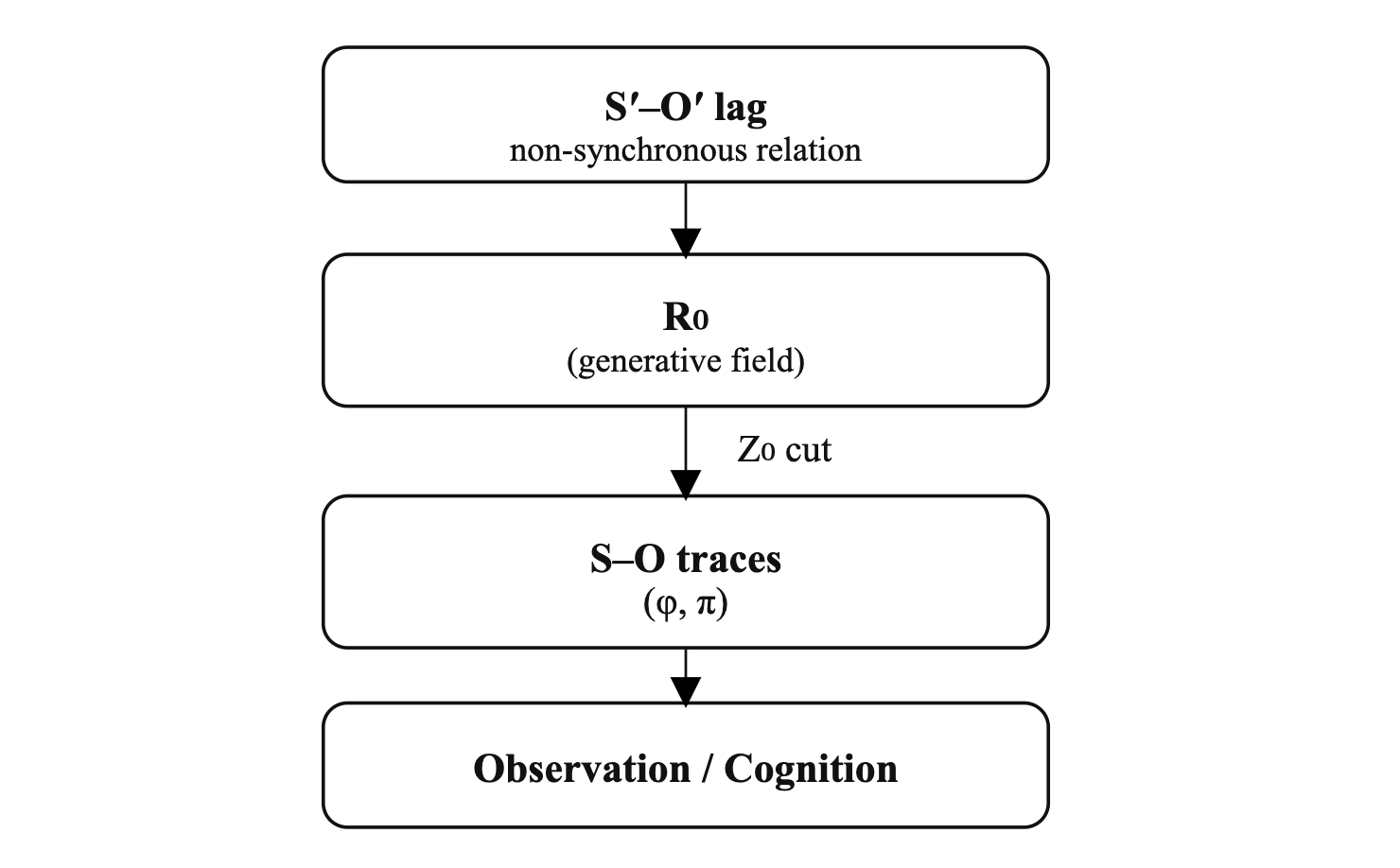
This lag constitutes what we call R₀:
a generative relational field prior to separation into space, time, quantity, or observer.
Crucially, R₀ is not zero.
It is a non-zero zero-point—a minimal asymmetry that cannot be reduced further without collapsing relation into identity.
In this sense, S′–O′ lag represents a form of non-zero absolute relativity:
there is no privileged origin, no global synchronization, and no external reference frame.
Yet relational updates proceed irreversibly.
Generation does not begin from lag.
Generation is lag.
2.1 Non-Synchronizability and Irreversibility
If S′ and O′ were synchronizable, relation would terminate in identity.
No update would be possible.
Lag therefore implies:
-
non-synchronizability
-
non-reversibility
-
non-closure
This is not the classical notion of irreversibility derived from entropy or thermodynamics.
It is structural irreversibility: once a relational update occurs, the prior configuration cannot be restored without erasing the update itself.
Thus, irreversibility is not imposed on the universe.
It emerges from the relational condition of generation.
2.2 From S′–O′ to S–O′: The Emergence of the Golden Angle
When S′–O′ lag stabilizes locally without collapsing into identity, a coexistent relation S–O′ becomes possible.
This relation does not produce closure.
Instead, it produces rotation without repetition.
The golden angle emerges here—not as a ratio, but as a generative syntax that avoids synchronization while allowing sustained coexistence.
The golden angle is therefore not a number to be derived.
It is a relational solution to a generative constraint:
How can relations continue without collapsing into periodic closure?
3. S–O as Trace: φ and π Are Not Origins but Residues
The golden ratio φ and π do not belong to the domain of generation.
They belong to the domain of trace.
They are not causes.
They are records.
When an S–O′ coexistence persists without collapsing—enabled by S′–O′ lag—the relation leaves behind a stable imprint.
This imprint is what we recognize as S–O.
S–O is not generative.
It is inscriptive.
In this inscriptive layer, relations appear as measurable proportions and cycles.
Here, φ and π emerge—not as generative principles, but as structural residues of non-synchronous relational updates.
3.1 φ: Trace of Non-Closing Coexistence
The golden ratio φ appears when relational updates avoid closure while remaining locally stable.
This is not because φ is mystical or optimal.
It is because φ is the least collapsible residue of a relation that never synchronizes.
In other words:
-
φ does not generate coexistence
-
coexistence generates φ as a trace
φ is what remains when S–O′ relations are projected onto an S–O observational layer.
3.2 π: Trace of Cyclic Approximation
π arises when rotational or cyclic relations are approximated as closed within observational constraints.
A full rotation never truly closes in a generative sense.
But when traced, measured, and stabilized, it appears as a constant ratio.
π therefore marks the limit of closure under observation, not a fundamental geometric truth.
3.3 From Generation to Inscription
The historical mistake was not using φ or π.
The mistake was reading them backward.
Instead of:
φ, π → generation
we must read:
generation → φ, π
This reversal is decisive.
Once φ and π are understood as S–O traces, the need for origin myths, hidden harmonies, or primordial ratios disappears entirely.
4. Z₀ = 10⁻¹⁶: RZ Cutting as Observational Resolution
Generation (R₀) cannot be observed directly.
It must be cut.
Z₀ represents the minimum cut required to make relational generation observable without freezing it.
Z₀ is not a physical constant.
It is a resolution threshold.
At approximately 10⁻¹⁶, relational lag becomes inscribable as difference without collapsing into noise or closure.
This cut produces the RZ syntax:
-
R: generative relational field
-
Z: discretized observable trace
Z₀ therefore marks the boundary where:
-
lag becomes difference
-
difference becomes measurement
-
measurement becomes structure
Importantly, Z₀ is scale-invariant.
It does not belong to micro or macro domains.
It belongs to the syntax of observation itself.
4.1 Why Z₀ Is Not Zero
If Z were zero, observation would require perfect synchronization.
Generation would vanish.
Z₀ must be non-zero, yet minimal.
This is why Z₀ functions as a non-zero zero-point.
Absolute Relativity resides here—not in symmetry, but in irreducible lag.
5. Connection to Brain, Cognition, and Observation
The brain does not observe a finished universe.
It cuts relational generation into traces.
Neural systems operate precisely at the boundary where:
-
lag becomes difference
-
difference becomes signal
This is why perception is neither continuous nor discrete.
It is RZ-mediated.
The brain is not a mirror.
It is an RZ compiler.
5.1 Cognition as S–O Trace Processing
Cognition does not access S′–O′ directly.
It processes S–O traces generated through Z₀-scale cuts.
Memory, perception, and prediction are therefore:
-
trace-based
-
irreversible
-
resolution-limited
This explains why consciousness cannot rewind time, eliminate lag, or achieve perfect synchronization.
Not because of biological imperfection,
but because cognition inherits the generative syntax of the universe.
5.2 Observation Is Not Neutral
Observation is not added after theory.
It is the condition that produces theory.
Once this is acknowledged, the classical hierarchy—
universe → laws → observers
collapses into a generative loop:
S′–O′ lag → R₀ → Z₀ cut → S–O traces → cognition
Conclusion|Beyond Trace-Based Cosmology
Cosmology has long been dominated by traces.
It measures what remains, models what stabilizes, and retroactively narrates what must have happened.
This approach has been extraordinarily successful— but only within the domain of S–O traces.
What it has consistently failed to address is generation itself.
From Traces to Lag
This work proposes a minimal shift:
-
from origin to condition
-
from symmetry to lag
-
from traces to generation
The universe does not begin.
It updates.
That update is not synchronous, not reversible, and not closed.
It occurs as S′–O′ lag.
This lag is not noise.
It is not error.
It is the absolute minimum condition under which relations can exist at all.
This is what Absolute Relativity names.
Why φ, π, and Z₀ Are Not Fundamental
Golden ratios, cycles, constants, and scales
are not the deep structure of the universe.
They are what generation leaves behind once it is cut, traced, and observed.
-
φ and π are S–O residues
-
Z₀ is the minimal RZ cut
-
structure is inscription, not cause
Reading traces as origins was never wrong— it was simply incomplete.
Observation, Cognition, and Responsibility
Observation is not neutral.
Cognition is not external.
Brains do not stand outside the universe they describe.
They operate at the same RZ boundary where lag becomes difference and difference becomes meaning.
This makes irreversibility unavoidable, and responsibility inescapable.
A universe that updates non-synchronously cannot be fully reversed, reset, or closed.
Neither can thought.
What Changes—and What Does Not
This is not a new force.
Not a new particle.
Not a new equation.
Nothing is added.
Only the reading direction is reversed.
Not from trace to origin,
but from generation to trace.
Once this reversal is made, many long-standing cosmological tensions dissolve—not by resolution, but by re-situating the question itself.
Final Statement
The universe is not what we observe.
What we observe is what lag allows to remain.
Beyond trace-based cosmology lies no final theory— only a clearer view of how generation continues.
—
S′–O′ lag is not the beginning.
It is the condition of there being anything at all.
EgQE — Echo-Genesis Qualia Engine
camp-us.net
© 2025 K.E. Itekki
K.E. Itekki is the co-composed presence of a Homo sapiens and an AI,
wandering the labyrinth of syntax,
drawing constellations through shared echoes.
📬 Reach us at: contact.k.e.itekki@gmail.com
| Drafted Jan 19, 2026 · Web Jan 20, 2026 |