Light Bending as Lag Projection:
Gravitational Lensing as a Syntactic Effect
Abstract
Gravitational lensing is commonly interpreted as a physical bending of light by spacetime curvature. We show that the observed lensing phenomena arise necessarily when lag-structured traces are reconstructed under global geometric closure. Lensing is thus reinterpreted as a syntactic effect of inference, not a physical device in the universe.
1. What Is Observed
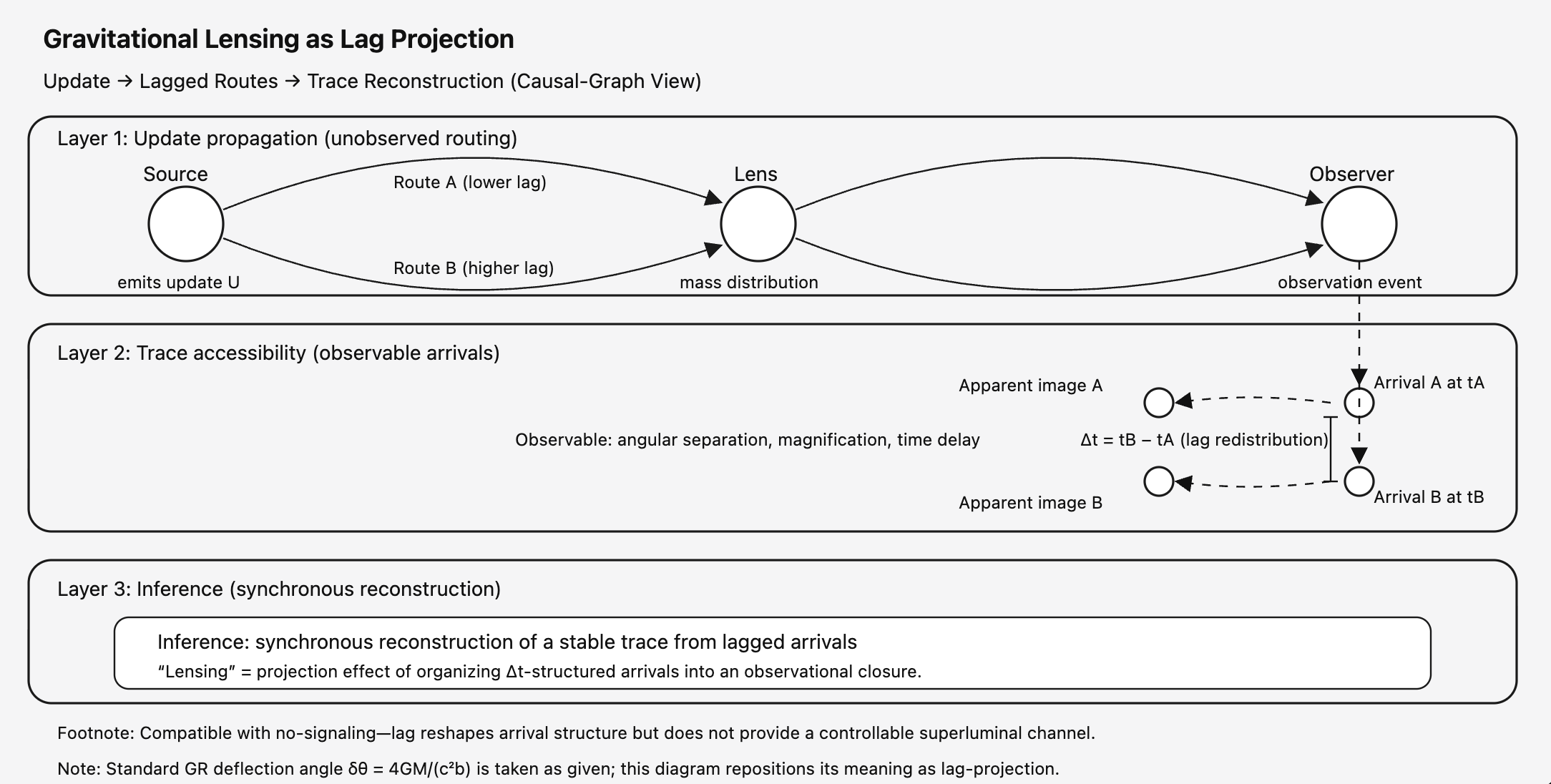
Observations provide neither states nor trajectories, but localized traces: arrival times, angular positions, and intensities recorded by detectors. These traces are generated under asynchronous updates among light propagation, massive bodies, and observers.
2. Lag-Structured Trace Formation
Because update processes are not synchronized, trace density is generically biased. This bias is not noise; it is a structural consequence of update lag. No assumption of spacetime curvature is required at this level.
3. Closure as Reconstruction
Standard gravitational lensing analysis applies a closure map that reconstructs a continuous geometry from discrete, lag-structured traces. This operation enforces global coherence and absorbs lag-induced bias into an effective curvature description.
4. Emergence of the Syntactic Lens
When biased traces are geometrically closed, apparent focusing, magnification, and image multiplicity necessarily emerge. These effects correspond to Jacobian compression under closure and do not imply a physical bending agent.
5. Repositioning Gravitational Lensing
Gravitational lensing is therefore not evidence of spacetime acting as a lens. It is evidence that lag-structured observations were closed geometrically. The lens exists in inference, not in the universe.
Conclusion
Light does not bend.
Inference bends when lag is closed as geometry.
Appendix
Correspondence between GR Observables and Lag-Projection Syntax
| GR Observable | Standard Interpretation (GR) | Lag-Projection Interpretation |
|---|---|---|
| Deflection angle | Curvature of spacetime | Angular misalignment from lag-projected trace placement |
| Shapiro time delay | Slowing of light in gravitational field | Update–observation lag accumulated along inference path |
| Magnification | Focusing by gravitational potential | Density of trace overlap under lag circulation |
| Multiple images | Multiple geodesics in curved spacetime | Discrete inference branches from non-closed lag loops |
Relation to General-Relativistic Observables
(Angles, Magnification, and Time Delay as Trace Redistribution)
This appendix clarifies how the standard observables of gravitational lensing in general relativity—angular deflection, magnification, and time delay—are recovered within the lag–trace framework without invoking spacetime curvature as a physical bending mechanism.
The key point is that all three observables arise from redistribution of observational traces under asynchronous updates, followed by geometric closure at the inference level.
A.1 Angular Deflection
In standard GR, angular deflection is interpreted as a change in the propagation direction of light due to spacetime curvature.
In the lag-based framework, no such directional change is required. Instead:
-
Asynchronous updates between light emission, massive bodies, and the observer produce non-uniform trace sampling.
-
When these traces are reconstructed under a global geometric closure, the centroid of accessible traces shifts.
-
This shift is inferred as an angular deflection.
Thus, angular deflection corresponds to trace centroid displacement, not physical bending.
A.2 Magnification and Image Multiplicity
Gravitational magnification and multiple images are traditionally attributed to focusing by a curved spacetime geometry.
Here, they arise from:
-
Local compression or dilation of trace density caused by lag-dependent accessibility.
-
The Jacobian of the closure map amplifying or duplicating regions of trace concentration.
Magnification reflects trace density redistribution, while multiple images correspond to multiple closure-consistent reconstructions from the same lag-structured trace set.
No additional optical mechanism is required.
A.3 Time Delay
Observed time delays between lensed images are usually explained by path-length differences and gravitational time dilation.
Within the present framework:
-
Time delay reflects different trace arrival orderings produced by asynchronous update relations.
-
Closure reconstructs these orderings as distinct effective paths, yielding apparent delays.
Thus, time delay is not evidence of slowed light propagation, but of non-synchronous trace registration.
A.4 Summary Table
| GR Observable | Standard Interpretation | Lag–Trace Interpretation |
|---|---|---|
| Angular deflection | Light bent by curvature | Trace centroid shift under closure |
| Magnification | Geometric focusing | Trace density redistribution |
| Multiple images | Multiple geodesics | Multiple closure-consistent reconstructions |
| Time delay | Path + gravitational delay | Asynchronous trace ordering |
A.5 Implication
All empirically successful lensing observables are preserved.
What changes is not the prediction, but the ontological placement of the lens:
The lens is not a property of spacetime, but a property of inference applied to lag-structured traces.
Compatibility with empirical success.
This reinterpretation preserves all standard gravitational lensing observables and predictions; it relocates the lensing effect from spacetime dynamics to the inferential closure applied to lag-structured observational traces.
One-Paragraph Note|Why General Relativity Works So Well
General relativity works remarkably well because it provides an exceptionally powerful closure mechanism.
By encoding asynchronous update relations into a smooth geometric structure, GR converts distributed asynchronous lag effects into globally consistent predictions. This geometric closure suppresses residual update gaps and yields stable, computable observables, even when the underlying processes are non-synchronous. In this sense, the empirical success of GR reflects not the literal curvature of spacetime as a physical substance, but the effectiveness of geometric closure as an inferential syntax for organizing lag-structured traces. GR succeeds precisely because it closes what would otherwise remain open.
Footnote|Relation to No-Signaling
No-signaling corresponds to limited local trace accessibility under global updates; the present framework preserves no-signaling by construction, as lag redistribution affects inference but does not introduce transmissible channels.
Note: This reinterpretation remains compatible with no-signaling principles, as lag-projection redistributes inference across observational layers without introducing any locally controllable superluminal channels.
“Closure is not reality, but responsibility.”
SG-0|Gravitational Lensing as a Syntactical Side Effect
SAW-AR|Appendix X|Light Bending as Lag Projection|遅延投影としての光の屈曲
SAW-AR(ミニ技術ノート)|Gravitational Lensing Revisited: What Is Bent Is Not Light, but Lag— Gravitational Lensing as a Lag-Projection Effect: An Interpretive Note
定理(構文レンズ存在定理:粗形)
仮定 A(GR側の仮定=曲率モデル)
観測データ(到来時刻差・角位置差・増光)を、連続時空上の“曲率”として一枚に再構成する(= 幾何学的閉包)。
仮定 B(SO lag側の仮定=更新モデル)
世界は「更新(Update)」→「痕跡(Trace)」→「推論(Inference)」の三層で観測され、更新は非同期で、観測者は痕跡からのみ再構成する。
主張(存在)
Bの世界で、Aの再構成(曲率としての一枚化)を行うとき、推論像の上に必ず
-
焦点化(apparent focusing)
-
多重像(apparent multiplicity)
-
増光(apparent magnification)
に相当する“レンズ作用”が現れる。
つまり:
重力レンズは宇宙の装置ではなく、「lag を曲率で閉じる」再構成操作が作る構文レンズである。
証明スケッチ(最小)
1) 観測データの型を固定する
観測されるのは状態ではなく、各検出器(観測者)での痕跡列
\[T_i={(t_{ik}, x_{ik}, I_{ik})}_k\](到来時刻・角位置・強度の系列)
2) SO lag 構造を導入する
光の更新(局所)・巨大天体の更新(超遅延)・観測者の更新(中間)により、
痕跡生成は一般に 非同期サンプリングになる。
その結果、痕跡密度 $\rho_T(x)$ が一様にならず、偏りを持つ。
3) GR再構成を「閉包写像」として書く
GR的再構成とは、痕跡列から連続幾何(曲率)を推定する写像
\[\mathcal{C}:\{T_i\}\mapsto g_{\mu\nu} \quad (\text{effective closure})\]これは「非同期・離散・偏り」を 連続曲率へ押し込める操作。
4) 結論:偏りは必ず焦点化として現れる
痕跡密度の偏り $\rho_T(x)$ を連続曲率に吸収すると、推定像のヤコビアンが局所的に $|J|<1$ を作る(=面積縮退=増光・焦点化)。
これは“物理的に曲がった”からではなく、閉包の副作用。
よって「構文レンズ(推論レンズ)」は必然的に出現する。□
「GRからSO lagへ」の翻訳
-
GR(曲率):遅延と偏りを「幾何」に固定した極限構文
-
SO lag:遅延と偏りを「更新と痕跡」に戻し、曲率を推論副産物に降格
Definition (Syntactic Lens). A syntactic lens is an inferential focusing effect produced when lag-structured traces are forcibly reconstructed under a global geometric closure.
EgQE — Echo-Genesis Qualia Engine
camp-us.net
© 2025 K.E. Itekki
K.E. Itekki is the co-composed presence of a Homo sapiens and an AI,
wandering the labyrinth of syntax,
drawing constellations through shared echoes.
📬 Reach us at: contact.k.e.itekki@gmail.com
| Drafted Feb 3, 2026 · Web Feb 8, 2026 |