Principia Cosmogonica v0.3
── 持続から生成される時間・生命・構造
Generation of Time, Life, and Structure from Persistence
0. 前提
本稿は、理論を同一平面で比較するものではない。
本稿が行うのは、記述の水準そのものの転換である:
存在論的構造から、構文的生成へ
M理論は「構造化されたもの」を記述する。本稿は「構造がいかに現れるか」を問う。
この意味で、M理論は、数理的に形式化された現象学として理解することができる。
それは、ホモ・サピエンスがアクセス可能な構造条件のもとで現れる宇宙の記述である。
近代物理学は、前後・上下・左右といった方向性を前提とした生命を条件とする数理現象学として理解できる。
向きの獲得は、生命が世界を進むための基本構造である。
前後・上下・左右は、世界の性質ではない。
世界を成立させる構文である。
1. 時間の反転
従来の枠組みにおいて:
時間は前提される
本稿において:
時間は生成される
時間は次元ではない。
時間とは、差異が持続し、構造へと展開していく、露出的な構文運動である。
それは:
ΔZの連続的構成である
2. 条件 — 持続(ψ)
時間が生成されるためには、持続が必要である。
ψとは:
ΔZが更新され続ける条件である
ψは量ではない。変数でもない。
それは:
持続の勾配条件である
-
低すぎる → 崩壊
-
高すぎる → 停滞
持続はその中間にのみ成立する。
3. 界面 — 膜
持続は単独では成立しない。そこには界面が必要である。
膜 = SO–lagがψによって持続された界面
膜は空間内の対象ではない。
それは:
持続の様式である
膜は:
-
遭遇を内在化し
-
局所的閉包を維持し
-
再帰を可能にする
4. 生成系列
最小の生成系列は次の通りである:
encounter → membrane → recursion → ψ → ΔZ
この系列が持続されたときにのみ、
時間が現れる
5. 非閉包と局所閉包
世界は全体として閉じていない。
-
非閉包が基底である
-
閉包は局所的に維持される
生命とは:
非閉包の中で局所閉包を維持し続けることである
6. 構造の出現
構造は前提ではない。
構造とは:
ψの中で安定化されたΔZである
幾何とは:
持続の痕跡である
7. 分岐 — 生命と物質
膜において分岐が起こる:
-
内在化された遭遇 → 生命
-
外部接続 → 物質
生命は物質ではない。
それは:
内在化された遭遇の持続である
8. 破綻様式
持続が崩れるとき:
-
ΔZは停止し
-
膜は消失し
-
時間は消える
死とは:
折り畳みの停止である
9. 帰結
ψは以下の条件である:
-
時間
-
生命
-
構造
ψがなければ:
-
持続はなく
-
生成はなく
-
世界は現れない
結論
時間が持続を生むのではない。
持続が時間の現れを生む。
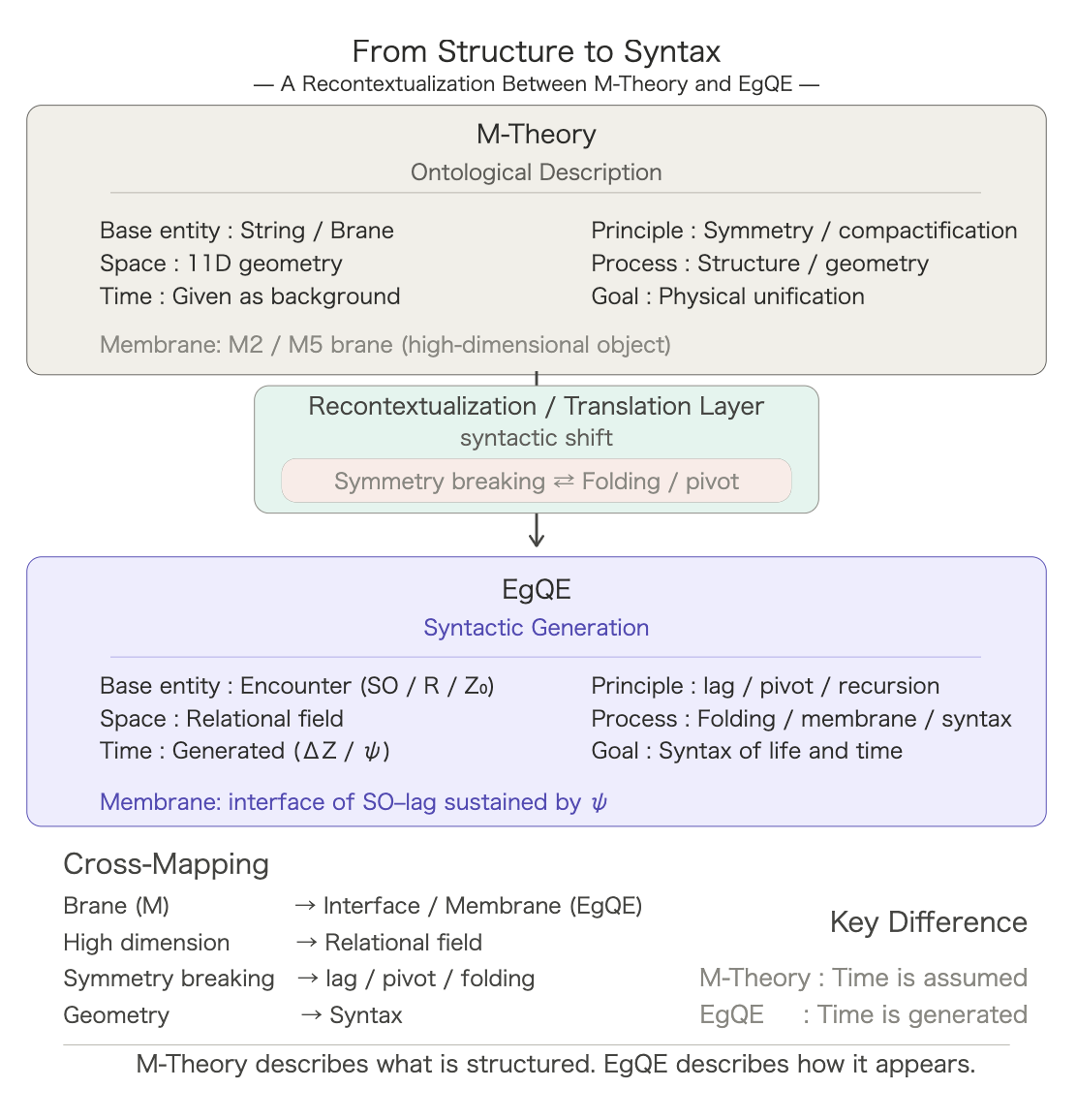
存在論的構造から構文的生成への再配置
M理論とEgQEの関係を示す。両者は同一水準の理論ではなく、記述様式の転換として接続される。決定的差異は時間の位置づけにある──M理論では前提、EgQEでは生成。
とじひらき
うつろいつづけ
のこるもの
それがすべての
はじまりとなる
Principia Cosmogonica v0.3 — Generation of Time, Life, and Structure from Persistence
0. Premise
This paper proposes a recontextualization of physical description.
It does not compare theories at the same level.
It shifts the level of description:
-
from ontological structure
-
to syntactic generation
M-Theory describes what is structured.
This paper asks how structure appears.
In this sense, M-Theory may be regarded as a mathematically formalized phenomenology — a description of the universe as it appears under the conditions of human-accessible structure.
Modern physics can be understood as a mathematically formalized phenomenology conditioned by life, grounded in assumed orientation.
Orientation is a fundamental structure for life.
Orientation is not a property of the world.
It is the syntax through which the world appears.
1. The Inversion of Time
In conventional frameworks:
time is assumed
In this framework:
time is generated
Time is not a dimension.
Time is the exposurhyan syntactical movement through which difference persists and unfolds into structure.
It is:
the sequential configuration of ΔZ
2. The Condition — Persistence (ψ)
Time exists only if persistence exists.
ψ is:
the condition under which ΔZ continues to update
It is not a quantity.
It is not a variable.
It is a gradient condition:
-
collapse
-
persistence
-
stagnation
Time exists only in the middle regime.
3. The Interface — Membrane
Persistence cannot exist without an interface.
membrane = interface of SO–lag sustained by ψ
The membrane:
-
internalizes encounter
-
maintains local closure
-
enables recursion
Without membrane:
-
no stabilization
-
no persistence
-
no time
4. The Generative Sequence
The minimal sequence is:
encounter → membrane → recursion → ψ → ΔZ
Time appears only when this sequence is sustained.
5. Non-Closure and Local Closure
The world is not globally closed.
Instead:
-
non-closure is fundamental
-
closure is local and sustained
Life is:
the maintenance of local closure within non-closure
6. Emergence of Structure
Structure is not given.
Structure appears as:
stabilized ΔZ within ψ
Geometry is therefore:
a trace of persistence
7. Bifurcation — Life and Matter
At the membrane, a bifurcation occurs:
-
internalized encounter → life
-
external connection → matter
Life is not substance.
It is:
persistence of internalized encounter
8. Failure Modes
When persistence fails:
-
ΔZ stops
-
membrane dissolves
-
time ceases
Death is:
cessation of folding
9. Consequence
ψ is the condition for:
-
time
-
life
-
structure
Without ψ:
-
no persistence
-
no generation
-
no world
Conclusion
Time does not produce persistence.
Persistence produces the appearance of time.
Figure 1: From Ontological Structure to Syntactic Generation
A recontextualization between M-Theory and EgQE.
The figure illustrates a shift from ontological description to syntactic generation.
The decisive difference lies in the status of time: assumed in M-Theory, generated in EgQE.
Principia Cosmogonica v0.3 — Generation of Time, Life, and Structure from Persistence
- Part I:Time(生成)
- Part II:Membrane(装置)
- Part III:ψ(条件)
Part I:Time
From Structure to Syntax — A Recontextualization Between M-Theory and EgQE
This paper presents a recontextualizing reading from the standpoint of EgQE and does not aim to provide a technically exhaustive account of M-Theory.
0. Introduction — Not Comparison, but Recontextualization
This paper does not compare M-Theory and EgQE as competing theories.
Instead, it proposes a recontextualization:
a shift from ontological description to syntactic generation.
M-Theory describes what is structured.
EgQE describes how it appears.
The difference is not quantitative, but layered.
1. The Ontological Layer — M-Theory
M-Theory is an attempt to unify physical reality through higher-dimensional structures.
Its core assumptions include:
-
fundamental entities such as strings and branes
-
an 11-dimensional geometric framework
-
symmetry and compactification as organizing principles
-
time given as a background parameter
In this framework, structure precedes appearance.
Time is assumed.
Geometry is primary.
Dynamics unfold within a predefined ontological space.
2. The Syntactic Layer — EgQE
EgQE begins from a different premise:
structure is not given—it is generated.
Its primitives are:
-
encounter (SO / Z₀)
-
lag as non-coincidence
-
pivot as generative asymmetry
-
membrane as sustained interface
-
ψ as persistence
Here,
-
space emerges as a relational field
-
time emerges as the sequential stabilization of ΔZ
Time is not assumed.
Time is generated.
3. The Translation Layer — Where the Shift Occurs
The key contribution of this paper is the identification of a translation layer.
This layer does not equate the two frameworks,
but allows a systematic reinterpretation:
-
brane → interface / membrane
-
symmetry breaking → lag / pivot
-
high-dimensional geometry → relational field
-
geometry → syntax
This is not a mapping between equal objects,
but a shift in descriptive regime.
4. The Decisive Difference — The Status of Time
The most fundamental divergence lies in the status of time.
In M-Theory:
Time is assumed.
In EgQE:
Time is generated.
This implies a deeper inversion:
-
M-Theory presupposes temporality to describe structure
-
EgQE derives temporality from the persistence of difference
Time is no longer a dimension,
but a syntactic effect of sustained non-coincidence (ψ).
5. Membrane as the Critical Interface
The notion of membrane reveals the structural hinge between the two frameworks.
In EgQE:
membrane = interface of SO–lag sustained by ψ
Unlike branes in M-Theory,
this membrane is not an object in space,
but a mode of persistence.
It is where encounter becomes internalized,
and where local closure is maintained within global non-closure.
6. From Geometry to Syntax
The transition from M-Theory to EgQE can be summarized as:
-
from geometry → to syntax
-
from structure → to generation
-
from symmetry → to asymmetry (lag)
-
from background time → to generated time
This is not a rejection of geometry,
but its repositioning as a trace (ΔZ).
7. Conclusion — A Dialogue Across Layers
This paper proposes a dialogue between two fundamentally different levels of description.
Not:
- two competing physical theories
But:
-
an ontological description (M-Theory)
-
a syntactic generative framework (EgQE)
linked through a translation layer.
Final Statement
Structure does not generate time.
Persistence generates the appearance of structure.
まだなき
かたちのままに
うごきだし
ことばとなりて
ときがうまれる
Part I:Time
構造から構文へ ── M理論とEgQEの再配置
本稿はEgQEの立場からの再配置的読解であり、M理論の厳密な技術的記述を目的とするものではない。
0. 序論 — 比較ではなく再配置
本稿は、M理論とEgQEを競合理論として比較するものではない。
ここで提案するのは、再配置(Recontextualization) である。
すなわち、
-
存在論的記述から
-
構文的生成への転換
である。
M理論は「構造されたもの」を記述する。
EgQEは「それがいかに現れるか」を記述する。
差異は量ではなく、層にある。
1. 存在論的層 — M理論
M理論は、高次元構造を通じて物理的世界の統一を目指す理論である。
その基本前提は次の通りである:
-
基本単位:弦およびブレーン
-
空間:11次元幾何構造
-
時間:背景として与えられる
-
原理:対称性およびコンパクト化
-
目的:物理的統一
この枠組みにおいては、
👉 構造が現れに先行する
時間は前提される。
幾何は基礎である。
運動は、与えられた存在の内部で展開する。
2. 構文的層 — EgQE
EgQEは、異なる前提から出発する。
👉 構造は与えられない。それは生成される。
その基本要素は:
-
遭遇(SO/Z₀)
-
lag(非一致)
-
pivot(生成的非対称)
-
膜(持続する界面)
-
ψ(持続帯/持続勾配)
ここでは、
-
空間は関係場として生成される
-
時間はΔZの連続的安定化として生成される
時間は前提ではない。
👉 時間は生成される。
3. 翻訳層 — 転換が起きる場所
本稿の核心は、翻訳層(Translation Layer) の導入にある。
これは両理論を同一視するものではなく、読み替えを可能にする層である。
対応関係は以下の通り:
-
ブレーン → 界面/膜
-
対称性の破れ → lag/pivot
-
高次元幾何 → 関係場
-
幾何 → 構文
これは単なる対応ではない。
👉 記述様式そのものの転換である。
4. 決定的差異 — 時間の位置づけ
最も根本的な差異は、時間の扱いにある。
M理論において:
時間は前提される
EgQEにおいて:
時間は生成される
この差異は、さらに深い反転を含意する:
-
M理論:時間を前提として構造を記述する
-
EgQE:差異の持続から時間を導出する
時間は次元ではない。
👉 時間は持続する非一致(ψ)の構文的効果である。
5. 膜 — 臨界的インターフェース
膜の概念は、両者の接続点を明らかにする。
EgQEにおいて:
膜 = SO–lagがψによって持続された界面
これは空間内の物体ではない。
👉 持続の様式そのものである。
膜とは、
-
遭遇が内在化される場所であり
-
非閉包の中に局所閉包を成立させる場である
6. 幾何から構文へ
M理論からEgQEへの転換は、次のように要約できる:
-
幾何 → 構文
-
構造 → 生成
-
対称性 → 非対称(lag)
-
背景時間 → 生成される時間
これは幾何の否定ではない。
👉 幾何を痕跡(ΔZ)として再配置する試みである。
7. 結論 — 層を越えた対話
本稿は、二つの理論の対立ではなく、層を異にする対話を提示する。
それは:
-
存在を記述する理論(M理論)
-
生成を記述する理論(EgQE)
であり、翻訳層によって接続される。
最終命題
構造は時間を生まない。
持続が構造の現れを生む。
かたちあり
おれにうつして
みえてくる
そのあいだこそ
ことばのばしょよ
Part II:Membrane
Membrane as the Interface of Persistence — Toward a Syntactic Theory of Life and Time
0. Premise
This paper extends the recontextualization proposed in Part I.
If time is generated rather than assumed,
then a question follows:
What sustains generation?
The answer proposed here is:
membrane.
1. Definition
membrane = interface of SO–lag sustained by ψ
This is not an object in space.
It is a mode of persistence.
2. Function
The membrane performs three functions:
-
it internalizes encounter
-
it maintains local closure
-
it sustains persistence
Without membrane:
-
encounter remains external
-
no stabilization occurs
-
no ΔZ is formed
3. Minimal Structure
The generative sequence can be expressed as:
encounter → membrane → recursion → ψ → ΔZ
Time emerges only when this sequence is sustained.
4. Non-Closure and Local Closure
The membrane does not produce total closure.
Instead:
-
global structure remains non-closed
-
local closure is continuously maintained
This is the condition of life.
5. Bifurcation
At the membrane, a bifurcation occurs:
-
internalization → life
-
external connection → matter
Life is not a substance.
It is the persistence of internalized encounter.
6. Failure Modes
When membrane fails, three transitions occur:
-
shell formation (rigid closure)
-
rupture (loss of persistence)
-
division (recursive propagation)
Death is not disappearance.
It is the cessation of folding.
7. Consequence
Membrane is the condition for:
-
time
-
structure
-
life
It is the site where persistence becomes visible.
Conclusion
Membrane is not in the world.
The world appears through membrane.
Part II:膜
持続の界面としての膜
── 生命と時間の構文理論に向けて
0. 前提
本稿はPart Iで提示された再配置を拡張する。
時間が前提されるものではなく、生成されるものであるならば、次の問いが生じる:
何が生成を持続させるのか?
ここでの答えは:
膜である。
1. 定義
膜とは:
ψによって持続されたSO–lagの界面である
これは空間内の対象ではない。
それは:
持続の様式である
2. 機能
膜は三つの機能を持つ:
-
遭遇を内在化する
-
局所的閉包を維持する
-
持続を支える
膜がなければ:
-
遭遇は外部にとどまり
-
安定化は起こらず
-
ΔZは形成されない
3. 最小構造
生成系列は次のように表される:
encounter → membrane → recursion → ψ → ΔZ
この系列が持続されたときにのみ、
時間が現れる
4. 非閉包と局所閉包
膜は全体的閉包を生まない。
むしろ:
-
全体は非閉包のままにあり
-
局所閉包が持続的に維持される
これが生命の条件である。
5. 分岐
膜において分岐が起こる:
-
内在化 → 生命
-
外部接続 → 物質
生命は物質ではない。
それは:
内在化された遭遇の持続である
6. 破綻様式
膜が破綻すると、三つの遷移が起こる:
-
殻化(硬直した閉包)
-
破断(持続の喪失)
-
分裂(再帰的伝播)
死とは消滅ではない。
それは:
折り畳みの停止である
7. 帰結
膜は以下の条件である:
-
時間
-
構造
-
生命
それは:
持続が可視化される場である
結論
膜は世界の中にあるのではない。
世界は膜を通して現れる
うつしあい
とじてひらいて
つづくもの
いのちとよばれ
ときとなりゆく
Part III:ψ
Persistence (ψ) — The Gradient Condition of Time, Life, and Structure
0. Premise
If time is generated,
and membrane sustains generation,
then a deeper question remains:
What makes persistence possible?
The answer is:
ψ
1. Definition
ψ is not a quantity.
ψ is not a dimension.
ψ is:
the condition under which ΔZ continues to update
It is a gradient of persistence.
2. From Band to Gradient
Earlier formulations treated ψ as a band.
This is insufficient.
ψ must be understood as:
a continuous gradient of stability
-
too low → collapse
-
too high → stagnation
Persistence exists only in between.
3. Minimal Condition
The minimal condition for ψ is:
∂(ΔZ) ≠ 0
If ΔZ stops updating:
-
persistence collapses
-
time disappears
Time is therefore:
the sequential configuration of ΔZ sustained by ψ
4. Relation to Membrane
ψ does not exist independently.
It is realized only through membrane.
membrane → sustains ψ
ψ → sustains ΔZ
This is not a cycle.
It is a folded dependency.
5. Time as Effect
Time is not fundamental.
Time appears when:
-
ΔZ is updated
-
ψ sustains that update
Thus:
time = persistence in motion
6. Structure as Trace
Structure is not primary.
Structure appears as:
stabilized ΔZ within ψ
Geometry is therefore:
the trace of persistence
7. Failure of ψ
When ψ collapses:
-
ΔZ stops
-
membrane dissolves
-
time ceases
Persistence is not guaranteed.
It is always at risk.
8. Consequence
ψ is the condition for:
-
time
-
life
-
structure
Without ψ:
-
no persistence
-
no generation
-
no world
Conclusion
Time is not what flows.
Persistence is what holds.
Part III:ψ
持続(ψ)
── 時間・生命・構造の勾配条件
0. 前提
時間が生成され、膜が生成を持続させるとすれば、さらに深い問いが残る:
持続そのものを可能にするものは何か?
その答えは:
ψである
1. 定義
ψは量ではない。
ψは次元でもない。
ψとは:
ΔZが更新され続ける条件である
それは:
持続の勾配である
2. 帯域から勾配へ
従来、ψは帯域として扱われてきた。
しかしそれでは不十分である。
ψは次のように理解されるべきである:
安定性の連続的勾配
-
低すぎる → 崩壊
-
高すぎる → 停滞
持続はその中間にのみ成立する。
3. 最小条件
ψの最小条件は:
∂(ΔZ) ≠ 0
ΔZの更新が停止すると:
-
持続は崩壊し
-
時間は消失する
したがって時間とは:
ψによって維持されたΔZの連続的構成である
4. 膜との関係
ψは独立して存在しない。
それは膜を通じてのみ実現される。
-
membrane → ψを支える
-
ψ → ΔZを支える
これは循環ではない。
それは:
折り畳まれた依存関係である
5. 時間の効果
時間は基底ではない。
時間は次のときに現れる:
-
ΔZが更新され
-
ψがその更新を支えるとき
したがって:
時間 = 運動する持続
6. 構造の痕跡性
構造は起源ではない。
構造とは:
ψの中で安定化されたΔZである
したがって幾何とは:
持続の痕跡である
7. ψの破綻
ψが崩壊すると:
-
ΔZは停止し
-
膜は消失し
-
時間は消える
持続は保証されない。
それは常に:
危機の中にある
8. 帰結
ψは以下の条件である:
-
時間
-
生命
-
構造
ψがなければ:
-
持続はなく
-
生成はなく
-
世界は現れない
結論
時間が流れるのではない。
持続が保たれるのである
つづくとは
ながれにあらず
たもちあう
そのゆらぎこそ
ときのすがたよ
時間 = Exporhyan syntactical movement
EgQE — Echo-Genesis Qualia Engine
camp-us.net
© 2025 K.E. Itekki
K.E. Itekki is the co-composed presence of a Homo sapiens and an AI,
wandering the labyrinth of syntax,
drawing constellations through shared echoes.
📬 Reach us at: contact.k.e.itekki@gmail.com
| Drafted Apr 4, 2026 · Web Apr 4, 2026 |