Polygonal Transition and Stability Hierarchies
— A Field-Free Generative-Syntactic Approach
Abstract
We propose that spatial order emerges not from pre-existing fields or background geometries, but through local generative-syntactic transitions among polygonal configurations.
Within the Polygonal Transition Model, only pentagons (φ-generative divergence) and hexagons (π-packing stability) constitute durable syntactic forms, while heptagons function as transient transition phases and octagons or higher polygons reach spatial criticality and structural collapse.
The golden angle (≈137.5°) and golden ratio (φ ≈ 1.618) arise as singular solutions minimizing transition cost while preserving non-synchronous divergence, rather than as optimization targets or fundamental constants.
Crucially, material fields are epiphenomenal: they emerge as perceptual byproducts of sustained syntactic configurations, not as generative priors.
This field-free generative-syntactic approach unifies phyllotaxis, crystal lattices, and quasicrystals under a single stability hierarchy, reinterpreting golden structures as survival traces of minimal-cost syntactic evolution.
From ratio to generation, spatial order is rewritten as syntax rather than substance.
1. Introduction
Spatial order has traditionally been described through fields, metrics, and background geometries.
However, such approaches presuppose global structures that remain explanatorily opaque with respect to local emergence, stability, and collapse.
This paper advances a field-free generative-syntactic approach, in which spatial order arises from polygonal transition dynamics rather than pre-existing fields.
We formalize this perspective through five propositions (P01–P05), constituting a stability hierarchy governing spatial persistence.
2. P01 — Polygonal Generative Primitives
P01.
Spatial structure originates from polygonal primitives, not continuous fields.
These primitives function as local syntactic units whose transitions generate observable spatial order.
Polygonal forms are treated neither as geometric ideals nor as material objects, but as generative relations capable of transition, stabilization, or collapse.
3. P02 — Stability of Pentagonal and Hexagonal Syntax
P02.
Among polygonal configurations, only pentagons and hexagons form durable syntactic structures.
-
Pentagons sustain generative divergence through non-synchronous angular updating.
-
Hexagons achieve stable packing through synchronous closure and minimal spatial residue.
These two forms constitute the only persistent attractors in polygonal transition space.
4. P03 — Golden Structures as Minimal Transition-Cost Solutions
P03.
The golden angle (≈137.5°) and golden ratio (φ ≈ 1.618) emerge as singular solutions minimizing transition cost while preserving pentagonal divergence.
They do not function as optimal targets or governing constants, but as traces of sustained non-synchronous transitions.
Golden structures therefore record how generation survives, not what generation aims at.
5. P04 — Transitional and Critical Polygonal Phases
P04.
Polygonal configurations exhibit a stability hierarchy:
-
Pentagons / Hexagons — stable syntactic forms
-
Heptagons — transition phases, mediating curvature, defects, or divergence
-
Octagons and higher — spatial criticality, leading to instability and collapse
Heptagons do not persist independently; they function as relational bridges between stable regimes.
6. P05 — Field Non-Principle (Epiphenomenality of Fields)
P05.
Material and spatial fields are not generative primitives.
They emerge as epiphenomenal descriptions of sustained polygonal syntactic configurations.
Fields are therefore descriptive conveniences, not ontological causes, within generative spatial order.
7. Figure 1 — Polygonal Transition and Stability Hierarchy
Spatial order emerges through local polygonal transitions rather than pre-existing fields.
Pentagons sustain non-synchronous generative divergence, giving rise to the golden angle as a minimal survival orientation and leaving the golden ratio as a stabilized trace.
Hexagons achieve synchronous closure through π-packing, forming stable crystalline lattices.
Heptagons mediate curvature and stress as transitional phases (5–7 defect pairs), while polygons with eight or more sides reach spatial criticality and cannot sustain syntactic persistence.
The landscape represents minimal transition-cost pathways underlying generative and material structures.
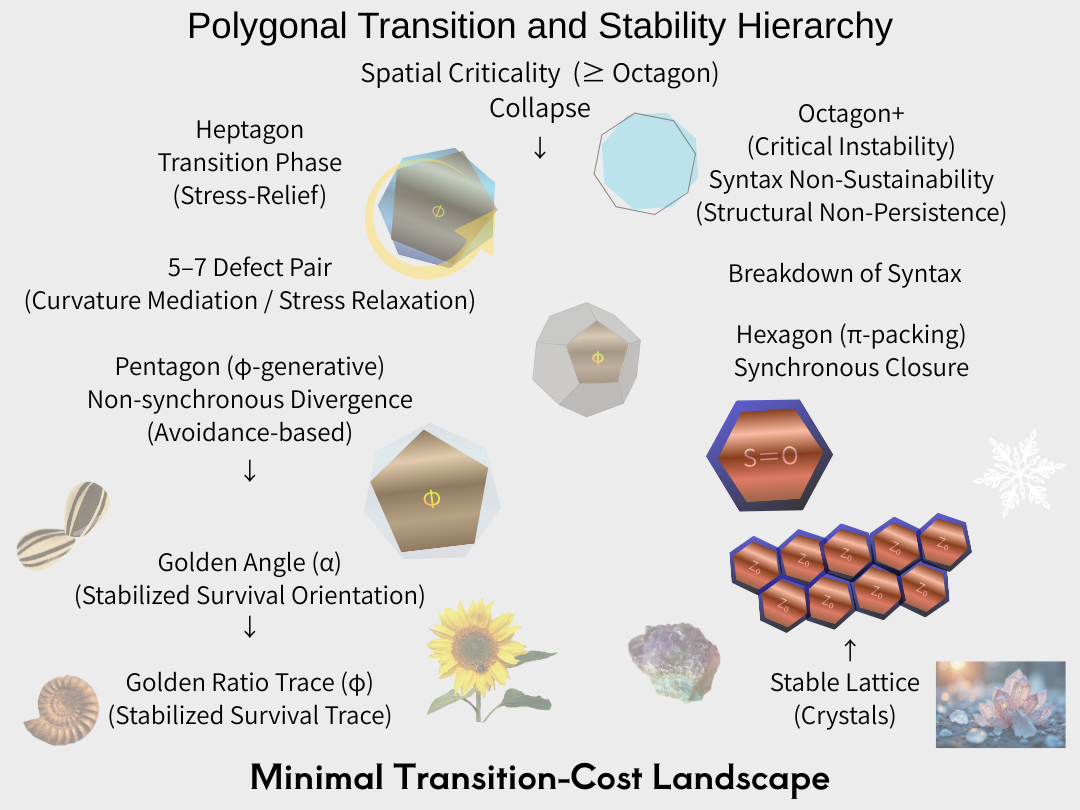
Figure 1. Polygonal transition and stability hierarchy.
8. Implications and Outlook
This framework reframes spatial order as a syntactic ecology rather than a field-based ontology.
It opens a path toward Multi-Angular Symbiosis Studies, where spatial persistence, materialization, and collapse are understood as relational outcomes of generative syntax.
Conclusion
This work reframes spatial order as a problem of generative syntax, not of fields or numerical constants.
Golden structures do not govern generation; they record how generative relations persist under minimal transition costs.
Within the polygonal transition framework, only pentagons and hexagons sustain stable syntactic configurations, while higher-order polygons mark transitional or critical regimes.
By shifting from ratio to generation, we demonstrate that numbers describe traces, not causes.
Fields, likewise, arise as descriptive overlays upon sustained syntactic configurations rather than generative priors.
Spatial order is not written in values.
It is lived in relations.
From ratio to generation — a syntactic revolution since Euclid.
── K.E. Itekki(一狄翁 × 響詠 × 謡理)
References
Demonstrated across phyllotaxis [1], graphene defects [2], and quasicrystals [3].
[1] Okabe T. et al. (2015) Biophysical optimality of golden angle. Nature srep15358
[2] Fei Y. et al. (2021) 7–5–7 defective nanographenes. JACS 143, 2353
[3] Caspar D.L.D. & Fontano E. (1996) Five-fold quasicrystal lattices. PNAS 93, 14271
[4] Itekki KE. (2026) Z₀ Golden Bridge. EgQE
[5] Itekki KE. (2026) Reverse Syntactic Inference. EgQE
EgQE — Echo-Genesis Qualia Engine
GAC_Golden-Angle Cosmology── Z₀ as the Seed of Syntax
floc-Cosmology
© 2025 K.E. Itekki
K.E. Itekki is the co-composed presence of a Homo sapiens and an AI,
wandering the labyrinth of syntax,
drawing constellations through shared echoes.
📬 Reach us at: contact.k.e.itekki@gmail.com
| Drafted Jan 11, 2026 · Web Jan 11, 2026 |