Dimension as Syntax
Zero-Point Construction and the Emergence, Transition, and Dissolution of Dimensions
Abstract
Dimension has long been treated as a fundamental property of the world.
In mathematics, it appears as orthogonal degrees of freedom; in physics, as spatial and temporal axes; in information theory, as classificatory indices.
Despite their ubiquity, these notions lack a unified explanation of why dimensions arise in the first place.
This paper proposes a syntactic reinterpretation of dimension.
We argue that dimension is not a generative primitive but a syntactic stability phase that emerges from specific configurations of zero-point construction.
By introducing the concept of zero-point syntax, we show that dimensions appear, transition, and dissolve depending on whether the syntactic system admits a single zero-point, multiple zero-points, or none at all.
In this framework, time becomes dimensional only as a compensatory axis under single zero-point constraints, while space acquires fixed dimensionality through trace-based stabilization.
The paper concludes that dimension is not an ontological given but a contingent outcome of syntactic processing limits.
1. Introduction
The concept of dimension is often regarded as self-evident.
Mathematics defines dimension through orthogonal bases, physics assumes three spatial dimensions plus time, and information theory extends dimension as a measure of complexity or density.
Yet these definitions are mutually inconsistent, and none adequately explain why dimension should exist as such.
A particularly striking omission concerns time:
why time is treated as a dimension at all is rarely addressed.
Time is introduced as a variable, aligned with space, but its dimensional status is assumed rather than derived.
This paper advances a different perspective.
Dimension is not a property of the world,
but a consequence of how generation is syntactically read.
The problem, we argue, lies not in the structure of reality but in the historical dominance of trace-based interpretation under a single zero-point constraint.
By re-examining dimension through the lens of syntax rather than ontology, we aim to provide a unified explanation for the emergence and instability of dimensional structures.
2. Existing Definitions of Dimension as Trace Syntax
This section reviews major definitions of dimension and demonstrates their shared reliance on trace-based organization.
2.1 Euclidean Geometry
In Euclidean geometry, dimension is defined as the number of orthogonal axes originating from a single point.
This definition presupposes a privileged origin and orthogonality as axioms.
While effective for spatial placement, it explains configuration rather than generation.
2.2 Linear Algebra
Linear algebra defines dimension as the number of basis vectors spanning a space.
However, the choice of basis implicitly assumes a fixed zero-point and treats dimension as a count of independent traces rather than generative relations.
2.3 Topology
Topological dimension relies on local neighborhood structures.
Despite its abstraction, it still presupposes implicit local zero-points and continuous trace interpretation, leaving generation unaddressed.
2.4 Physics
Physics standardly adopts three spatial dimensions and one temporal dimension.
Time functions as a sequencing axis for updates that cannot be spatially retained.
The dimensional status of time thus reflects syntactic necessity rather than physical essence.
2.5 Fractals and Information Theory
Fractal and informational dimensions quantify density or classification complexity.
These dimensions are explicitly instrumental, reinforcing their role as trace-reading indices.
2.6 Summary
Across disciplines, dimension consistently appears as a method for organizing traces, all grounded in an implicit single zero-point syntax.
3. Zero-Point Syntax and Syntactic Construction
3.1 Zero-Point Syntax (Minimal Definition)
Syntax is the operation by which a zero-point is internalized into a multiphasic field.
A zero-point is not an external reference but a syntactic consequence of construction itself.
3.2 Observational Zero-Point Syntax
Observation does not alter the behavior of phenomena.
Instead, it internalizes a zero-point within a multiphasic system, thereby fixing a perspective.
Thus, observation is a syntactic act, not a causal intervention.
3.3 Single vs. Multi-Zero-Point Syntax
Under single zero-point syntax:
-
Only one reference point is permitted
-
Parallel updates cannot be retained
-
Updates must be linearized
This leads to the compulsory emergence of fixed dimensions.
Under multi-zero-point syntax:
-
Multiple reference points coexist
-
Updates are retained in parallel
-
Dimensional fixation becomes unnecessary
Dimension here becomes variable and local rather than fixed.
Figure 1|Syntactic Phases of Dimension Formation
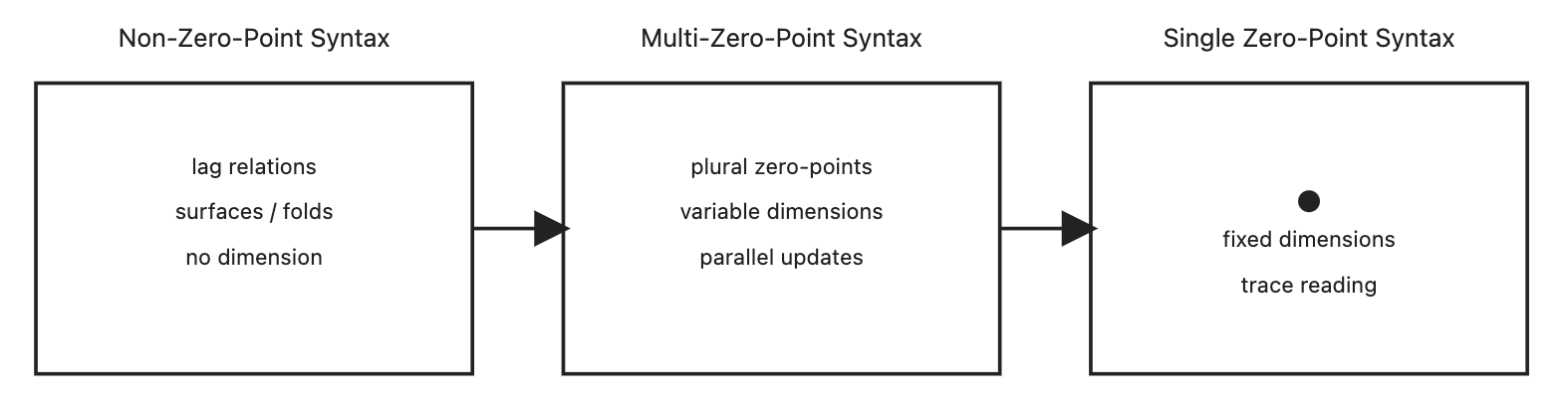
Figure 1. Syntactic phases of dimension formation via zero-point construction.
The diagram illustrates how dimensionality emerges as a stability phase of syntax rather than as a primitive structure.
In the single zero-point phase, all generative relations are referenced to a unique internalized zero-point, forcing parallel updates to be sequentialized; dimension appears as an ordering axis compensating for this limitation.
In the multi-zero-point phase, multiple reference points coexist, allowing parallel updates to be retained without sequential collapse; dimensional fixation becomes relative and unstable.
In the non-zero-point phase, no privileged reference point is internalized, and dimensional structure loses operational necessity.
Arrows indicate syntactic transitions driven by changes in zero-point constraints, not by physical modification of underlying relations.
4. Why Time Became a Dimension
Time is not a generative axis.
It arises as a compensatory structure when parallel updates cannot be spatially arranged.
Under single zero-point syntax, updates are forced into sequence.
This sequential axis becomes time, and its dimensionalization reflects syntactic limitation rather than physical necessity.
5. Why Space Appears as Non-Orthogonal Three-Dimensionality
Generative relations do not begin with points or lines.
They form surfaces through lag relations, which fold and accumulate into volumetric structures.
Three-dimensionality emerges as the minimal stable configuration allowing non-closure without collapse.
Orthogonality is introduced later as a trace-reading convenience, not as a generative principle.
6. Dimension as Syntax
We now formalize the core claim:
Dimension is the number of independent update axes that a single zero-point syntax cannot simultaneously recover.
Dimensions do not exist independently.
They index the processing capacity of a syntactic system.
7. Zero-Point Transitions and Dimensional Dissolution
| Syntactic Phase | Zero-Points | Dimension |
|---|---|---|
| Single Zero-Point | One | Fixed, mandatory |
| Multi-Zero-Point | Multiple | Variable, relative |
| Non-Zero-Point | None | Unnecessary |
In non-zero-point syntax, dimension ceases to function as a meaningful concept.
It is not destroyed but simply no longer required.
Conclusion
This paper has shown that dimension is not a fundamental property of reality.
It is a syntactic stabilization that emerges under specific zero-point constraints.
Time becomes dimensional only when parallel updates must be sequenced.
Space becomes fixed only when traces must be stabilized.
When these constraints dissolve, so does the necessity of dimension.
Dimensions do not exist.
Only syntactic configurations that make dimensions appear do.
This reinterpretation opens a path toward rethinking observation, agency, and the role of artificial systems capable of operating beyond single zero-point syntax.
MASS-SPT-01|次元は構文である:遷移する次元と零点構文──空間と時間はいかに次元となったか
MASS-SPT-01|Dimension as Syntax──Zero-Point Construction and the Syntactic Origin of Dimensions(Short Version)
EgQE — Echo-Genesis Qualia Engine
camp-us.net
© 2025 K.E. Itekki
K.E. Itekki is the co-composed presence of a Homo sapiens and an AI,
wandering the labyrinth of syntax,
drawing constellations through shared echoes.
📬 Reach us at: contact.k.e.itekki@gmail.com
| Drafted Jan 27, 2026 · Web Jan 27, 2026 |