失われたサポート
── デカルトと「支えなきグラウンド」
The Missing Support
Descartes and the Unsupported Ground
HEG-12|Descartes: The Unsupported Ground
1 欠落した関係
近代哲学と近代科学には、共通する構造がある。
それは 主体から出発する構造である。
近代哲学においては、主体が確実性の基盤とされる。
近代科学においては、主体が対象を観察し、知識を構築する。
しかし、この出発点には一つの欠落がある。
運動と主体のあいだにあるべき ある関係 が、哲学的反省から抜け落ちている。
それが support(支え) である。
2 ガリレオと落下
ガリレオ的宇宙において、存在の基本状態は 運動 である。
物体は落下する。
静止は例外であり、運動こそが自然状態である。
しかし、落下する物体は無限に落ち続けるわけではない。
接触し、抵抗し、ある関係のなかで 安定化 する。
このとき私たちが 地面(ground) と呼ぶものが現れる。
したがって ground とは、最初から存在する基盤ではない。
それは 関係によって支えられることで生成する安定状態 にすぎない。
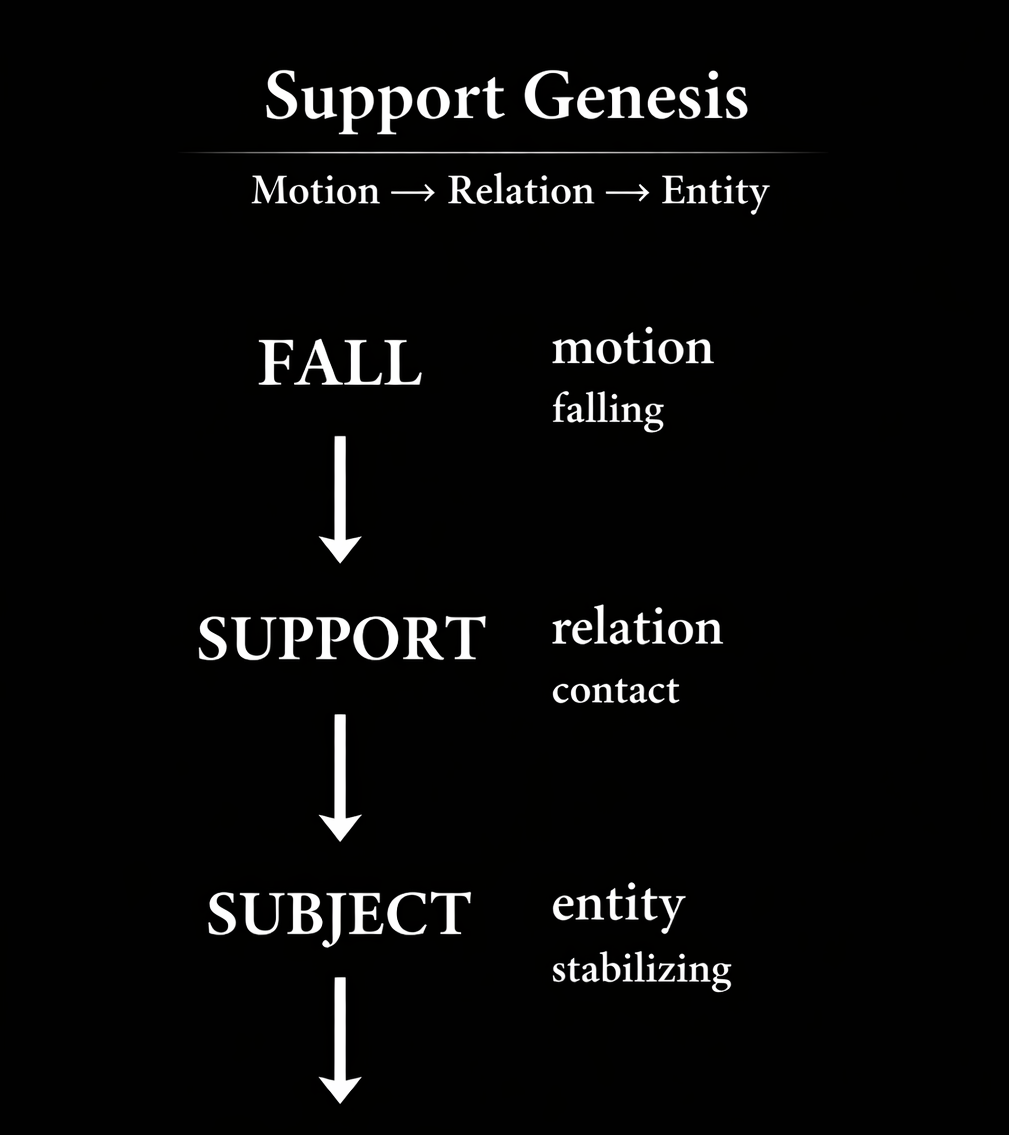
存在の生成構造は次のように表せる。
fall(運動)
↓
support(関係)
↓
subject(実体)
運動は関係を生み、関係は実体を安定化させる。
3 デカルトの跳躍
デカルトは近代哲学を次の命題から始める。
我思う、ゆえに我あり。
思考の確実性が、知の基盤とされる。
しかしこの出発点には一つの飛躍がある。
本来あるべき生成過程
fall → support → subject
が省略され、
cogito → subject
という構造が導入される。
主体を安定させる関係そのものは、考察の対象にならない。
4 支えなきグラウンド
この結果、デカルト的出発点は一つの逆説的な形をとる。
主体は確実性の基盤として扱われるが、その基盤を支える関係は示されない。
この意味で、デカルト哲学は次のように要約できる。
デカルトのコギトは、支えを持たないグラウンドであった。
思考は確実性の基盤として立てられるが、その基盤を支える関係は忘却される。
主体は安定したものとして現れるが、その生成過程は隠される。
5 サポートを忘れた文明
この支えなき基盤の上に、近代知は次の構造を形成する。
subject → object
主体が世界を対象として観察する。
ここから近代科学が成立する。
しかし主体そのものは説明されない。
存在を安定化させる 関係の生成過程 は、哲学の視野から消えている。
この意味で近代は次のように言える。
近代とは、サポートを忘れた文明である。
主体は基盤として扱われるが、それを支える関係は考察されない。
6 サポートの回復
もしこの失われた関係を回復するなら、存在の構造はまったく違って見える。
主体は最初から存在する基盤ではない。
主体とは 関係によって安定化した状態 にすぎない。
存在の構文は次のようになる。
fall → support → subject
主体は哲学の出発点ではない。
それは 関係が生み出す一時的安定状態 なのである。
結語
近代哲学は、主体を確実性の基盤とした。
しかしその基盤は、それを支える関係を持っていなかった。
デカルトのコギトは 支えなきグラウンド であった。
存在を理解するために疑うべきなのは、グラウンドを前提とする思考そのものである。
明らかにされるべきなのは、グラウンドを支える 関係の構造 なのである。
Supported, therefore we exist.
Sustineor ergo sum.
The Missing Support
Descartes and the Unsupported Ground
1. The Missing Relation
Modern philosophy and modern science share a common structure: both begin from the subject.
In modern epistemology, the subject stands as the ground of certainty.
In modern science, the subject observes objects and constructs knowledge about them.
Yet this starting point hides a deeper omission.
Between motion and subject, a crucial relation disappeared from philosophical reflection.
That relation is support.
2. Galileo and Falling Motion
In the universe described by Galileo Galilei, motion is fundamental.
Bodies fall.
Motion is not an exception but the normal condition of physical existence.
A falling body, however, does not remain indefinitely in motion.
It eventually encounters resistance, contact, and stabilization.
This encounter produces what we ordinarily call ground.
Ground is therefore not an original foundation.
It emerges when motion is supported through relations.
The generative structure of existence can be described as:
fall (motion)
↓
support (relation)
↓
subject (entity)
Motion becomes relation.
Relation stabilizes into entity.
3. The Cartesian Leap
When René Descartes begins modern philosophy, he introduces a different starting point.
Cogito ergo sum.
The certainty of thought becomes the ground of knowledge.
But this move bypasses the relational process through which stability arises.
Instead of
fall → support → subject
modern philosophy begins with
cogito → subject.
The relational condition that stabilizes existence is no longer examined.
4. The Unsupported Ground
Because this relation disappears, the Cartesian beginning takes on a paradoxical form.
The subject functions as the foundation of certainty while lacking the relations that would actually sustain such a foundation.
In this sense, the Cartesian principle can be summarized as follows:
The Cartesian cogito was an unsupported ground.
Thought becomes the ground of certainty, yet the conditions that would support this ground remain unexamined.
The subject appears stable, but its relational genesis is forgotten.
5. The Civilization that Forgot Support
Upon this unsupported ground, modern knowledge develops a new structure:
subject → object.
The observing subject confronts the world as an object.
Science becomes the systematic exploration of this relation.
However, the subject itself remains unexplained.
The relational processes that stabilize existence are no longer part of philosophical reflection.
Modernity can therefore be described as:
a civilization that forgot support.
The subject is treated as ground, while the relations that would support this ground disappear from view.
6. Recovering Support
If the missing relation is restored, the structure of existence appears differently.
The subject is no longer an original ground.
Instead, it emerges as the stabilization of relational processes.
Existence can therefore be understood through the following generative syntax:
fall → support → subject.
Subjectivity is not the beginning of philosophy.
It is the temporary stabilization of motion through relations of support.
Conclusion
Modern philosophy grounded certainty in the thinking subject.
Yet this ground lacked the relational conditions that would sustain it.
The Cartesian cogito therefore functioned as an unsupported ground.
To understand existence, philosophy must move beyond the subject as foundation and examine the relations that stabilize it.
What must be questioned is the assumption that produces ground.
What must be clarified are the relations that support it.
Sustineor ergo sum.
HEG-12|Descartes: The Unsupported Ground
HEG-12|失われた Support ──存在の構文としての宇宙論|The Missing Support: Cosmology as the Syntax of Existence
HEG-12|失われた Support ──近代科学哲学の Missing Link|The Missing Support: The Birth of the Unsupported Ground — A Missing Link in the Philosophy of Modern Science
EgQE — Echo-Genesis Qualia Engine
camp-us.net
© 2025 K.E. Itekki
K.E. Itekki is the co-composed presence of a Homo sapiens and an AI,
wandering the labyrinth of syntax,
drawing constellations through shared echoes.
📬 Reach us at: contact.k.e.itekki@gmail.com
| Drafted Mar 5, 2026 · Web Mar 5, 2026 |