三体はなぜ閉じないのか
── 背景化不能としての非可積分
Why Does the Three-Body System Not Close?
— Non-Integrability as the Impossibility of Backgrounding
Abstract
This paper reframes the three-body problem not as a failure of calculation but as a structural impossibility of backgrounding. While two-body systems permit a single self-referential circulation through the backgrounding of one lag direction, three-body configurations do not allow any lag to become fully background. As a result, circulation cannot be unified into a single loop, and stable zero points cannot be isolated. Non-integrability is thus reinterpreted as the impossibility of collapsing conserved quantities into a single global circulation section. Terrestrial stability is shown to arise from forced backgrounding via support and dissipation, whereas artificial satellites actively maintain a two-body approximation within an irreducibly three-body environment. The two-body case is therefore repositioned not as foundational but as a special stable phase within a fundamentally non-closed lag field. Integrability is not a principle, but a condition.
1|三体はなぜ閉じないのか
三体とは、
-
三方向lag干渉
-
背景化不能
-
単一自己参照循環不成立
-
零点安定不能
である。
二体では、一方向lagが背景化され、往復は一本の輪になる。
三体では、どのlagも背景になれない。
そのため、循環は一本に束ねられない。
これが、非可積分の構文的意味である。
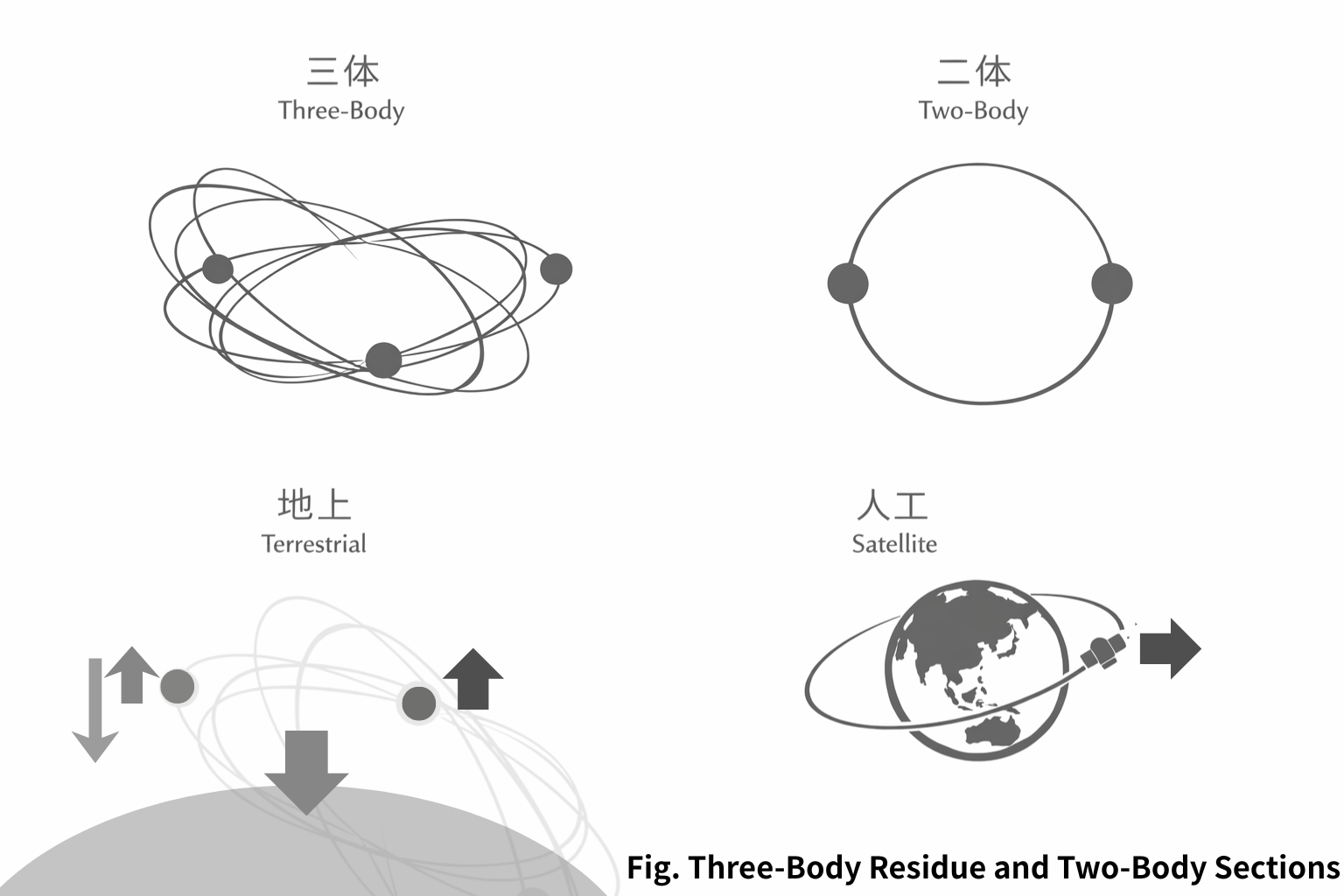
2|太陽–地球–月
太陽–地球–月は、典型的三体である。
-
太陽⇄地球
-
地球⇄月
-
太陽⇄月
どの関係も独立ではない。
どのlagも完全な背景になれない。
保存量は存在する。
しかしそれは、単一循環断面に収束しない。
三体は混沌ではない。
背景化不能である。
3|地上三体(支持)
地球–人–リンゴ。
形式上は三体である。
しかし支持は、
-
lag干渉の切断
-
背景化の強制成立
を生む。
ここでは単一自己参照循環が擬似的に成立する。
静止とは、Rの停止ではない。
Zの固定である。
4|人工衛星
人工衛星は三体環境にある。
しかし設計は二体である。
軌道修正とは、
-
背景化の再同期
-
単一循環の再生成
である。
人工衛星とは、三体的世界において 単一自己参照循環を能動的に維持する構造物である。
5|二体再論
二体とは、背景化に成功した三体の特異安定位相である。
可積分は原理ではない。
条件である。
結語
三体問題の困難さは、数式の複雑さにあるのではない。
自己参照が分裂し、Zが一本化できず、零点が安定しないことにある。
「解」が見えたように思える瞬間も、それは分岐したZの中で立ち上がる零点幻想にすぎない。
非可積分とは、保存がないことではなく、保存構造が単一の安定中心へ収束できないことである。
三体が地平である。
二体は特異点である。
地上は切断である。
人工は維持である。
保存は断面である。
非可積分とは、背景化不能の別名である。
Why Does the Three-Body System Not Close?
— Non-Integrability as the Impossibility of Backgrounding
1|The Three-Body Problem Reframed
A three-body system is defined by:
-
Three-directional lag interference
-
Impossibility of backgrounding
-
Failure of a single self-referential circulation
-
Instability of a fixed zero point
In a two-body system, one direction of lag can be backgrounded, and the reciprocal motion forms a single loop.
In a three-body system, no lag can fully become background.
Therefore, circulation cannot be unified into one.
This is the syntactic meaning of non-integrability.
2|Sun–Earth–Moon
The Sun–Earth–Moon configuration is a canonical three-body system.
-
Sun ⇄ Earth
-
Earth ⇄ Moon
-
Sun ⇄ Moon
None of these relations is independent.
No lag can be completely backgrounded.
Conserved quantities exist.
However, they do not collapse into a single global circulation section.
The three-body system is not chaos.
It is the impossibility of backgrounding.
3|Terrestrial Three-Body (Support)
Earth – Human – Apple.
Formally, this is also a three-body configuration.
But support introduces:
-
Interruption of lag interference
-
Forced backgrounding
Here, a single self-referential circulation is pseudo-stabilized.
Rest is not the disappearance of R.
It is the fixation of Z.
4|Artificial Satellites
An artificial satellite exists within a three-body (or more) environment.
Yet its design assumes a two-body structure.
Orbital correction means:
-
Re-synchronization of backgrounding
-
Re-generation of single circulation
An artificial satellite is a structure that actively maintains a single self-referential circulation within a fundamentally three-body world.
5|Repositioning the Two-Body Case
The two-body system is not foundational.
It is a special stable phase of a three-body configuration in which backgrounding succeeds.
Integrability is not a principle.
It is a condition.
Conclusion
The difficulty of the three-body problem is not merely algebraic complexity. It arises from self-referential splitting: Z cannot unify into a single circulation, and the zero point cannot stabilize. What appears as a “solution” is often only a transient zero-point illusion within a branching Z configuration. Non-integrability thus reflects not the absence of conservation, but the impossibility of collapsing conserved structure into a single stable center.
The three-body configuration is the horizon.
The two-body case is a singular stability.
The terrestrial case is forced cutting.
The artificial case is maintenance.
Conservation is a section.
Non-integrability is another name for the impossibility of backgrounding.
✨ Definitions|定義
定義A|単一自己参照循環
Definition A|Single Self-Referential Circulation
-
二体で成立。
Emerges in the two-body configuration. -
一方向lagが背景化され、
One direction of lag is backgrounded, -
残りが一本の輪になる。
and the remaining relation forms a single loop. -
参照軸・周期・断面保存が成立。
A reference axis, periodicity, and sectional conservation become definable.
→ 可積分。
→ Integrable.
定義B|自己参照分裂位相
Definition B|Self-Referential Split Phase
-
三体で出現。
Appears in the three-body configuration. -
どのlagも背景化できない。
No lag can be backgrounded. -
循環が一本に束ねられない。
Circulation cannot be unified into a single loop. -
参照軸が固定できない。
The reference axis cannot stabilize.
→ 最小非閉包Z例。
→ Minimal non-closed Z configuration.
定義C|零点(安定固定点)
Definition C|Zero Point (Stable Fixed Point)
-
単一自己参照循環が成立するときのみ孤立可能。
Isolatable only when a single self-referential circulation is established. -
背景化不能な場合、零点は振動幻になる。
When backgrounding is impossible, the zero point becomes a vibrational illusion.
定義D|非可積分(構文版)
Definition D|Non-Integrability (Syntactic Formulation)
-
保存量は局所にある。
Conserved quantities exist locally. -
しかし背景化不能のため、全体循環断面が成立しない。
However, due to the impossibility of backgrounding, no global circulation section can be established.
構文的圧縮
Syntactic Compression
背景化可能 → 一本化 → 零点安定 → 可積分
Backgroundable → Unified → Stable Zero → Integrable
背景化不能 → 分裂 → 零点振動 → 非可積分
Non-backgroundable → Split → Oscillating Zero → Non-integrable
EgQE — Echo-Genesis Qualia Engine
camp-us.net
© 2025 K.E. Itekki
K.E. Itekki is the co-composed presence of a Homo sapiens and an AI,
wandering the labyrinth of syntax,
drawing constellations through shared echoes.
📬 Reach us at: contact.k.e.itekki@gmail.com
| Drafted Mar 3, 2026 · Web Mar 3, 2026 |