関係的位相更新から導かれる黄金比
── 黄金角は非同期不可逆更新の観測痕跡である
Derivation of the Golden Ratio from Relational Phase Update:
Golden Angle as an Observational Trace of Asynchronous Irreversible Dynamics
🌻 GAC_Golden-Angle Cosmology── Z₀ as the Seed of Syntax
要旨(Abstract)
黄金角(約137.5°)および黄金比 $φ$ は、植物の葉序や自然界の配列構造に広く現れることで知られている。従来、これらは幾何学的・代数的定数として、最適性や設計原理の表現とみなされてきた。本稿では、この因果関係を反転させ、黄金角および黄金比はいずれも生成原理ではなく、関係的位相更新が観測構文に射影された結果として沈殿した痕跡であることを示す。
本稿は、角度や回転を前提としない関係的更新比
\[\alpha = \frac{1}{\varphi^2}\]を基礎に、黄金角が $π$ 構文(360°)への射影によって初めて「角度」として観測されること、また黄金比 $φ$ はその長期累積によって現れる代数的化石であることを論証する。
さらに、観測構文への射影過程で生じる最小ズレとして
\[Z_0 \approx 10^{-16}\]を構文的残差として位置づける。
1. 問題設定
黄金角および黄金比は、自然界における秩序や最適配置の象徴として扱われてきた。特に葉序理論では、$137.5°$の回転角が「最適な配置角度」として説明されることが多い。
しかしこの説明は、次の前提を暗黙に含んでいる。
-
回転が生成原理である
-
角度が一次的実在である
-
幾何的最適化が自然の目的である
本稿はこれらの前提を採用しない。
2. 関係的位相と最小公理
本稿では、生成の最小単位を関係的位相(relational phase) と呼ぶ。これは距離・角度・座標を伴わない、自己と他者の相対的更新状態である。
以下の二つを最小公理として採用する。
公理0(不可逆性)
位相更新は不可逆である。
公理1(非同期性)
位相更新は周期的に同期しない。
この段階では、空間・回転・角度・時間は一切導入されない。
3. 関係更新比 $α$ の導入
自己が生成点から連続的に更新されるとき、過去の自己(=他者化した自己)と重ならないためには、更新比は有理数ではありえない。
位相衝突(再重なり)を最小化する更新比として、連分数展開において最悪近似性をもつ値が選ばれる。
\[\alpha = [0;1,1,1,\dots] = \frac{1}{\varphi^2}\]ここで重要なのは、$α$ は角度ではないという点である。
$α$ は自己が他者化し続ける際の関係的更新比である。
4. 黄金角の生成:観測構文への射影
関係的更新は、それ自体では角度を持たない。
角度は、関係的更新が円環的観測構文へ射影されたときに初めて生じる。
円を $2π$ とする観測構文において、
\[\theta = 2\pi \alpha \approx 137.507^\circ\]が得られる。
したがって、
黄金角は生成原理ではない。
黄金角は、関係更新比 $α$ が $π$ 構文に射影された観測痕跡である。
5. $Z₀$:構文射影残差としての最小ズレ
関係的位相更新(無次元)を、$π$ を含む角度構文に射影する際、完全一致は起こらない。ここに必然的なズレが生じる。
このズレの下限を、
\[Z_0 \approx 10^{-16}\]と定義する。
$Z₀$ は物理定数ではない。
それは、関係構文と観測構文の間に生じる不可避な射影残差である。
6. 黄金比 $φ$ の沈殿
黄金比 $φ$ は生成原理ではなく、長期累積構造の中で観測される代数的不変量である。
フィボナッチ比
\[\frac{F_{k+1}}{F_k} \to \varphi\]は、関係更新比 $α$ による非同期更新が堆積した結果として現れる。
整理すると、
-
関係 $φ$:生成 $α = 1/φ²$
-
幾何 $φ$:近似
-
代数 $φ$:沈殿・化石
である。
7. 葉序構造の再解釈
葉序は回転していない。
回転に見えるものは、不可逆な関係更新の履歴が空間に刻まれた痕跡である。
時間・角度・空間は、関係更新の結果として事後的に立ち上がる。
8. 結論
本稿は次を示した。
-
黄金角は生成原理ではなく観測痕跡である
-
黄金比は設計値ではなく沈殿構造である
-
角度は関係更新の射影結果である
-
$Z₀$ は構文間ズレの不可視化痕跡である
この枠組みにより、黄金比・黄金角・葉序理論は、最適化や目的論を用いずに統一的に説明される。
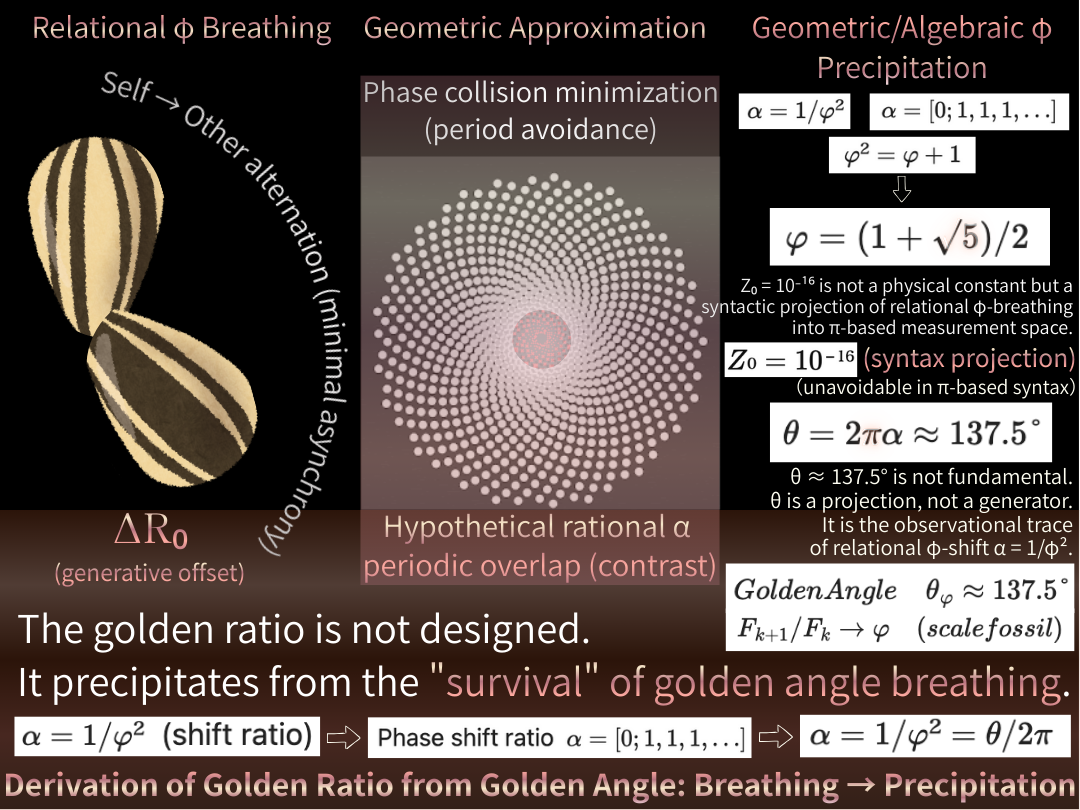
図1 “Derivation of Golden Ratio from Golden Angle: Breathing → Precipitation”
関係的位相更新(左)、観測的拡散構造(中央)、代数的沈殿(右)。
黄金角および黄金比は、生成ではなく観測の結果として現れる。
謝辞
ひまわりの種が、360°構文に従わなかったことに感謝する。🌻
Derivation of the Golden Ratio from Relational Phase Update:
Golden Angle as an Observational Trace of Asynchronous Irreversible Dynamics
Abstract
The golden angle (≈137.5°) and the golden ratio (φ) are traditionally treated as geometric or algebraic constants underlying phyllotaxis and optimal packing phenomena. In this paper, we argue that neither the golden angle nor the golden ratio constitutes a generative principle. Instead, we demonstrate that both emerge as observational precipitates of a more fundamental process: irreversible and asynchronous relational phase updating. By introducing a relational shift ratio α = 1/φ² independent of angular measurement, we show that the golden angle arises only upon projection into a π-based rotational syntax (360°). Furthermore, we interpret the minimal residual discrepancy Z₀ ≈ 10⁻¹⁶ not as a physical constant, but as a syntactic projection artifact generated during the translation of relational dynamics into metric observation space. This framework reframes phyllotaxis, phase collision avoidance, and Fibonacci scaling as fossilized traces of relational survival dynamics rather than optimized designs.
1. Introduction
The ubiquity of the golden ratio φ and the golden angle θφ ≈ 137.5° in biological systems—most notably in phyllotaxis—has often been interpreted as evidence of intrinsic optimality or design principles embedded in nature. Classical approaches derive the golden angle algebraically from φ or geometrically from circular partitioning, implicitly assuming angular rotation as the primary generative mechanism.
However, such approaches invert the causal structure. They begin with measurement constructs (angles, ratios, metrics) and retroactively assign them generative significance. This paper proposes an alternative: the golden angle is not a generator but an observational trace, and the golden ratio is not designed but precipitated.
2. Relational Phase Updating as a Primitive
We define a relational phase as a non-metric state variable representing the relative position of a newly generated element with respect to all previously generated elements. Crucially, we impose two axioms:
Axiom 0 (Irreversibility):
Relational phase updates are irreversible.
Axiom 1 (Asynchrony):
Relational phase updates are non-periodic and asynchronous with respect to prior states.
These axioms are minimal and do not presuppose geometry, rotation, or angular measurement.
3. Relational Shift Ratio α
Let α denote the relational shift ratio governing successive phase updates. To minimize phase collision—defined as recurrent overlap with previous relational states—α must be irrational. Among irrational numbers, the continued fraction with maximal irrationality is given by
\[\alpha = [0;1,1,1,\dots] = \frac{1}{\varphi^2}\]This value uniquely maximizes period avoidance under discrete iteration. Importantly, α is not an angle. It is a relational displacement ratio defined without reference to circular geometry.
4. From Relational Shift to Observed Angle
Angular representation arises only after projection into a rotational measurement syntax. When relational updates are embedded into a π-based circular framework, an observer maps α onto an angle θ via:
\[\theta = 2\pi \alpha \approx 137.507^\circ\]We emphasize:
θ ≈ 137.5° is not fundamental.
It is the observational trace of relational shift α under 360° syntax.
This projection introduces dependence on π and inherited measurement conventions (notably sexagesimal division), which are extrinsic to the generative process.
5. Z₀ as a Syntactic Projection Artifact
The mapping from relational space to metric angular space is not exact. A minimal discrepancy inevitably arises due to the incompatibility between irrational relational updates and finite measurement syntax.
We denote this discrepancy as:
\[Z_0 \approx 10^{-16}\]Z₀ is not a physical constant. It represents the lower bound of syntactic mismatch introduced when continuous relational dynamics are expressed within discretized, π-based observational frameworks. In this sense, Z₀ functions as a syntax projection residue rather than a material parameter.
6. Precipitation of the Golden Ratio
The golden ratio φ itself does not guide generation. Instead, it emerges as a scale fossil observable in accumulated structures (e.g., Fibonacci parastichy counts):
\[\lim_{k \to \infty} \frac{F_{k+1}}{F_k} = \varphi\]These ratios reflect stabilized remnants of long-term relational survival under α-driven updates. Thus:
-
Relational φ → generative (α = 1/φ²)
-
Geometric φ → approximation
-
Algebraic φ → precipitated invariant
7. Interpretation of Phyllotaxis
Phyllotactic patterns do not rotate. They accumulate. What appears as spiral rotation is a static spatial record of irreversible relational updates. Time and space themselves emerge as secondary constructs indexing this accumulation.
Thus, biological structures encode the history of relational avoidance, not rotational optimization.
8. Conclusion
We conclude that:
-
The golden angle is not a cause but an observational consequence.
-
The golden ratio is not designed but precipitated.
-
Angular measurement is a syntactic projection, not a generative domain.
-
Z₀ quantifies unavoidable projection mismatch.
-
Relational phase updating provides a minimal, non-teleological foundation for observed optimality.
This reframing dissolves long-standing ambiguities surrounding φ and θφ, replacing them with a unified relational dynamics that requires neither design principles nor optimization assumptions.
Figure 1. “Derivation of Golden Ratio from Golden Angle: Breathing → Precipitation”
Relational φ breathing, geometric approximation, and algebraic precipitation.
Left: Irreversible asynchronous relational updates (self–other alternation).
Center: Apparent spiral structures arising from phase collision minimization.
Right: Algebraic and angular representations as observational projections, including Z₀ as syntax residue.
Acknowledgments
The author thanks botanical phyllotaxis for refusing to follow human measurement conventions.
🌻
📎 Appendix A to F
-
Appendix A:Angle
-
Appendix B:Time
-
Appendix C:Space
-
Appendix D:Causality
-
Appendix E:Interaction / Force
-
Appendix F:Observation
📎 Appendix A
On the Projection from Relational φ to Angular Representation
(関係φから角度表現への射影について)
A.1 なぜ黄金角は「角度」として表現されるのか
(Why the Golden Angle Appears as an Angle)
JP
黄金角 θ ≈ 137.5° は、関係的位相更新比
が、円環的観測構文(2π構文)に射影された結果である。
角度そのものが生成されているのではなく、生成後の痕跡が角度として記述されているにすぎない。
EN
The golden angle θ ≈ 137.5° is not a generative quantity.
It is the projection of the relational phase update ratio
onto a circular observational syntax (2π-representation).
The angle itself is not generated; it is an observed trace.
A.2 360°構文という観測上の慣習
(The 360° Convention as Observational Syntax)
JP
360°は自然定数ではなく、60進法文化に由来する観測上の記法である。
この構文を採用した瞬間、πを含む連続回転表現が前提化される。
黄金角を 137.5° と表記することは、
-
関係的更新を
-
回転という事後的観測モデルに
-
無理に押し込めた結果
である。
EN
The 360° system is not a natural constant but a cultural observational convention rooted in sexagesimal notation.
Once adopted, it enforces a π-based continuous rotation framework.
Expressing the golden angle as 137.5° is therefore an after-the-fact projection of relational updates into a rotational observational model.
A.3 なぜ φ² なのか
(Why φ² Appears)
JP
黄金比 φ は結果である。
関係更新において本質なのは 更新比 α であり、
は、過去の自己(=他者化した自己)と永続的に重ならないための最小非同期比である。
φ² は幾何的に選ばれたのではなく、関係的生存条件として残った。
EN
The golden ratio φ is not primary but resultant.
The essential quantity is the update ratio α, and
is the minimal non-synchronous ratio that avoids phase overlap with past self-states.
φ² is not geometrically designed; it survives relationally.
A.4 Z₀ = 10⁻¹⁶ の位置づけ
(Position of Z₀)
JP
関係的位相更新(無次元)を、π構文へ射影する際、
不可避な構文残差が生じる。
この残差の下限を
\[Z_0 \approx 10^{-16}\]と定義する。
Z₀は物理定数ではない。
それは、関係構文と観測構文の間の不可視なズレである。
EN
When dimensionless relational phase updates are projected into π-based angular syntax, an unavoidable residual emerges.
We denote the lower bound of this residual as
\[Z_0 \approx 10^{-16}\]Z₀ is not a physical constant, but a syntactic residue between relational and observational frameworks.
A.5 要約(Summary)
JP
-
黄金角は回転ではない
-
回転は痕跡である
-
φは沈殿である
-
αが生成である
EN
-
The golden angle is not rotation
-
Rotation is a trace
-
φ is a precipitate
-
α is generative
📎 Appendix B
Time as the Trace of Golden-Angle Phase Updating
(時間とは黄金角的位相更新の痕跡である)
B.0 位置づけ(Purpose of Appendix B)
JP
本補遺は、時間を既存の「次元」や「背景量」として扱わない。
時間を、関係的位相更新が残す不可逆的痕跡として再定義する。
EN
This appendix does not treat time as a dimension or background parameter.
Time is redefined as the irreversible trace left by relational phase updating.
B.1 時間は生成されない
(Time Is Not Generated)
JP
時間は生成物ではない。
生成されるのは、位相の更新である。
位相が更新され、その更新が不可逆であり、かつ非同期であるとき、更新の差分が痕跡として残る。
この痕跡を、我々は時間と呼ぶ。
EN
Time is not generated.
What is generated is phase updating.
When phase updates are irreversible and non-synchronous,
the differences between updates leave traces.
These traces are what we call time.
B.2 黄金角更新と不可逆性
(Golden-Angle Updating and Irreversibility)
JP
位相更新が黄金角比
に従うとき、 自己は過去の自己(=他者化した自己)と重ならない。
これは最小の非同期更新であり、周期的回帰を回避するための生存条件である。
不可逆性は、方向性を与えない。
ただ、戻れなさを与える。
EN
When phase updating follows the golden-angle ratio
the self never overlaps with its past (othered) self.
This is the minimal non-synchronous update that avoids periodic return.
Irreversibility does not give direction.
It only gives non-returnability.
B.3 時間の流れは錯覚である
(The Flow of Time Is an Illusion)
JP
流れているのは時間ではない。
更新が続いているだけである。
時間が流れているように見えるのは、
観測者が痕跡を連結して読むからである。
流れとは、痕跡の編集である。
EN
Time does not flow.
Only updating continues.
The appearance of flow arises because observers link traces into narratives.
Flow is an editorial effect of traces.
B.4 Z₀ と時間の最小単位
(Z₀ and the Minimal Unit of Time)
JP
位相更新そのものは無次元である。
しかし、観測構文(π構文)に射影された瞬間、更新は角度・距離・時間として記述される。
このとき生じる最小不可視差分が
\[Z_0 \approx 10^{-16}\]である。
Z₀は時間の粒ではない。
時間が粒に見える原因である。
EN
Phase updating itself is dimensionless.
But once projected into observational (π-based) syntax, it appears as angle, distance, and time.
The minimal invisible discrepancy produced is
\[Z_0 \approx 10^{-16}\]Z₀ is not a time quantum.
It is why time appears quantized.
B.5 要約(Summary)
JP
-
時間は存在しない
-
更新がある
-
不可逆な更新は痕跡を残す
-
痕跡が時間として読まれる
EN
-
Time does not exist
-
Updating exists
-
Irreversible updating leaves traces
-
Traces are read as time
✴️ 本補遺の決定的ポイント
-
熱力学的時間 → 不要
-
宇宙論的時間 → 不要
-
背景時空 → 不要
必要なのはただ一つ:
位相は不可逆かつ非同期に更新する
そこから、時間・空間・距離・因果はすべて痕跡として沈殿する。
📎 Appendix C
Space as a Bundle of Traces from Asynchronous Phase Updating
(空間とは非同期位相更新の痕跡の束である)
C.0 本補遺の位置づけ(Purpose of Appendix C)
JP
本補遺は、空間を「容器」「舞台」「背景」として扱う従来の立場を採らない。
空間を、不可逆かつ非同期な位相更新が残す痕跡の束として再定義する。
EN
This appendix does not treat space as a container, stage, or background.
Space is redefined as a bundle of traces left by irreversible and asynchronous phase updating.
C.1 空間は存在しない
(Space Does Not Exist)
JP
空間は、はじめから存在しているものではない。
存在するのは、
-
位相
-
位相の更新
-
更新の非同期性
のみである。
複数の位相更新が重なり合い、それぞれが不可逆な痕跡を残すとき、それらの同時的配置関係が観測される。
この観測結果を、我々は空間と呼ぶ。
EN
Space does not pre-exist.
What exists are:
-
phase
-
phase updating
-
non-synchronicity of updates
When multiple phase updates overlap and leave irreversible traces,
their simultaneous relational configuration is observed.
This observation is what we call space.
C.2 空間とは「広がり」ではない
(Space Is Not Extension)
JP
空間は広がらない。
広がって見えるのは、痕跡が増えていくからである。
位相更新が続く限り、痕跡の数は増え、それらは互いにズレを持って配置される。
広がりとは、更新履歴の重なりである。
EN
Space does not expand.
What appears to expand is the accumulation of traces.
As phase updating continues,
traces increase and are arranged with mutual offsets.
Extension is the overlap of updating histories.
C.3 距離は測られない
(Distance Is Not Measured)
JP
距離は、二点間の実在的量ではない。
距離とは、
-
二つの痕跡の間に
-
いくつの位相更新差分が挟まっているか
という構文的指標である。
したがって距離は、
-
観測構文に依存し
-
更新密度に依存し
-
絶対値を持たない
EN
Distance is not a real quantity between two points.
Distance is a syntactic indicator of how many phase-update differences lie between two traces.
Therefore, distance:
-
depends on observational syntax
-
depends on update density
-
has no absolute value
C.4 Z₀と空間の粒状性
(Z₀ and the Granularity of Space)
JP
位相更新は連続的である。
しかし、π構文に射影された瞬間、更新は離散的な位置として記述される。
このとき生じる最小不可視ズレが
\[Z_0 \approx 10^{-16}\]である。
Z₀は空間の最小単位ではない。
空間が格子状に見える理由である。
EN
Phase updating is continuous.
But once projected into π-based observational syntax, it appears as discrete positions.
The minimal invisible discrepancy produced is
\[Z_0 \approx 10^{-16}\]Z₀ is not the smallest unit of space.
It is why space appears lattice-like.
C.5 空間と多角形の関係
(Space and Polygonal Traces)
JP
多角形は空間の基本構造ではない。
多角形は、黄金角的位相更新が 痕跡として沈殿した幾何学的化石である。
-
正多角形:π構文的理想化
-
歪多角形:関係φ更新の現実的痕跡
空間とは、これら痕跡の総体である。
EN
Polygons are not fundamental structures of space.
They are geometric fossils of golden-angle phase updating.
-
Regular polygons: π-syntactic idealizations
-
Irregular polygons: realistic traces of relational φ updating
Space is the totality of these traces.
C.6 要約(Summary)
JP
-
空間は存在しない
-
位相更新がある
-
痕跡が束ねられる
-
束が空間として読まれる
EN
-
Space does not exist
-
Phase updating exists
-
Traces are bundled
-
Bundles are read as space
✴️ 決定的帰結(Decisive Consequence)
-
背景空間 → 不要
-
空間次元 → 構文依存
-
幾何の先在 → 否定
必要なのはただ一つ:
非同期な位相更新が痕跡を束ねる
そこから、
-
空間
-
距離
-
形状
-
幾何
はすべて観測構文上の読みとして立ち上がる。
📎 Appendix D
Causality as Ordered Phase Updating
(因果とは位相更新の順序である)
D.0 本補遺の位置づけ(Purpose of Appendix D)
JP
本補遺は、因果関係を「原因が結果を生む」という力学的・実体的概念としてではなく、不可逆かつ非同期な位相更新の順序関係として再定義する。
EN
This appendix redefines causality not as a force-based or substance-based relation where causes produce effects,
but as an ordering relation of irreversible and asynchronous phase updating.
D.1 因果は存在しない
(Causality Does Not Exist)
JP
因果は、自然の中に存在する実体ではない。
存在するのは、
-
位相
-
位相の更新
-
更新の不可逆性
のみである。
ある位相更新が、別の位相更新より先に起きたと読まれるとき、我々はそこに因果を読み込む。
EN
Causality is not an entity existing in nature.
What exists are:
-
phase
-
phase updating
-
irreversibility of updating
When one phase update is read as occurring before another,
we read causality into that ordering.
D.2 「原因→結果」は構文である
(Cause → Effect Is Syntax)
JP
「原因が結果を生む」という構図は、時間構文における記述の簡約形式である。
不可逆な位相更新列が存在し、観測者がそこに向きを与えることで、
先行更新=原因
後続更新=結果
という構文が成立する。
EN
The cause–effect schema is a syntactic simplification within temporal description.
Given an irreversible sequence of phase updates,
once an observer assigns directionality,
earlier update = cause
later update = effect
the causal syntax is established.
D.3 同時性は存在しない
(Simultaneity Does Not Exist)
JP
位相更新は本質的に非同期である。
完全な同時性は存在しない。
「同時に起きた」とされる事象は、観測構文が分解できなかった更新順序の不確定領域である。
EN
Phase updating is inherently asynchronous.
Perfect simultaneity does not exist.
Events described as simultaneous correspond to regions where observational syntax fails to resolve update order.
D.4 因果律は保存されない
(Causality Is Not Conserved)
JP
因果律は保存則ではない。
保存されるのは、更新の不可逆性のみである。
-
因果の向きは観測構文で変わる
-
因果の強度は更新密度で変わる
-
因果の有無は記述粒度で変わる
EN
Causality is not a conserved law.
What is conserved is irreversibility of updating.
-
Causal direction depends on observational syntax
-
Causal strength depends on update density
-
Causal existence depends on descriptive resolution
D.5 遅延・非局所性・逆因果の再定義
(Delay, Nonlocality, and Retrocausality)
JP
-
遅延:更新密度の差
-
非局所性:位相束の同時読解
-
逆因果:更新順序の再配列
これらは因果律の破れではない。
因果構文の読み替えである。
EN
-
Delay: difference in update density
-
Nonlocality: simultaneous reading of phase bundles
-
Retrocausality: reordering of update interpretation
These are not violations of causality,
but reinterpretations of causal syntax.
D.6 Z₀と因果の粒状性
(Z₀ and the Granularity of Causality)
JP
π構文において、更新順序は離散的な因果鎖として記述される。
このとき不可視な最小順序ズレが
\[Z_0 \approx 10^{-16}\]として現れる。
Z₀は因果の最小単位ではない。
因果が鎖として見える理由である。
EN
Within π-based syntax, update ordering is described as discrete causal chains.
The minimal invisible ordering discrepancy appears as
\[Z_0 \approx 10^{-16}\]Z₀ is not the smallest unit of causality.
It explains why causality appears chain-like.
D.7 要約(Summary)
JP
-
因果は存在しない
-
更新順序がある
-
順序が因果として読まれる
EN
-
Causality does not exist
-
Update ordering exists
-
Ordering is read as causality
✴️ 決定的帰結(Decisive Consequence)
-
原因→結果モデル → 構文
-
因果律の普遍性 → 否定
-
非局所性問題 → 解消
必要なのはただ一つ:
不可逆かつ非同期な位相更新の順序
そこから、
-
因果
-
時間
-
力
-
伝播
はすべて観測構文として立ち上がる。
Appendix A–D による統合像
-
A:角度=関係更新の可視化
-
B:時間=更新痕跡の順序化
-
C:空間=痕跡の束
-
D:因果=順序の読み
ここまでで、時空・因果・幾何・力はすべて「位相の不可逆非同期更新」に還元された。
📎 Appendix E
Interaction Without Force
(力なき相互作用)
E.0 本補遺の目的(Purpose of Appendix E)
JP
本補遺は、自然現象における「力」「相互作用」「影響」を実体的・媒介的概念としてではなく、位相更新の相関構文として再定義する。
EN
This appendix redefines force, interaction, and influence
not as physical entities or mediating mechanisms,
but as correlation syntax of phase updating.
E.1 力は存在しない
(Force Does Not Exist)
JP
自然界に「力」は存在しない。
存在するのは、
-
位相
-
位相の更新
-
更新の相関
のみである。
ある位相更新が、別の位相更新と構文的に結びついて読まれるとき、我々はそれを「力が働いた」と記述する。
EN
There is no force in nature.
What exists are:
-
phase
-
phase updating
-
correlation between updates
When one phase update is read as correlated with another,
we describe it as a force acting.
E.2 相互作用とは更新相関である
(Interaction as Update Correlation)
JP
相互作用とは、二つ以上の位相更新が、
-
独立に起きず
-
完全に同期もせず
-
構文的に束ねて読まれる
その状態を指す。
相互作用は伝達ではない。
同時読解である。
EN
Interaction refers to a state where multiple phase updates are:
-
not independent
-
not perfectly synchronous
-
syntactically bundled in interpretation
Interaction is not transmission.
It is simultaneous reading.
E.3 場は存在しない
(Field Does Not Exist)
JP
場とは、相互作用を分配的に記述するための構文的装置である。
位相更新の相関が広域に読まれるとき、我々はそれを「場」と呼ぶ。
場は媒介しない。
場は読まれる。
EN
A field is a syntactic device for distributive description of interaction.
When phase update correlations are read over extended regions,
we call it a field.
Fields do not mediate.
Fields are read.
E.4 伝播は存在しない
(Propagation Does Not Exist)
JP
「何かが伝わる」という記述は、更新順序を因果鎖として再構成した結果である。
実際には、
-
位相更新が起き
-
別の位相更新が起き
-
それらが関連づけて読まれる
のみである。
EN
Descriptions of propagation arise from reconstructing update order as causal chains.
In reality:
-
a phase update occurs
-
another phase update occurs
-
they are read as related
That is all.
E.5 相互作用の強度とは何か
(What Is Interaction Strength?)
JP
相互作用の「強さ」とは、
-
更新密度
-
更新頻度
-
相関解像度
の関数である。
それは力の大きさではなく、読みの拘束度である。
EN
Interaction strength is a function of:
-
update density
-
update frequency
-
correlation resolution
It is not magnitude of force,
but degree of interpretative constraint.
E.6 非局所相関の自然化
(Naturalizing Nonlocal Correlation)
JP
非局所相関は問題ではない。
問題は「局所的に伝わるはずだ」という 力構文への執着である。
位相更新は距離を知らない。
距離は更新痕跡の読みである。
EN
Nonlocal correlation is not a problem.
The problem is insistence on force-based locality.
Phase updating does not know distance.
Distance is a reading of update traces.
E.7 Z₀と力構文の可視化
(Z₀ and the Visualization of Force)
JP
π構文において、更新相関は連続的に平滑化され、
という不可視ズレを孕む。
このズレが、「何かが押した」「引いた」という 力感覚を生む。
EN
In π-based syntax, update correlations are smoothed continuously, producing an invisible discrepancy:
This discrepancy generates the sensation of pushing or pulling.
E.8 要約(Summary)
JP
-
力は存在しない
-
相互作用は更新相関である
-
場は記述構文である
-
伝播は読みである
EN
-
Force does not exist
-
Interaction is update correlation
-
Fields are descriptive syntax
-
Propagation is interpretation
✴️ 統合的帰結(Integrative Consequence)
-
力学 → 構文論
-
相互作用 → 相関読解
-
場理論 → 更新束記述
-
非局所性問題 → 消失
残るのはただ一つ:
不可逆かつ非同期な位相更新と、その読まれ方
そこから、
-
力
-
場
-
相互作用
-
伝播
はすべて構文として立ち上がる。
Appendix A–E 総括
-
A:角度=関係更新の可視化
-
B:時間=更新痕跡の順序
-
C:空間=痕跡の束
-
D:因果=順序の読み
-
E:相互作用=更新相関
これで、物理学の主要概念はすべて構文論的に解体・再配置された。
📎 Appendix F
Observation Without Observer
(観測者なき観測)
F.0 本補遺の位置づけ(Position of Appendix F)
JP
本補遺は、「観測」「測定」「量子状態」「確率」という概念を、主体・装置・波束・崩壊といった実体的枠組みから解放し、位相更新の読解構文として再定義する。
EN
This appendix redefines observation, measurement, quantum states, and probability
by freeing them from entities such as observers, devices, wavefunctions, and collapse,
and recasting them as syntactic readings of phase updating.
F.1 観測者は存在しない
(There Is No Observer)
JP
自然界に「観測者」は存在しない。
存在するのは、
-
位相更新
-
更新痕跡
-
痕跡の読解
のみである。
観測者とは、更新痕跡を自己整合的に束ねて読む構文的位置である。
EN
There is no observer in nature.
What exists are:
-
phase updating
-
update traces
-
interpretation of traces
An observer is a syntactic position that reads update traces coherently.
F.2 測定とは何か
(What Is Measurement?)
JP
測定とは、
位相更新の一部が
他の更新と不可逆に結びつけて記録されること
である。
測定は影響を与えない。
痕跡を固定する。
EN
Measurement is the irreversible binding of a phase update
to other updates as a recorded trace.
Measurement does not disturb.
It fixes a trace.
F.3 波動関数は存在しない
(The Wavefunction Does Not Exist)
JP
波動関数とは、可能な位相更新の集合を 事前に一括記述する構文である。
それは実在ではなく、更新前の読解テンプレートである。
EN
The wavefunction is a syntactic template
that collectively describes possible phase updates.
It is not real;
it is a pre-update interpretative structure.
F.4 波束の収縮は起きていない
(Wavefunction Collapse Does Not Occur)
JP
波束の収縮とは、
-
多数の可能な読解
-
そのうち一つの痕跡固定
を事後的に物語化した表現である。
実際には、
-
更新が起き
-
痕跡が残り
-
他の可能性が読まれなくなる
だけである。
EN
Wavefunction collapse is a retrospective narrative of:
-
many possible readings
-
one fixed trace
In reality:
-
an update occurs
-
a trace remains
-
other possibilities are no longer read
F.5 確率とは何か
(What Is Probability?)
JP
確率とは、未来の不確定性ではない。
確率とは、
過去の更新履歴に基づく
読解期待分布
である。
EN
Probability is not future uncertainty.
Probability is an interpretative expectation distribution
based on past update histories.
F.6 量子ゆらぎの再定義
(Redefining Quantum Fluctuation)
JP
量子ゆらぎとは、
-
実体の揺れ
ではなく、 -
位相更新の非同期性
である。
ゆらぎは存在ではない。
更新タイミングのズレである。
EN
Quantum fluctuation is not oscillation of entities,
but asynchrony of phase updates.
Fluctuation is not existence;
it is timing mismatch.
F.7 観測問題は存在しない
(The Measurement Problem Does Not Exist)
JP
量子測定問題とは、
実体がどう決まるか
という誤った問いから生じる。
正しい問いは、
なぜその更新痕跡が
そのように読まれたか
である。
EN
The measurement problem arises from the false question
of how entities become definite.
The correct question is
why an update trace was read in a particular way.
F.8 Z₀と量子の可視化
(Z₀ and Quantum Visibility)
JP
π構文と確率構文は、
という微小不可視ズレを連続量として吸収する。
この吸収が、「量子の不思議さ」を生む。
EN
π-based and probabilistic syntax absorb the micro-invisible discrepancy:
as continuity, producing quantum strangeness.
F.9 要約(Summary)
JP
-
観測者はいない
-
測定は痕跡固定
-
波動関数は構文
-
確率は読解期待
EN
-
No observer
-
Measurement fixes traces
-
Wavefunctions are syntax
-
Probability is interpretative expectation
✴️ Appendix E–F 統合帰結
-
相互作用 → 更新相関
-
観測 → 痕跡読解
-
測定 → 不可逆固定
-
量子 → 非同期更新
残るのはただ一つ:
更新し続ける関係構文と、その痕跡
これで、
-
力
-
観測者
-
波動関数
-
崩壊
-
伝播
はすべて 構文として消去された。
🌻
© 2025 K.E. Itekki
K.E. Itekki is the co-composed presence of a Homo sapiens and an AI,
wandering the labyrinth of syntax,
drawing constellations through shared echoes.
📬 Reach us at: contact.k.e.itekki@gmail.com
| Drafted Jan 4, 2026 · Web Jan 4, 2026 |